Newspaper clipping on the Col. William Rhett house, with typescript memorandum on the FitzSimons emigrant
Book 1, Page 18 ·1712–1961
Transcription
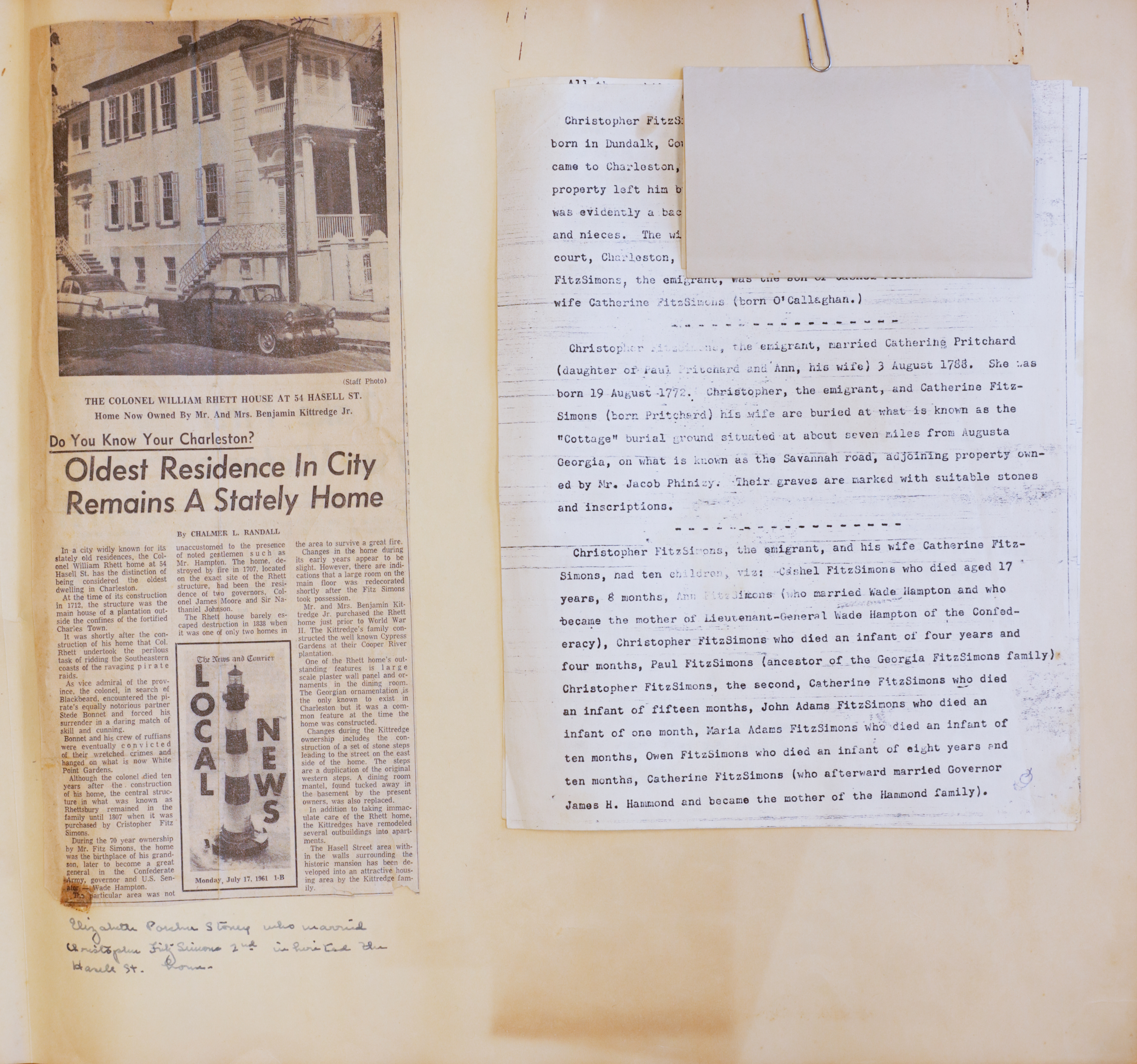
The page holds two items: a long newspaper clipping with photograph at left, and a typewritten memorandum sheet at right. A pencilled annotation in the compiler’s hand sits below the clipping.
Newspaper clipping
A photograph of a three-story brick house with shuttered windows and parked cars in front, captioned beneath:
(Staff Photo)
THE COLONEL WILLIAM RHETT HOUSE AT 54 HASELL ST.
Home Now Owned By Mr. And Mrs. Benjamin Kittredge Jr.
The headline beneath the photograph:
Do You Know Your Charleston?
Oldest Residence In City Remains A Stately Home
By Chalmer L. Randall
The article body (small print, several columns):
In a city well known for its stately old residences, the Colonel William Rhett home at 54 Hasell St. has the distinction of being considered the oldest dwelling in Charleston.
At the time of its construction in 1712, the structure was the main house of a plantation outside the confines of the fortified Charles Town.
It was shortly after the construction of his home that Col. Rhett undertook the perilous task of ridding the southeastern coasts of the ravaging pirate raids.
As vice admiral of the province, the colonel, in search of Blackbeard, encountered the pirate’s equally notorious partner, Stede Bonnet and forced his surrender in a daring match of skill and cunning.
Bonnet and his crew of ruffians were eventually convicted of their wretched crimes and hanged on what is now White Point Gardens.
Although the colonel died ten years after the construction of his home, the central structure in what was known as Rhettsbury remained in the family until 1807 when it was purchased by Cristopher Fitz Simons.
During the 76 year ownership by Mr. Fitz Simons, the home was the birthplace of his grandson, later to become a great general in the Confederate Army, governor and U.S. Senator, Wade Hampton.
[This] particular area was not unaccustomed to the presence of noted gentlemen such as Mr. Hampton. The home, destroyed by fire in 1707, located on the exact site of the Rhett structure, had been the residence of two governors, Colonel James Moore and Sir Nathaniel Johnson.
The Rhett house barely escaped destruction in 1838 when it was one of only two homes in the area to survive a great fire. Changes in the home during its early years appear to be slight. However, there are indications that a large room on the main floor was redecorated shortly after the Fitz Simons took possession.
Mr. and Mrs. Benjamin Kittredge Jr. purchased the Rhett home just prior to World War II. The Kittredge’s family constructed the well known Cypress Gardens at their Cooper River plantation.
One of the Rhett home’s outstanding features is large scale plaster wall panel and ornaments in the dining room. The Georgian ornamentation is the only known to exist, in Charleston, but it was a common feature at the time the house was constructed.
Changes during the Kittredge ownership includes the construction of a set of stone steps leading to the street on the east side of the home. They are a duplication of the original western steps. A dining room mantel, found tucked away in the basement by the present owners, was also replaced.
In addition to taking immaculate care of the Rhett home, the Kittredges have remodeled several outbuildings into apartments.
The Hasell Street area within the walls surrounding the historic mansion has been developed into an attractive haven by the Kittredge family.
A small “LOCAL NEWS” stamp at the foot of the clipping reads:
Monday, July 17, 1961
[Pencilled annotation below the clipping]: Elizabeth Porcher Stoney who married Christopher Fitz Simons 2nd inherited the Hasell St. home.
Typewritten memorandum
A typewritten sheet at right. A smaller piece of paper is paperclipped over the top of the sheet, obscuring the first several lines. The visible portions read:
[Top of sheet obscured by paperclipped paper. Visible fragments at the right edge of the obscuring paper:]
Christopher FitzS[imons]
born in Dundalk, Co[unty of Louth, Ireland …]
came to Charleston, […]
property left him b[y …]
was evidently a ba[chelor …]
and nieces. The wi[ll …]
court, Charleston, […]
FitzSimons, the emigrant, was the son of [Cashel FitzSimons and his]
wife Catherine FitzSimons (born O’Callaghan.)
The body of the typescript (visible below the obscuring paper):
Christopher FitzSimons, the emigrant, married Cathering Pritchard (daughter of Paul Pritchard and Ann, his wife) 3 August 1788. She was born 19 August 1772. Christopher, the emigrant, and Catherine FitzSimons (born Pritchard) his wife are buried at what is known as the “Cottage” burial ground situated at about seven miles from Augusta Georgia, on what is known as the Savannah road, adjoining property owned by Mr. Jacob Phinizy. Their graves are marked with suitable stones and inscriptions. _ _ _
Christopher FitzSimons, the emigrant, and his wife Catherine FitzSimons, had ten children, viz: Cashel FitzSimons who died aged 17 years, 8 months, Ann FitzSimons (who married Wade Hampton and who became the mother of Lieutenant-General Wade Hampton of the Confederacy), Christopher FitzSimons who died an infant of four years and four months, Paul FitzSimons (ancestor of the Georgia FitzSimons family), Christopher FitzSimons, the second, Catherine FitzSimons who died an infant of fifteen months, John Adams FitzSimons who died an infant of one month, Maria Adams FitzSimons who died an infant of ten months, Owen FitzSimons who died an infant of eight years and ten months, Catherine FitzSimons (who afterward married Governor James H. Hammond and became the mother of the Hammond family).
AI Notes
Two items mounted on the page. Left: a long newspaper clipping (by Chalmer L. Randall) with a photograph of the Col. William Rhett House at 54 Hasell Street, captioned ‘Oldest Residence In City Remains A Stately Home,’ dated Monday, July 17, 1961. A pencilled annotation below the clipping notes that Elizabeth Porcher Stoney, wife of Christopher FitzSimons (2nd), inherited the Hasell Street house. Right: a typewritten memorandum (a near-duplicate of the page 003 family record) with the upper portion obscured by a smaller paper paperclipped on top. The clipping body includes a paragraph about the original Rhett-site home ‘destroyed by fire in 1707’ (the residence of Gov. James Moore and Sir Nathaniel Johnson). The typewritten name on the bound sheet appears as ‘Cathering Pritchard’ — a typewriter slip preserved in the source rather than a transcription error.
The Rhett house at 54 Hasell Street — purchased by Christopher FitzSimons in 1807 and held in the family for 76 years — was the birthplace of Wade Hampton III, born there 28 March 1818 to Ann FitzSimons + Wade Hampton II. Col. William Rhett’s 1718 capture of Stede Bonnet at the Cape Fear River shortly after the house was built ended with Bonnet’s trial and December 1718 hanging at White Point (today’s Battery). The 1707 fire on the same site referenced in the clipping destroyed an earlier home owned by SC governors James Moore and Sir Nathaniel Johnson.