Newspaper clipping: 'DAR Opens New Hunt For FitzSimons Picture'
Book 1, Page 5 ·1787–1965
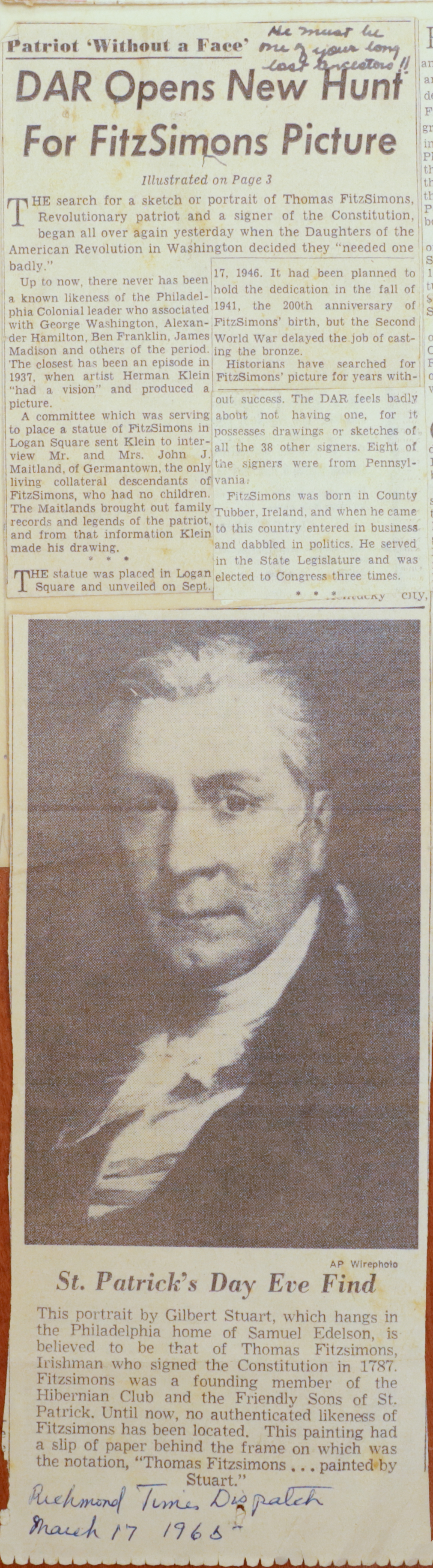
Transcription
A long vertical newspaper clipping is pasted nearly the full length of the page. Two pencilled annotations in the compiler’s hand frame it: one above the headline, one below the article.
[Pencilled note above the clipping]: “He must be one of your long lost ancestors!”
The clipping itself:
Patriot ‘Without a Face’
DAR Opens New Hunt For FitzSimons Picture
Illustrated on Page 1
The search for a sketch or portrait of Thomas FitzSimons, Revolutionary patriot and a signer of the Constitution, has begun all over again yesterday when the Daughters of the American Revolution in Washington decided they “needed one badly.”
Up to now, there never has been a known likeness of the Philadelphia Colonial leader who associated with George Washington, Alexander Hamilton, Ben Franklin, James Madison and others of the period. The closest has been an episode in 1937, when artist Herman Klein “had a vision” and produced a picture.
A committee which was serving to place a statue of FitzSimons in Logan Square sent Klein to interview Mr. and Mrs. John J. Mailand, of Germantown, the only living collateral descendants of FitzSimons, who had no children. The Maitlands brought out family records and legends of the patriot, and from that information Klein made his drawing.
The statue was placed in Logan Square and unveiled on Sept. 17, 1946. It had been planned to hold the dedication in the fall of 1941, the 200th anniversary of FitzSimons’ birth, but the Second World War delayed the job of casting the bronze.
Historians have searched for FitzSimons’ picture for years without success. The DAR feels badly about not having one, for it possesses drawings or sketches of all the 38 other signers. Eight of the signers were from Pennsylvania.
FitzSimons was born in County [uncertain], Ireland, and when he came to this country entered in business and banking and politics. He served in the State Legislature and was elected to Congress three times…
[The article continues; the clipping is cut off here.]
A photograph in the lower portion of the clipping shows a man seated for a formal oval portrait. Caption beneath:
St. Patrick’s Day Eve Find
(AP Wirephoto)
This portrait by Gilbert Stuart, which hangs in the Philadelphia home of Samuel Edelson, is believed to be that of Thomas FitzSimons, Irishman who signed the Constitution in 1787. FitzSimons was a founding member of the Hibernian Club and the Friendly Sons of St. Patrick. Until now, no authenticated likeness of FitzSimons has been located. This painting had a slip of paper behind the frame on which was the notation, “Thomas FitzSimons … painted by Stuart.”
[Pencilled note at the foot of the clipping, identifying the source]: “Richmond Times Dispatch · March 17 1965”
AI Notes
A 1965 follow-up to the Thomas FitzSimons ‘Patriot Without a Face’ story already pasted in on page 004. The DAR (Daughters of the American Revolution) reopens the search for a likeness; a Gilbert Stuart portrait at a Philadelphia home is identified as a possible match. The compiler added two pencilled annotations — one above the headline reading ‘He must be one of your long lost ancestors!’ (a single exclamation, unlike the double-bang version on p004), and one at the foot of the clipping identifying the source as the Richmond Times-Dispatch, March 17, 1965. The lower image caption (‘AP Wirephoto’) identifies the Gilbert Stuart portrait as hanging in Samuel Edelson’s Philadelphia home. The county-of-birth name in the article body is too faintly inked to read with confidence.
A 1965 update — almost twenty years after the Logan Square statue was unveiled — to the same “Patriot Without a Face” thread the family had been following since at least the earlier clipping on page 004. The Charleston FitzSimons line in fact descends from Cashel of Dundalk, not from Thomas of Philadelphia (an entirely separate Irish-immigrant branch); the connection the compiler entertains is family lore rooted in the shared surname rather than documented genealogy.