Memorandum continued — Hampton, Hammond, and Irish relations
Book 1, Page 4 ·1788–1960
Transcription
Continuation of the memorandum
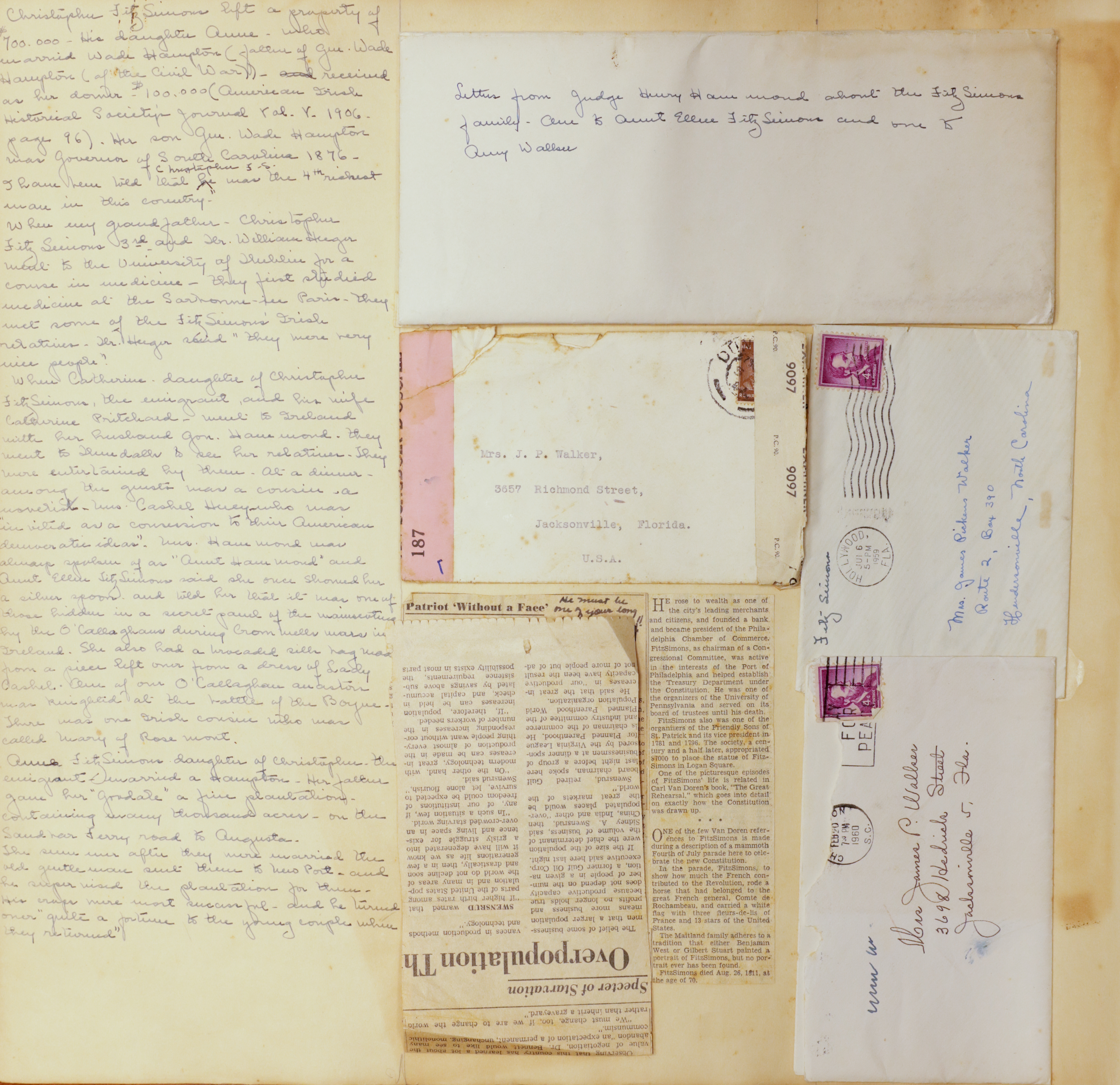
Christopher Fitz Simons left a property of $700,000. His daughter Anne — who married Wade Hampton (father of Gen. Wade Hampton of the Civil War) — received as her dower $100,000. (American Irish Historical Society Journal, Vol. V, 1906, page 96.) Her son Gen. Wade Hampton was Governor of South Carolina, 1876.
I have been told that he [Christopher S.C. — inserted above the line] was the 4th richest man in this country.
When my grandfather — Christopher Fitz Simons 3rd — and Mr. William Huger went to the University of Dublin for a course in medicine, they first studied medicine at the Sorbonne — see Paris. They met some of the Fitz Simons’ Irish relatives. Mr. Huger said, “They were very nice people.”
When Catherine — daughter of Christopher Fitz Simons, the emigrant, and his wife Catherine Pritchard — went to Ireland with her husband Gov. Hammond, they went to Dundalk to see her relatives. They were entertained by them. At a dinner — among the guests was a cousin, a novelist — Mrs. Cashel Hoey — who was “invited as a concession to their American democratic ideas.” Mrs. Hammond was always spoken of as “Aunt Hammond,” and Aunt Ellen Fitz Simons said she once showed her a silver spoon, and told her that it was one of those hidden in a secret panel of the wainscoting by the O’Callaghans during Cromwell’s wars in Ireland. She also had a brocaded silk bag made from a piece left over from a dress of Lady Cashel. One of our O’Callaghan ancestors was knighted at the Battle of the Boyne. There was one Irish cousin who was called Mary of Rose Mont.
Anne Fitz Simons, daughter of Christopher the emigrant, who married a Hampton — her father gave her “Goodale,” a fine plantation containing many thousand acres, on the Sand Bar Ferry road to Augusta. The summer after they were married the old gentleman sent them to Newport — and he supervised the plantation for them. His crops were most successful — and he turned over “quite a fortune to the young couple when they returned.”
Envelopes preserved on this page
A large envelope is captioned in pencil:
“Letters from Judge Henry Hammond about the Fitz Simons family — one to Aunt Ellen Fitz Simons and one to Amy Walker.”
The envelope evidently held the actual correspondence; it was mounted to the page as a pocket.
A small wartime censored airmail envelope (British P.C. 90 censor seal, marked 9097 / 187) addressed to:
Mrs. J. P. Walker 3657 Richmond Street Jacksonville, Florida, U.S.A.
Two later envelopes addressed to Mrs. James Pickens Walker:
- Postmarked Hollywood, Fla., July 6, 1959 — to Route 2, Box 390, Hendersonville, North Carolina. Annotated “Fitz Simons” in the corner.
- Postmarked Feb. 20, 1960 — to 3698 Hedrick Street, Jacksonville 5, Fla. Annotated “from W—”.
Newspaper clippings
“Patriot ‘Without a Face’”
Pasted in with the handwritten pencil note: “He must be one of your long [forebears]!!” (the final word is partly cut at the page edge; the existing inked exclamation marks are clear). The article reads:
He rose to wealth as one of the city’s leading merchants and citizens, and founded a bank, and became president of the Philadelphia Chamber of Commerce. FitzSimons, as chairman of a Congressional Committee, was active in the interests of the Port of Philadelphia and helped establish the Treasury Department under the Constitution. He was one of the organizers of the University of Pennsylvania and served on its board of trustees until his death.
FitzSimons also was one of the organizers of the Friendly Sons of St. Patrick and its vice president in 1781 and 1796. The society, a century and a half later, appropriated $7000 to place the statue of FitzSimons in Logan Square.
One of the picturesque episodes of FitzSimons’ life is related in Carl Van Doren’s book, “The Great Rehearsal,” which goes into detail on exactly how the Constitution was drawn up.
One of the few Van Doren references to FitzSimons is made during a description of a mammoth Fourth of July parade here to celebrate the new Constitution. In the parade, FitzSimons, to show how much the French contributed to the Revolution, rode a horse that had belonged to the great French general, Comte de Rochambeau, and carried a white flag with three fleurs-de-lis of France and 13 stars of the United States.
The Maitland family adheres to a tradition that either Benjamin West or Gilbert Stuart painted a portrait of FitzSimons, but no portrait ever has been found. FitzSimons died Aug. 26, 1811, at the age of 70.
This is Thomas FitzSimons of Philadelphia (1741–1811), signer of the U.S. Constitution — the “patriot without a face” because no portrait survives. The annotator’s hunch reflects family belief in a connection, though the Charleston FitzSimons line in the family tree descends from Cashel FitzSimons of Dundalk, a different branch.
“Overpopulation: Specter of Starvation”
A second clipping, pasted upside down, quoting Sidney A. Swensrud (former Gulf Oil chairman) on overpopulation. Appears unrelated to family history — possibly mounted as scrap padding.
AI Notes
A continuation of the family memorandum, plus pasted-in envelopes (one wartime British censored letter, two from 1959–1960 to Mrs. James Pickens Walker) and two newspaper clippings — one about Thomas FitzSimons of Philadelphia (the ‘Patriot Without a Face,’ a signer of the Constitution), and one unrelated clipping on overpopulation that appears to be scrap padding. The page carries the cursive ‘American Irish Historical Society Journal Vol. V, 1906, page 96’ citation, the interlinear insertion ‘Christopher S.C.’ above ‘he was the 4th richest man in this country,’ the silver-spoon anecdote of the O’Callaghan family plate hidden from Cromwell’s soldiers, and the Goodale plantation anecdote of Newport honeymoon. The pencilled annotation on the ‘Patriot Without a Face’ clipping reads ‘He must be one of your long [forebears]!!’ (last word partly cropped at the page edge, two exclamation marks at the close).