Benjamin Lord's advertisement — 'next door to Mr. Christopher Fitz-Simmons, chandler, in Tradd-Street' (South-Carolina Gazette, 17 January 1761)
Book 4, Page 25 ·1761
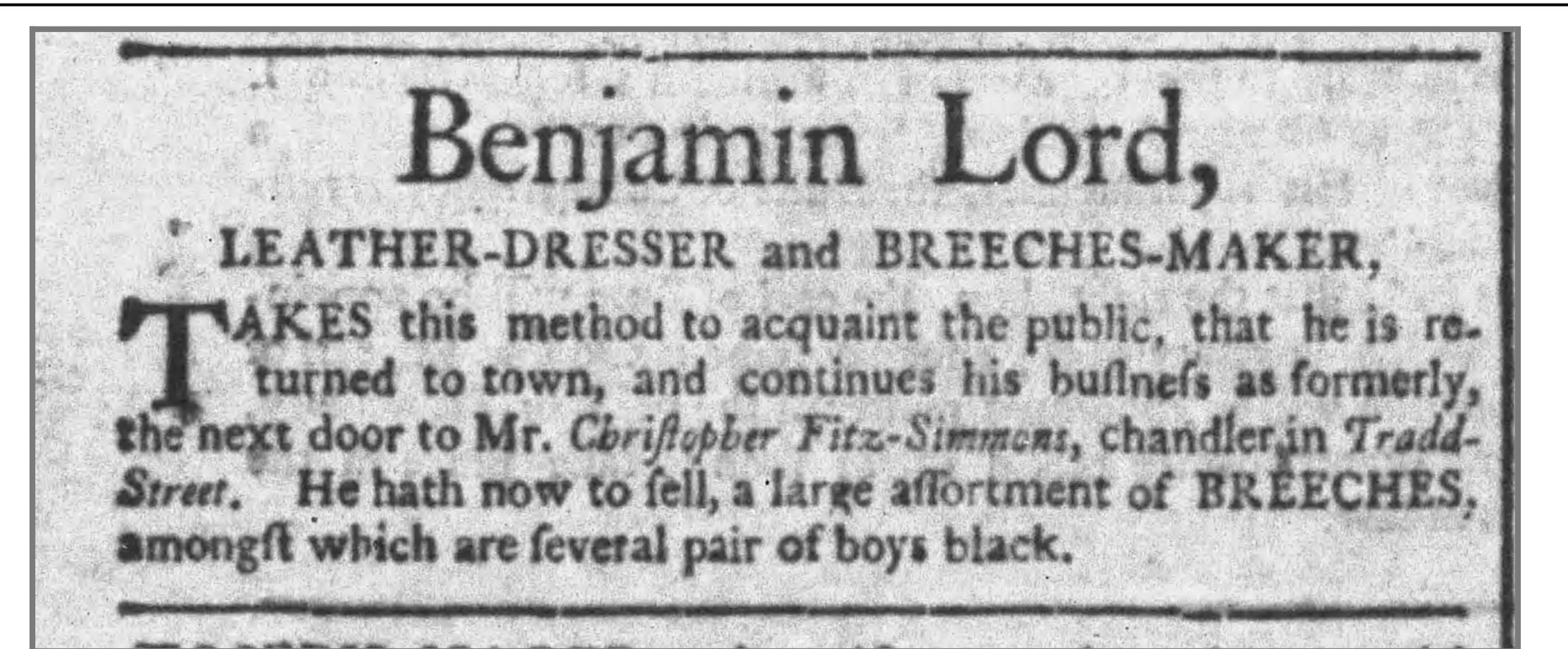
Transcription
Benjamin Lord,
LEATHER-DRESSER and BREECHES-MAKER,
TAKES this method to acquaint the public, that he is returned to town, and continues his business as formerly, the next door to Mr. Christopher Fitz-Simmons, chandler, in Tradd-Street. He hath now to sell, a large assortment of BREECHES, amongst which are several pair of boys black.
Source: The South-Carolina Gazette (Charleston, S.C.), Saturday, 17 January 1761, page 1. Image from newspapers.com, image 605078052. Public-domain newspaper.
AI Notes
The South-Carolina Gazette, Saturday 17 January 1761, page 1 — a small classified advertisement for Benjamin Lord, leather-dresser and breeches-maker, returned to Charleston and continuing his business ‘next door to Mr. Christopher Fitz-Simmons, chandler, in Tradd-Street.’ This is the earliest known dated reference to Christopher Fitz-Simons (the emigrant’s uncle) by name and location: it places him in business as a chandler on Tradd Street, Charleston, by January 1761 — 21 years before his 1782 will (Book 4, p001) and 22 years before his death and probate in July 1783. The fact that another tradesman uses Christopher’s shop as a navigation landmark in a paid newspaper advertisement establishes that by Jan 1761 he was an established, recognisable Charleston tradesman whose location was well known to the Gazette’s readers. Spelling note: the 1761 ad sets the surname as ‘Fitz-Simmons’ with a double m — distinct from the single-m ‘Fitz-Simons’ of the contemporaneous Marine Intelligence entry for the sea-captain Thomas Fitz-Simons (Book 4, p024, 1760). The same colonial Charleston paper, six months apart, uses both spellings — confirming that the m-count was already in flux. The 1782 will uses ‘Fitz Simons’ as two words; the 19th-century family memorandum at Book 1, p003 normalises to ‘FitzSimons’ single-m; the 1820s-1860s family of the emigrant typically used ‘Fitzsimons’ (single-m, no hyphen); the 20th-century Columbia branch (Kit and his descendants) reverted to ‘FitzSimmons’ (double-m). The 1761 ad’s double-m spelling may therefore reflect the family’s own preference at that date. Significance for the album. The emigrant Christopher (b. Dundalk 27 Dec 1762, arr. Charleston 1781/1783) inherited the bulk of his uncle’s estate, including the Tradd Street property implied here — the chandler’s shop was the foundation of what became the emigrant’s mercantile fortune.
The earliest dated reference to Christopher Fitz-Simons (the emigrant’s uncle) by name and location. January 1761 — 21 years before his 1782 will and 22 years before his death in 1783 (probate). The chandler’s shop on Tradd Street is described as a known landmark — Benjamin Lord uses it as a navigation reference in his own paid advertisement, implying that Charleston readers would recognise the location. The Tradd Street block was, in 1761, a chiefly artisan and merchant precinct just south of Broad Street, adjacent to the old city wall remnants. The chandler trade (rendering tallow into candles and soap) was the same business the 1782 will identifies — “Tallow Chandler and Soap Boiler”.
The double-m vs single-m surname spelling, January 1761. The Gazette here sets the surname as Fitz-Simmons with double m, in italic. The contemporaneous Marine Intelligence Thomas Fitz-Simons of 12 July 1760 (Book 4, p024) is set as Fitz-Simons with single m. The same paper, six months apart, uses both spellings — confirming the m-count was already in flux in colonial Charleston. The double-m may reflect the family’s own preferred spelling at that date; the single-m form became dominant in the family record by the 1820s and survives in the modern “FitzSimons” standardisation used in album metadata.
A January 1761 anchor. This ad pushes the documented Charleston presence of the emigrant’s uncle Christopher back to January 1761 at the latest. Combined with the 1782 will’s reference to a long-established household with substantial bequests to multiple nieces and nephews back in Ireland (Cashel FitzSimons’s daughters Mary and Ann, James Handlin’s children, etc.), it is reasonable to suppose he had been in Charleston before 1761 — possibly arriving in the 1740s or 1750s, in the wave of Irish-Catholic emigration that followed the wars and famines of mid-century. He never married and had no surviving children of his own, naming his nephew Christopher (the future emigrant, then 19) and the broader Irish family as his heirs.