'Dr. Christopher Fitzsimons' — Charleston Daily News, 19 May 1866 (independent tornado notice)
Book 4, Page 12 ·1866
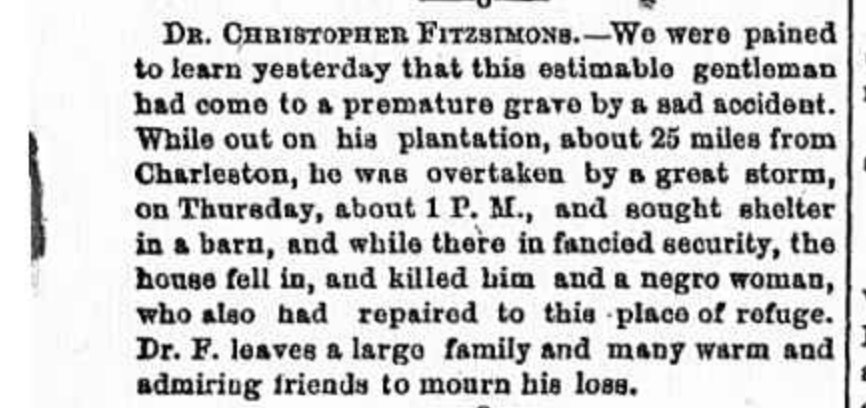
Transcription
Dr. Christopher Fitzsimons.
Dr. Christopher Fitzsimons.—We were pained to learn yesterday that this estimable gentleman had come to a premature grave by a sad accident. While out on his plantation, about 25 miles from Charleston, he was overtaken by a great storm, on Thursday, about 1 P. M., and sought shelter in a barn, and while there in fancied security, the house fell in, and killed him and a negro woman, who also had repaired to this place of refuge. Dr. F. leaves a large family and many warm and admiring friends to mourn his loss.
Source: The Daily News (Charleston, S.C.), Saturday morning, 19 May 1866, page 5, column 1, under the “LOCAL MATTERS” heading. From the National Digital Newspaper Program / Library of Congress Chronicling America corpus, LCCN sn84026994, public domain.
AI Notes
A short notice in the Charleston Daily News, Saturday morning 19 May 1866, page 5 — a second, independent account of Dr. Christopher Fitzsimons’s death in the 17 May 1866 tornado at his Moss Grove plantation. The Daily News was the Courier’s rival paper, and this notice carries details absent from the Courier’s longer brief reproduced at document 11: the time of the storm is given as ‘Thursday, about 1 P. M.’, and the plantation’s distance from Charleston as ‘about 25 miles’. The Daily News also frames the building as a ‘barn’ rather than the Courier’s more abstract ‘one of these buildings,’ and the survivor is described only as ‘a negro woman’ (the Courier names Mr. A. Milliken). Read together, the two notices reconstruct the event from two independent vantage points. The Daily News obit-style framing (sympathetic but brief, focused on the man and his family rather than the storm’s path) suggests its author had personal acquaintance with the deceased; the Courier’s account is more journalistic and was based on a witness (Mr. Milliken).
The Daily News brief adds two precise details to the family record: (1) the time — the storm reached Moss Grove around 1 p.m. on Thursday 17 May 1866; and (2) the distance — Moss Grove was about 25 miles from Charleston, fixing its general location on the Cooper River in St. John’s-Berkeley parish (consistent with the Courier brief on the same event). The “premature grave” framing is striking: Dr. Christopher was only 38 years old, with seven young children. The “large family and many warm and admiring friends” — the children, his wife Susan Milliken Barker FitzSimons, and the extended Charleston / Stoney / Barker / Milliken / Huger / Hampton network — would scatter and contract in the post-war decade that followed.
The Daily News brief and the Courier brief at document 11 appear to be entirely independent — they share no copied sentences, take different vantage points, and contain disjoint details. Together they are the two contemporary primary sources for the event, with the family hand-copy on Book 1, p279 (Kit FitzSimons’s later transcription of the Courier text) forming the album’s own derivative record.