Obituary of Christopher Fitzsimons — Charleston Mercury, 6 August 1825
Book 4, Page 10 ·1825
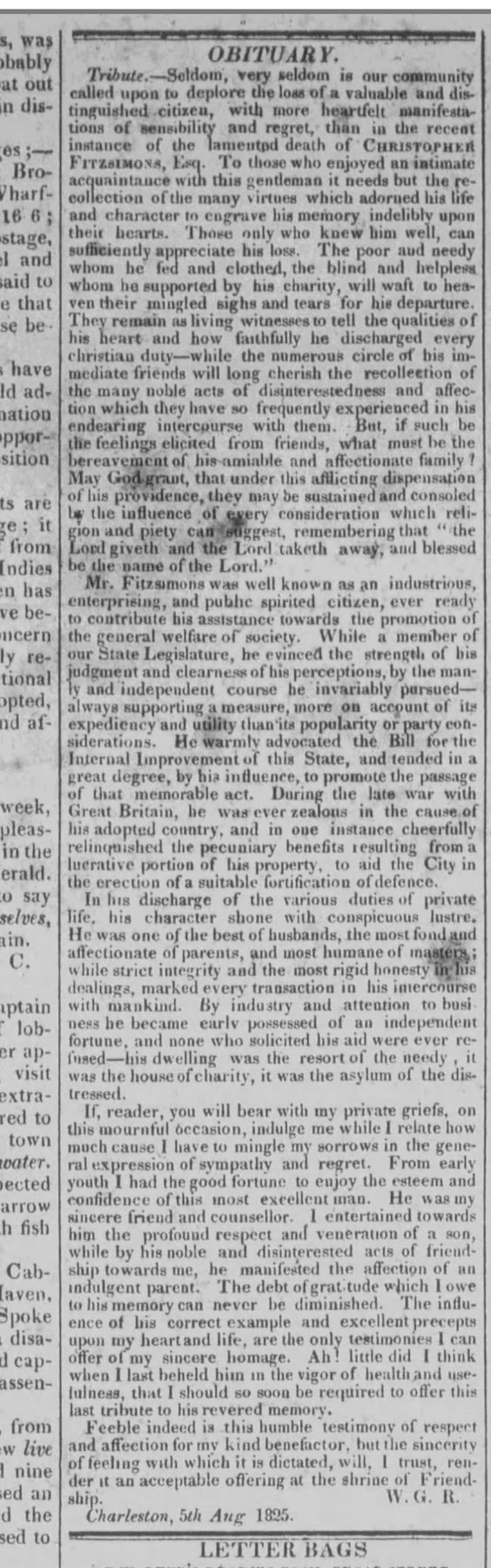
Transcription
OBITUARY.
Tribute.—Seldom, very seldom is our community called upon to deplore the loss of a valuable and distinguished citizen, with more heartfelt manifestations of sensibility and regret, than in the recent instance of the lamented death of Christopher Fitzsimons, Esq. To those who enjoyed an intimate acquaintance with this gentleman it needs but the recollection of the many virtues which adorned his life and character to engrave his memory indelibly upon their hearts. Those only who knew him well, can sufficiently appreciate his loss. The poor and needy whom he fed and clothed, the blind and helpless whom he supported by his charity, will waft to heaven their mingled sighs and tears for his departure. They remain as living witnesses to tell the qualities of his heart and how faithfully he discharged every christian duty—while the numerous circle of his immediate friends will long cherish the recollection of the many noble acts of disinterestedness and affection which they have so frequently experienced in his endearing intercourse with them. But, if such be the feelings elicited from friends, what must be the bereavement of his amiable and affectionate family! May God grant, that under this afflicting dispensation of his providence, they may be sustained and consoled by the influence of every consideration which religion and piety can suggest, remembering that “the Lord giveth and the Lord taketh away, and blessed be the name of the Lord.”
Mr. Fitzsimons was well known as an industrious, enterprising, and public spirited citizen, ever ready to contribute his assistance towards the promotion of the general welfare of society. While a member of our State Legislature, he evinced the strength of his judgment and clearness of his perceptions, by the manly and independent course he invariably pursued—always supporting a measure, more on account of its expediency and utility than its popularity or party considerations. He warmly advocated the Bill for the Internal Improvement of this State, and tended in a great degree, by his influence, to promote the passage of that memorable act. During the late war with Great Britain, he was ever zealous in the cause of his adopted country, and in one instance cheerfully relinquished the pecuniary benefits resulting from a lucrative portion of his property, to aid the City in the erection of a suitable fortification of defence.
In his discharge of the various duties of private life, his character shone with conspicuous lustre. He was one of the best of husbands, the most fond and affectionate of parents, and most humane of masters; while strict integrity and the most rigid honesty in his dealings, marked every transaction in his intercourse with mankind. By industry and attention to business he became early possessed of an independent fortune, and none who solicited his aid were ever refused—his dwelling was the resort of the needy, it was the house of charity, it was the asylum of the distressed.
If, reader, you will bear with my private griefs, on this mournful occasion, indulge me while I relate how much cause I have to mingle my sorrows in the general expression of sympathy and regret. From early youth I had the good fortune to enjoy the esteem and confidence of this most excellent man. He was my sincere friend and counsellor. I entertained towards him the profound respect and veneration of a son, while by his noble and disinterested acts of friendship towards me, he manifested the affection of an indulgent parent. The debt of gratitude which I owe to his memory can never be diminished. The influence of his correct example and excellent precepts upon my heart and life, are the only testimonies I can offer of my sincere homage. Ah! little did I think when I last beheld him in the vigor of health and usefulness, that I should so soon be required to offer this last tribute to his revered memory.
Feeble indeed is this humble testimony of respect and affection for my kind benefactor, but the sincerity of feeling with which it is dictated, will, I trust, render it an acceptable offering at the shrine of Friendship. W. G. R.
Charleston, 5th Aug 1825.
Source: The Charleston Mercury (Charleston, S.C.), Saturday, 6 August 1825, page 3, column 2. Image from newspapers.com, image 605331829. Public-domain newspaper (pre-1929).
AI Notes
Signed tribute to the emigrant Christopher Fitzsimons (1762–1825), published in the Charleston Mercury of Saturday, 6 August 1825, page 3, eight days after his death. The piece is more a eulogy than a news obituary: it gives no exact date or place of death, no estate valuation, no list of survivors. What it does establish, however, are three biographical facts absent from the family record — that Christopher served in the South Carolina State Legislature; that he was a notable advocate of the Bill for the Internal Improvement of this State (plausibly the 1819 Internal Improvements Act, a founding statute of South Carolina’s canal and turnpike program); and that during the War of 1812 he relinquished a lucrative portion of his Charleston property income to enable the City to erect a fortification of defence. The Mercury here spells the surname Fitzsimons (one word, lowercase s) — a fourth variant alongside the family’s own Fitz Simons, FitzSimons, and (in the Columbia branch later in the century) FitzSimmons. The tribute is signed simply W. G. R., Charleston, 5th Aug 1825 — the writer is unidentified; his style places him as a man in early middle life who regarded Christopher as a paternal figure (‘I entertained towards him the profound respect and veneration of a son… he manifested the affection of an indulgent parent’). Possible candidates include any of the several W. G. R-initialed merchants and attorneys of Charleston of the period.
The tribute fixes the death within the eight-day window between Christopher’s last “vigor of health” (within the writer’s recent memory) and the 5 August dateline of the tribute itself — consistent with the long-standing family tradition of 28 July 1825, though the obit prints no specific date. The phrase “adopted country” echoes the album’s own family memorandum: Christopher had come from Dundalk, Co. Louth, Ireland in 1781/1783 and qualified as executor of his uncle’s Charleston will in July 1783 (document 2). The legislative reference is the one substantive policy claim in the obit; the 1819 Internal Improvements Act (Statutes at Large of S.C., vol. VI) is a plausible matching statute. The Mercury’s spelling Fitzsimons (one word, lowercase) differs from both the Fitz Simons of the 1782 uncle’s will (document 1) and the Fitzsimons of his own 1831 son’s will (document 7) — the family spelling was visibly in flux during this generation.