Letter from Lubomir Maleeff in Sofia, Bulgaria — page 2 with return address
Book 2, Page 186 ·1945–1949
Transcription
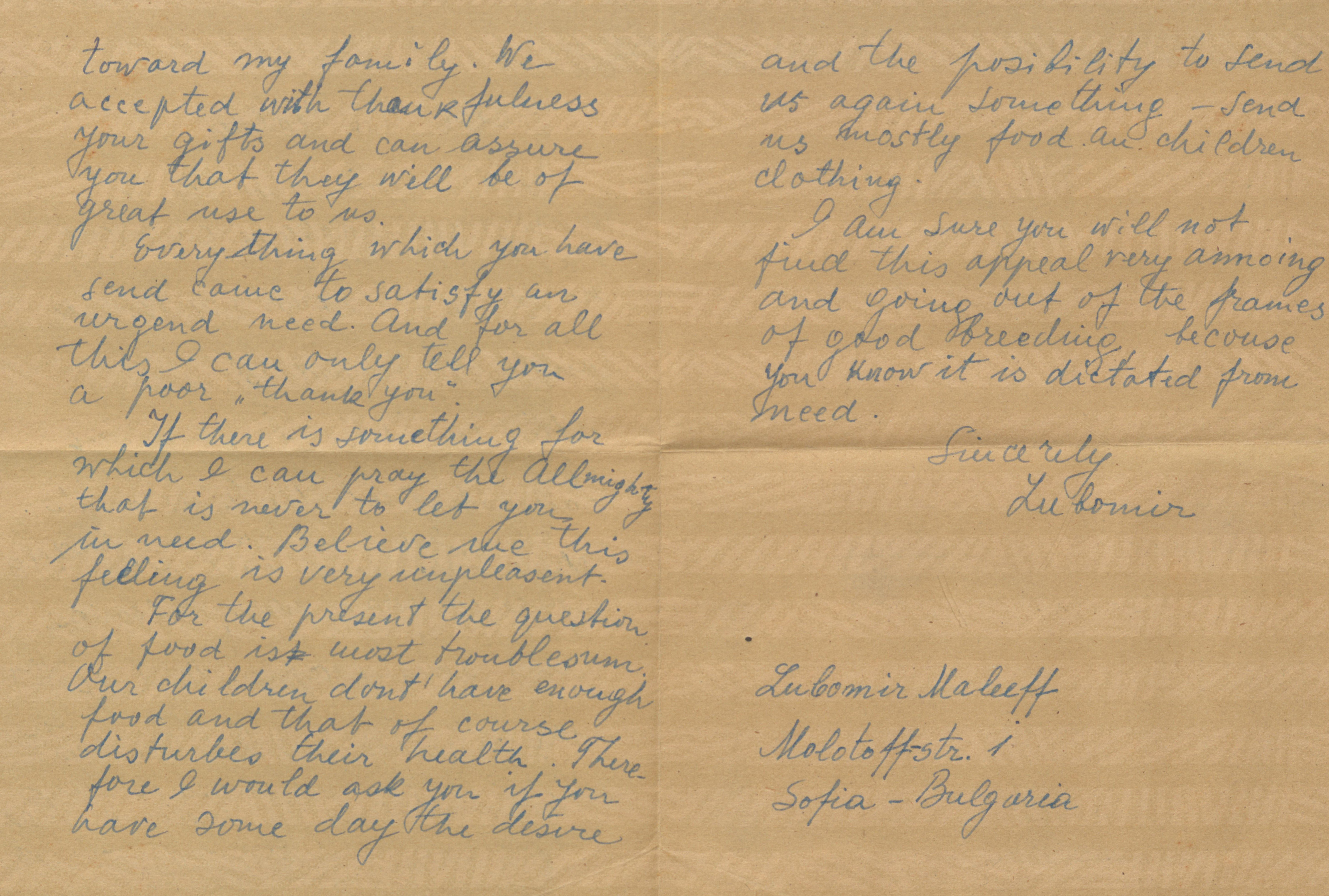
toward my family. We accepted with thankfulness your gifts and can assure you that they will be of great use to us.
Everything which you have send came to satisfy an urgent need. And for all this, I can only tell you a poor “thanks you”.
If there is something for which I can pray the Almighty that is never to let you in need. Believe me this feeling is very unpleasant.
For the present the question of food is most troublesome. Our children don’t have enough food and that of course disturbes their health. Therefore I would ask you, if you have some day the desire and the possibility to send us again something — send us mostly food and children clothing.
I am sure you will not find this appeal very annoying and going out of the frames of good breeding, because you know it is dictated from need.
Sincerely
Lubomir
Lubomir Maleeff
Molotoff-str. 1
Sofia – Bulgaria
AI Notes
Second page (the interior spread of the folded sheet) of the letter begun on page 185. Contains the closing of the body, the signature ‘Lubomir,’ and the writer’s typed-out return address. Written in blue ink across two facing leaves of a folded sheet. The return address reads ‘Molotoff-str. 1, Sofia – Bulgaria’ — Molotoff (Молотов) Street in central Sofia was the Communist-era name (1945–1990) for what is today Boulevard Vasil Levski, renamed in honour of Soviet foreign minister Vyacheslav Molotov. The address dates the letter firmly to the late 1940s, shortly after Bulgaria became a Soviet-aligned People’s Republic, when the family was sending food and clothing parcels to a Bulgarian correspondent in straitened postwar conditions.
The return address is “Molotoff Street, No. 1, Sofia.” In Sofia from 1945 until the fall of Communism in 1989–90, the central boulevard now known as Boulevard Vasil Levski bore the name Molotoff (Bulgarian Молотов) in honour of Soviet foreign minister Vyacheslav Molotov. The use of that street name dates this correspondence to the late 1940s, when American families like the Walkers were sending food and clothing parcels to friends and contacts in the newly Soviet-aligned People’s Republic of Bulgaria.