Letter from Edna (Brinson Williams), Fort George, Florida — pages 2 and 3
Book 2, Page 177 ·1944
Transcription
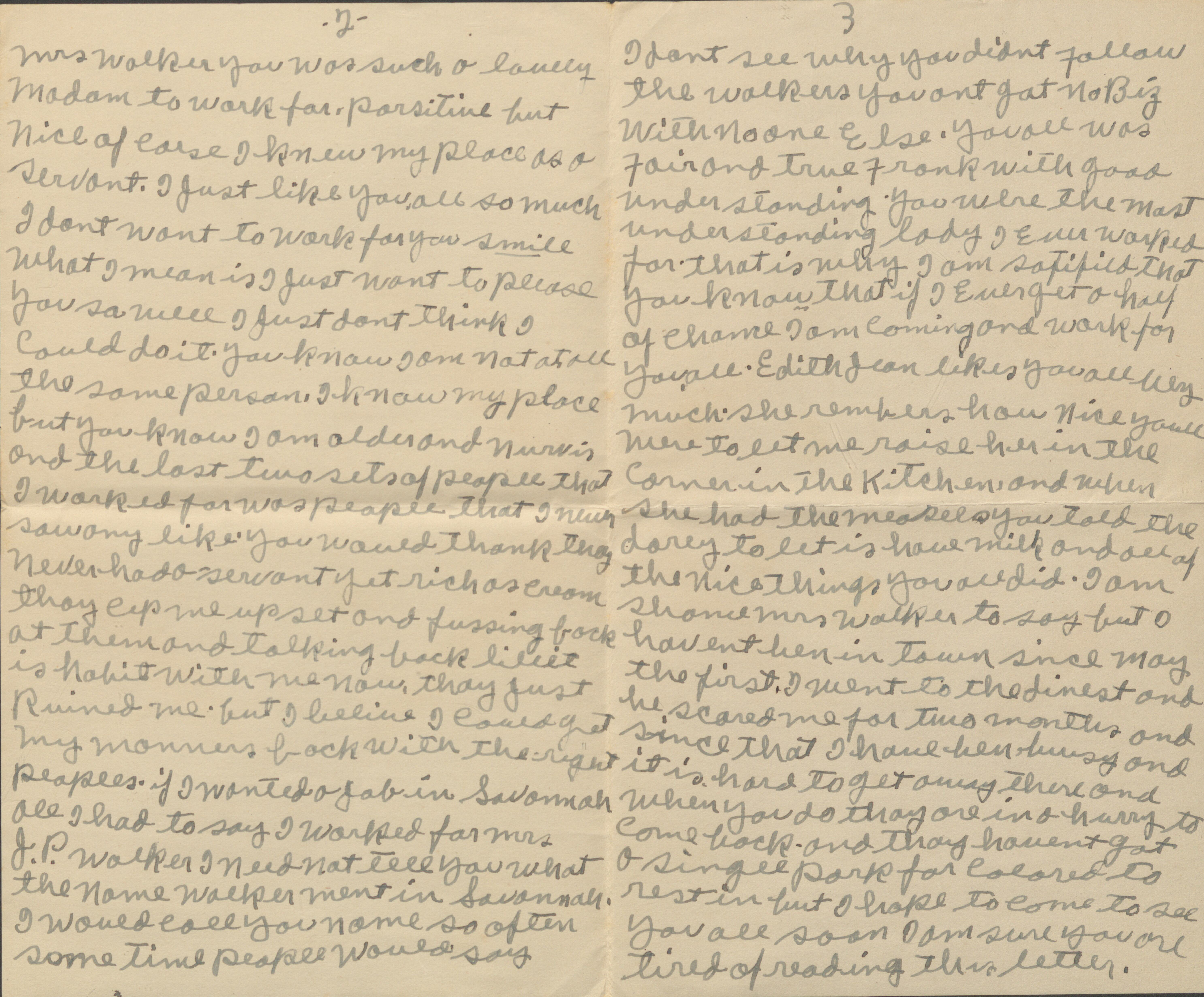
[Page 2 of the letter, marked ‘·2·’ at the top:]
mrs walker You was such a lovely Madam to work for. possitive but nice of corse I knew my place as a Servant. I just like ya all so much I dont want to work for you
smile. what I mean is I just want to please you so well I just dont think I could do it. you know I am not at all the same person. I know my place but you know I am older and nurves and the last two sets of peapel that I worked for was peapel that I new sawony like you would thank thay Never had no servant yet rich as cream. thay cep me upset and fussing back at them and Talking back I beleve is habit with me Now, thay just Ruined me but I beleve I could get my manners back with the rig[h]t peoples. if I wanted a job in Savannah all I had to say I worked for mrs. J. P. Walker I need not tell you what the name walker ment in Savannah. I would call your name so often some Time peapel would say
[Page 3, marked ‘3’:]
I dont see why you dident fallow the walkers you ant got no Biz with Noone Else. you all was fair and true Frank with good understanding. you were the most understanding lady I Ever worked for. that is why I am sotisfied that you know that if I Ever get a half of chance I am coming and work for ya all. Edith I can like[s] ya all very much she rembers how Nice ya all were to let me raise her in the Corner in the Kitchen and when she had the measles you told the dorey to let us have milk and all of the Nice things you all did. I am shame mrs walker to say but I havent ben in Town since may the first. I went to the d[e]ntest and he scared me for two months and since that I have ben busy and it is hard to get away there and when you do thay are in a hurry to come Back and thay havent got a single park for colered to rest in but I hope to come to see you all soon I am sure you are tired of reading this letter.
AI Notes
Pages 2 and 3 of a multi-page handwritten letter in pencil on plain unlined paper, written in a faltering hand. The two leaves are mounted side-by-side on the album page, marked ‘·2·’ at the top of the left leaf and ‘3’ at the top of the right leaf. Page 1 of the letter is on the preceding album page (176); the signature ‘Edna’ appears on the next album page (178). The writer addresses ‘Mrs. Walker’ (the compiler, Amy FitzSimons) and reflects on her former service as a domestic for the Walker family — particularly J. P. Walker in Savannah — and on her daughter ‘Edith’. The hand and spelling reflect a writer with limited formal schooling, almost certainly African-American (the closing paragraph speaks of the lack of ‘a Single park for colered to rest in’ in town). Original spelling, punctuation, and capitalization are preserved as closely as legibility permits.
Edna’s idiosyncratic hand reads, in part: “ant got no Biz with Noone Else” (i.e., “ain’t got no business”); “I went to the d[e]ntest” (dentist); “busy”; “I am shame[d]”; “I could get my manners back with the rig[h]t peoples”; “I worked for”. Spellings preserve what the page shows. Edna’s full identity is not established on this page, so no surname attribution is asserted in the frontmatter.
Edna’s closing line — “thay havent got a single park for colered to rest in” — locates the letter precisely in the world of the Jim Crow South: Savannah’s public parks in 1944 were segregated, with no benches or rest areas legally available to African Americans on a downtown shopping trip. Her language throughout — “I knew my place as a Servant,” “Rich as cream,” her need to “get my manners back” — gives a rare first-person window into the social grammar a Black domestic worker was expected to perform with her white employers in the wartime Deep South.