Newspaper clipping: 'Ex Railroader Visits Barbour' — retirement profile of James Pickens Walker Sr.
Book 2, Page 141 ·1946
Transcription
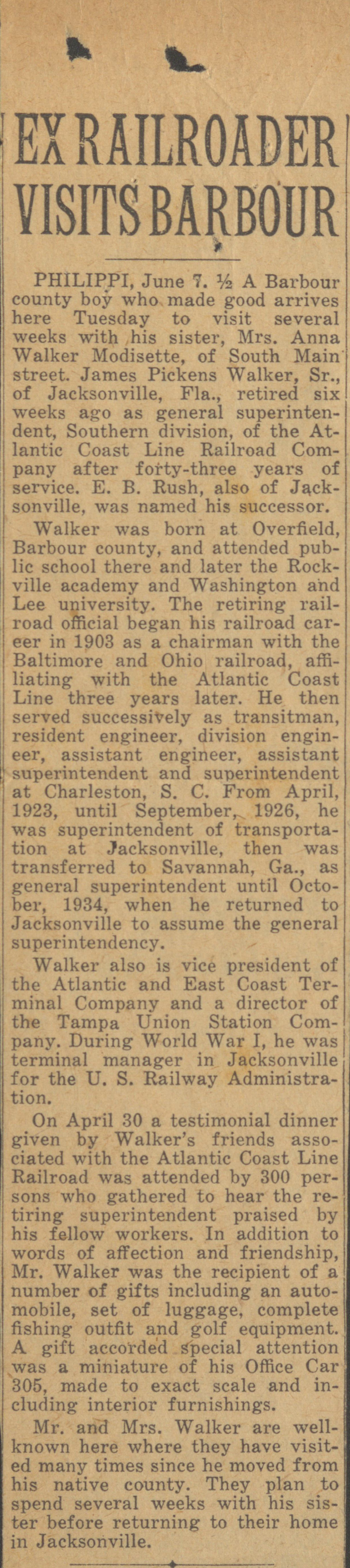
EX RAILROADER VISITS BARBOUR
PHILIPPI, June 7. — A Barbour county boy who made good arrives here Tuesday to visit several weeks with his sister, Mrs. Anna Walker Modisette, of South Main street. James Pickens Walker, Sr., of Jacksonville, Fla., retired six weeks ago as general superintendent, Southern division, of the Atlantic Coast Line Railroad Company after forty-three years of service. E. B. Rush, also of Jacksonville, was named his successor.
Walker was born at Overfield, Barbour county, and attended the public school there and later the Rockville academy and Washington and Lee university. The retiring railroad official began his railroad career in 1903 as a chairman with the Baltimore and Ohio railroad, affiliating with the Atlantic Coast Line three years later. He then served successively as transitman, resident engineer, division engineer, assistant engineer, assistant superintendent and superintendent at Charleston, S. C. From April, 1923, until September, 1926, he was superintendent of transportation at Jacksonville, then was transferred to Savannah, Ga., as general superintendent until October, 1934, when he returned to Jacksonville to assume the general superintendency.
Walker also is vice president of the Atlantic and East Coast Terminal Company and a director of the Tampa Union Station Company. During World War I, he was terminal manager in Jacksonville for the U. S. Railway Administration.
On April 30 a testimonial dinner given by Walker’s friends associated with the Atlantic Coast Line Railroad was attended by 300 persons who gathered to hear the retiring superintendent praised by his fellow workers. In addition to words of affection and friendship, Mr. Walker was the recipient of a number of gifts including an automobile, set of luggage, complete fishing outfit and golf equipment. A gift accorded special attention was a miniature of his Office Car 305, made to exact scale and including interior furnishings.
Mr. and Mrs. Walker are well-known here where they have visited many times since he moved from his native county. They plan to spend several weeks with his sister before returning to their home in Jacksonville.
AI Notes
A long narrow newspaper column clipping pasted to the album page, headlined ‘EX RAILROADER VISITS BARBOUR.’ The dateline reads ‘PHILIPPI, June 7.’ The clipping profiles James Pickens Walker Sr. of Jacksonville, Fla., retired six weeks earlier as general superintendent of the Southern division of the Atlantic Coast Line Railroad after 43 years of service. He is visiting his sister, Mrs. Anna Walker Modisette, on South Main Street in Philippi (Barbour County, W. Va.). Walker was born at Overfield and attended the Rockville academy and Washington and Lee University. The clipping refers to a testimonial dinner on April 30 attended by 300 persons. Full-resolution recrop confirms the transcription is complete. Note on ‘chairman’: the printed word ‘chairman’ (in ‘began his railroad career in 1903 as a chairman with the Baltimore and Ohio’) is almost certainly a typesetting error for chainman (a railroad survey assistant — the conventional starting position for a civil engineer’s apprentice on a railroad survey crew). Preserved as printed in the transcription. The full career arc (chainman → transitman → resident engineer → division engineer → assistant engineer → assistant superintendent → superintendent) matches the standard civil-engineering ladder on early 20th-century U.S. railroads.
The Atlantic Coast Line Railroad was one of the major Southern carriers, running from Richmond to Tampa and headquartered in Wilmington, N.C. Walker’s 43-year ascent — from chainman (a survey-crew rodman, the conventional entry rung for an engineer’s apprentice) to general superintendent — was a typical civil-engineering ladder on early-20th-century U.S. railroads. His World War I role as terminal manager in Jacksonville fell under the United States Railroad Administration (1917–1920), which nationalized the U.S. rail network for the duration of the war.