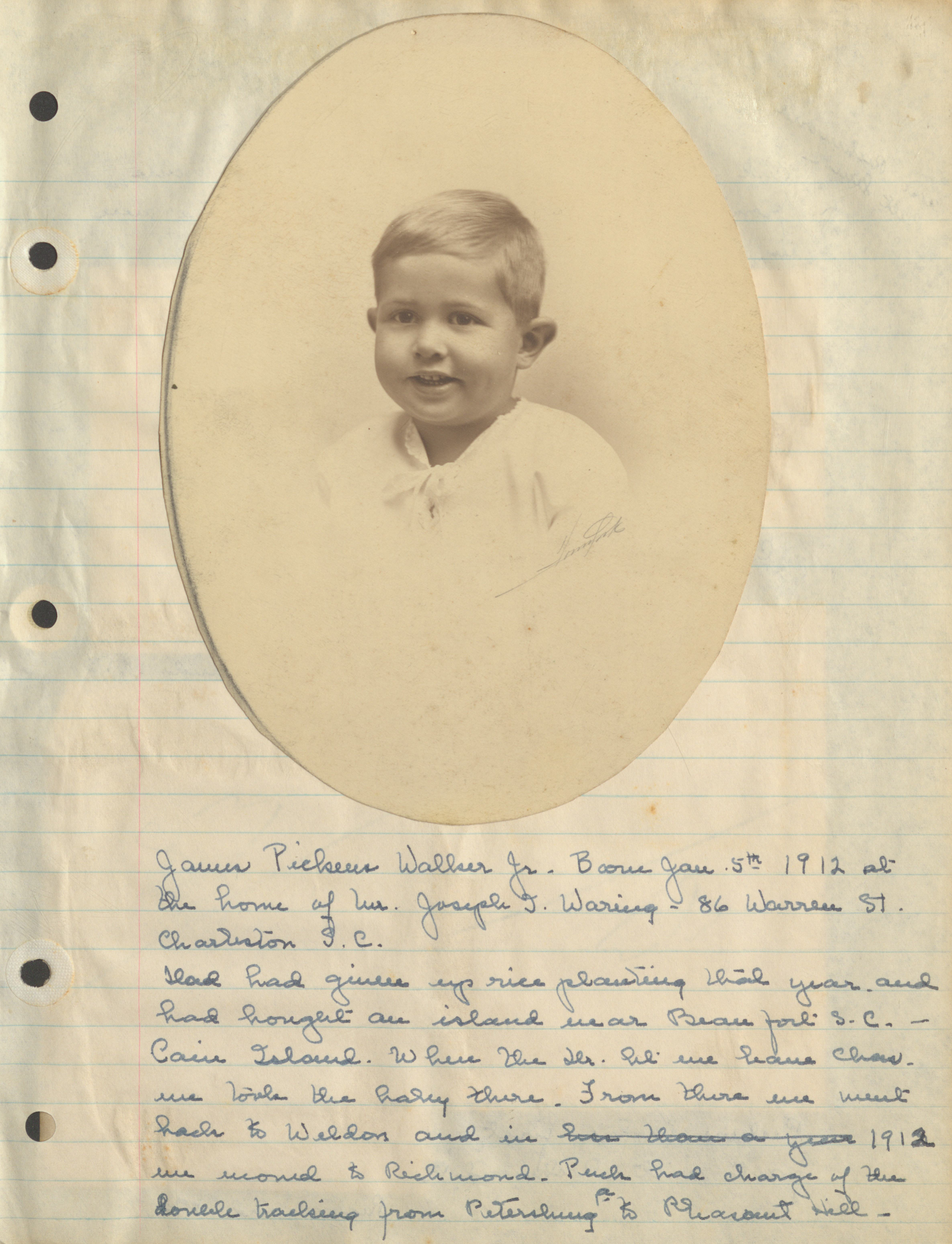
Oval portrait of James Pickens Walker Jr. as a toddler, with memoir of his birth and the family's move to Richmond
Book 2, Page 70 ·1912
Transcription
A large oval-vignette sepia studio portrait of a smiling fair-haired toddler boy in a white shirt, mounted at the top of the page.
Beneath the portrait, in blue ink:
James Pickens Walker Jr. — Born Jan. 5th 1912 at the home of Mr. Joseph J. Waring — 86 Warren St. Charleston S. C.
Dad had given up rice planting that year and had bought an island near Beaufort S. C. — Cain Island. When the Dr. let me leave Chas. we took the Baby there. From there we went back to Weldon and in
less than a year1912 we moved to Richmond. Puck had charge of the double tracking from Petersburg to Pleasant Hill —
AI Notes
Album page (a lined sheet from a three-ring binder) with a large oval-vignette sepia studio portrait at the top — a smiling fair-haired toddler boy in a white shirt — and a long handwritten memoir passage in blue ink filling the lower half. Continues Amy FitzSimons’s family narrative, recording the birth of her son James Pickens Walker Jr. (‘Bo’) on Jan. 5, 1912 at the Joseph J. Waring home, 86 Warren St., Charleston; her father’s purchase of Cain Island (near Beaufort) when he gave up rice planting that year; the family’s stay at Cain Island after she left Charleston; their return to Weldon, N. C.; and their move to Richmond, Va. later in 1912 when Puck was put in charge of the double-tracking of the Atlantic Coast Line from Petersburg to Pleasant Hill. The ‘Dad’ who bought Cain Island is the compiler’s father Samuel Gaillard FitzSimons Sr. (not Puck — Puck was working construction); and the original ink shows ‘less than a year’ struck through and replaced with ‘1912’.
‘less than a year’ is struck through with a wavy line and ‘1912’ added in the same ink — the compiler revising her own dating. The ‘Dad’ who bought Cain Island after giving up rice planting is the writer’s father, Samuel Gaillard FitzSimons Sr., not her husband Puck.
Samuel Gaillard FitzSimons Sr.'s giving up rice planting in 1912 coincides with the final collapse of the Carolina Lowcountry rice industry, wrecked by a combination of postwar labor changes, competition from mechanized Louisiana and Texas operations, and the catastrophic 1893 and 1911 hurricanes. By the mid-1910s, commercial rice cultivation in the South Carolina tidewater was effectively over.