Photograph of a Charleston building 'Puck' built; recollection of debut dance
Book 2, Page 58 ·1906–1908
Transcription
Above the photograph, in blue ink:
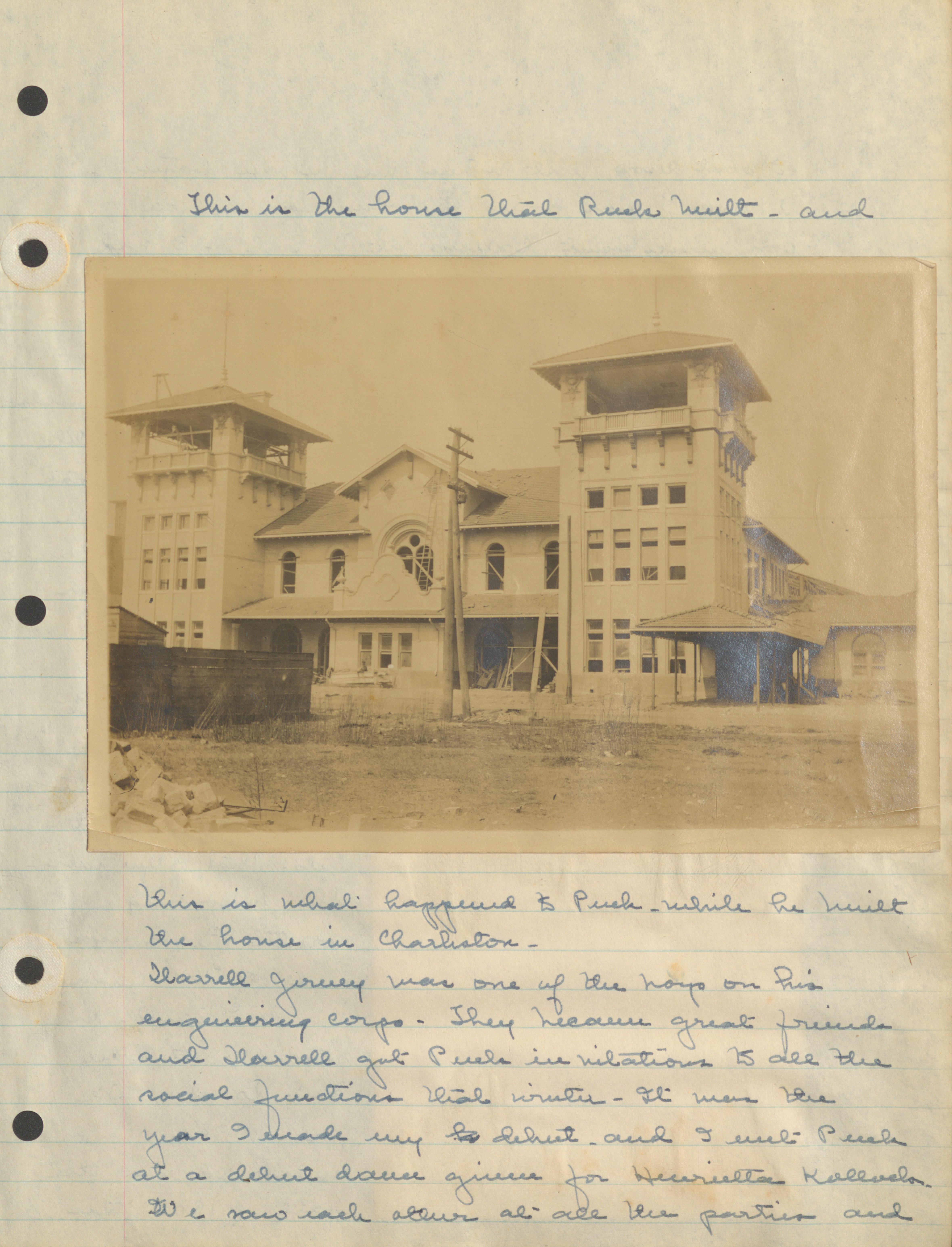
This is the house that Puck built — and
A large sepia photograph of a brick building under construction, two square towers flanking a central gabled block with arched windows.
Below the photograph, continuing the memoir:
Here is what happened to Puck while he built the house in Charleston.
Harrell Gurney was one of the boys on his engineering corps. They became great friends and Harrell got Puck invitations to all the social functions that winter. It was the year I made my
todebut — and I met Puck at a debut dance given for Henrietta Halloran. We saw each other at all the parties and
AI Notes
Album page with a single large sepia photograph of an industrial or institutional building under construction — multi-story brick structure with two square towers flanking a central gabled block with arched windows. The structure resembles the kind of brick power-plant / warehouse / depot Charleston was building during the 1906–08 city / Navy Yard expansion. Handwritten captions in blue ink above and below. The narrative continues Amy FitzSimons’s memoir, picking up the courtship with James Pickens Walker (‘Puck’), then a young engineer in Charleston working on this building. Text continues onto the following page. The writer struck through a false start ‘to’ between ‘my’ and ‘debut’ on the debut-dance sentence. ‘Harrell Gurney’ is the canonical spelling (matches p060).
The 1906–08 period was a moment of rapid industrial expansion in Charleston, much of it tied to the new U.S. Navy Yard (commissioned 1901, operational 1909) and the Atlantic Coast Line Railroad’s growing freight infrastructure. Puck (James Pickens Walker Sr.) was a young civil engineer who would soon work for the Atlantic Coast Line Railroad — see page 068 for his role as chief engineer on the new ACL route through Weldon, N.C.