Letter recalling May's debut in Charleston society, 1906, with pasted portrait of Myron T. Herrick
Book 2, Page 42 ·1906
Transcription
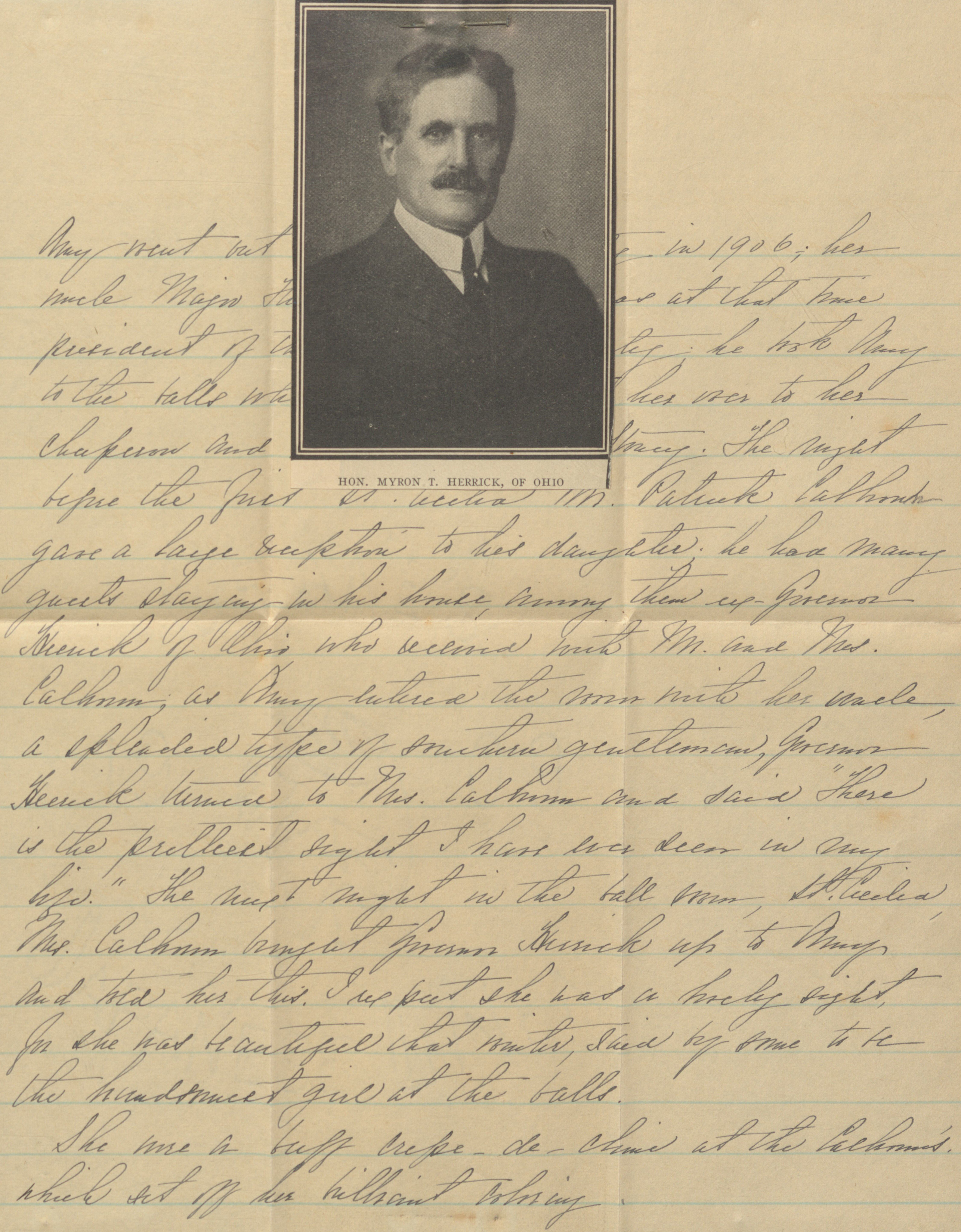
A pasted newspaper portrait at the top center of the page partially obscures the opening lines of a handwritten letter.
Pasted clipping (portrait):
A head-and-shoulders photographic portrait of a gentleman with thinning hair and a moustache, captioned:
Hon. Myron T. Herrick, of Ohio
Letter (handwritten, brown ink) — fully reconstructed from page 043 where the portrait is absent:
May went out in Charleston society in 1906; her uncle Major Theodore G. Barker was at that time president of the [obscured: St. Cecilia society], so took May to the balls where he served [obscured: as her] chaperon, and Cousin Mrs. Daniel Stoney. The night before the first St. Cecilia, Mr. Patrick Calhoun gave a large reception to his daughter; he had many guests staying in his house, among them ex-Governor Herrick of Ohio who became great with Mr. and Mrs. Calhoun. As May entered the room with her uncle — a splendid type of southern gentleman — Governor Herrick turned to Mrs. Calhoun and said “There is the prettiest sight I have ever seen in my life.” The next night in the ball room, St. Cecilia, Mrs. Calhoun brought Governor Herrick up to May, and told her this. I suppose she was a lovely sight, for she was beautiful that winter, said by some to be the handsomest girl at the ball.
She wore a buff crêpe-de-Chine at the Calhoun’s, which set off her brilliant coloring …
AI Notes
A handwritten letter in brown ink on cream paper, with a clipped newspaper portrait of ‘Hon. Myron T. Herrick, of Ohio’ pasted at the top center, partly obscuring the upper lines of the text. The letter recounts May’s debut in Charleston society in 1906, escorted by her uncle Major Theodore G. Barker, then president of the St. Cecilia Society, and a reception at Patrick Calhoun’s house at which ex-Governor Herrick admired May. Page 043 is the same sheet scanned without the pasted portrait — see that page for the obscured passage. The admirer is Myron T. Herrick (matching the pasted clipping); the letter records that he ‘became great with Mr. and Mrs. Calhoun’ (i.e., became close friends), and that May wore a buff crêpe-de-Chine at ‘the Calhoun’s’.
Letter continues beyond the bottom edge of the sheet. The Herrick portrait was pasted onto this letter as a keepsake by the compiler — Herrick being the gentleman whose admiring remark about May at the Calhoun reception is the central anecdote.
Patrick Calhoun (1856–1943), a grandson of John C. Calhoun, was a railroad and street-railway financier who had inherited the Williams (now Calhoun) Mansion at 16 Meeting Street, Charleston, from his father-in-law in 1903 — the Beaux-Arts house where this reception was held. Myron T. Herrick had just left the Ohio governorship in January 1906 and was a nationally prominent figure that season. The St. Cecilia Society, founded 1766, is Charleston’s oldest and most exclusive social institution; its winter balls were the apex of the city’s social calendar.