Envelope 'For May's children' and group photograph strip with reminiscence about a visit to Columbia
Book 2, Page 40 ·1900–1915
Transcription
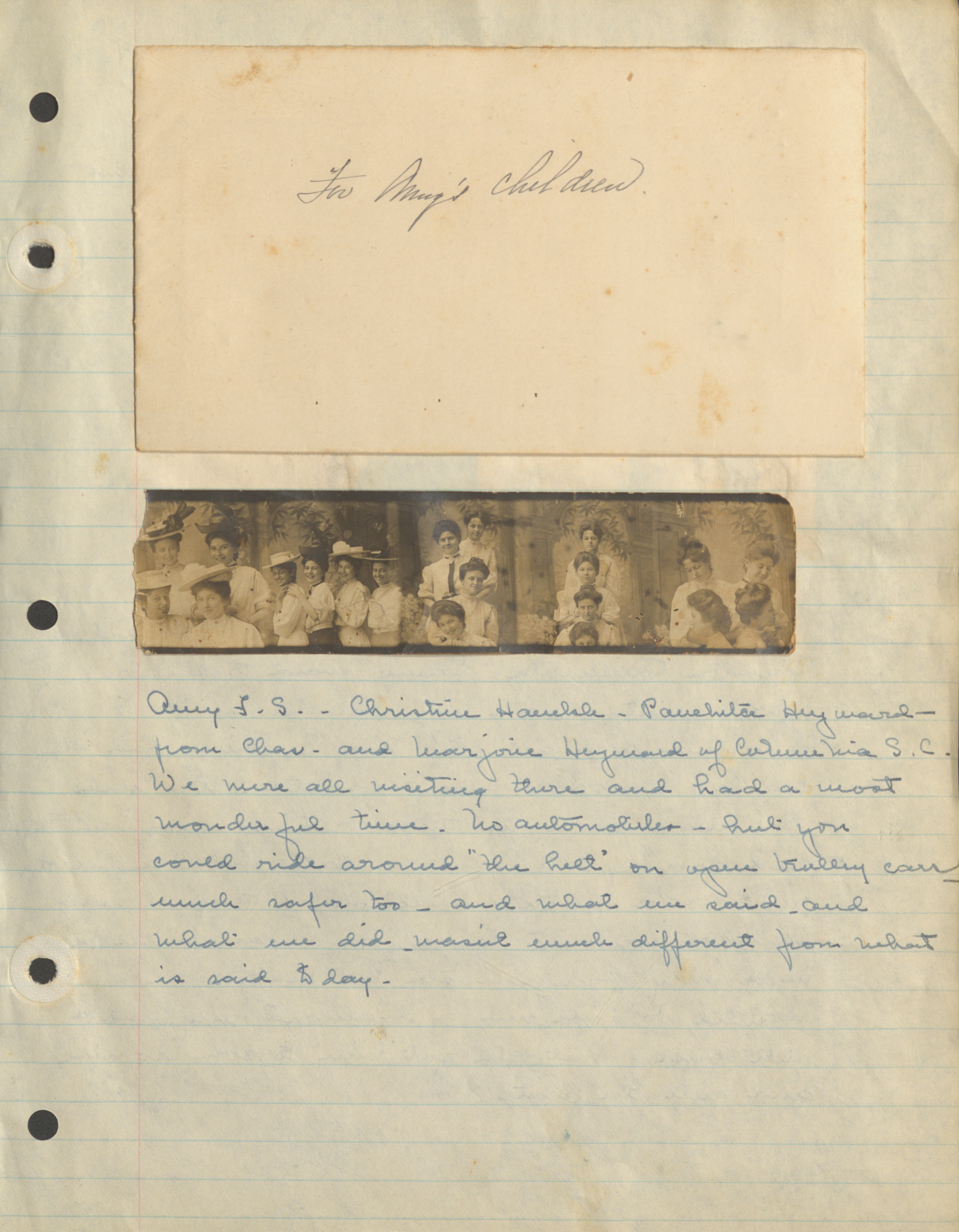
Upper left — envelope:
A small ivory envelope, unaddressed and unstamped, inscribed in pale ink across the front in a hand that differs from the album’s body captions (older and finer):
For May’s children.
Center — group photograph (strip print):
A horizontal photographic strip showing seven or eight young women in light-colored summer dresses and broad-brimmed hats, arranged in two clusters of three or four. The photograph is faded sepia and the figures’ faces are indistinct.
Below the strip — caption in the compiler’s hand (blue ink):
Amy F.S. — Christine Haskell — Pauletta Heyward from Char. and Marjorie Heyward of Columbia, S.C. We were all visiting there and had a most wonderful time. No automobiles — but you could ride around “the hill” on mule trolley cars — much safer too — and what we said and what we did wasn’t much different from what is said to-day.
AI Notes
An album page (lined paper) bearing three elements: at the upper left, a small ivory envelope inscribed ‘For May’s children.’ in faded ink (older and lighter than the page’s blue-ink caption — possibly inscribed when the envelope first held the photograph, by someone other than the compiler). In the middle of the page, a long horizontal strip-photograph showing seven or eight young women in early-1900s dress posed in two clusters against an outdoor backdrop. Below the strip, a five-line note in the compiler’s hand in blue ink identifying the sitters: Amy F.S. (the compiler), Christine Haskell, Pauletta Heyward from Charleston, and Marjorie Heyward of Columbia, S.C. They were ‘all visiting’ (the venue isn’t named — likely Columbia, given Marjorie Heyward’s residence there). The compiler recalls riding around ‘the hill’ on mule trolley cars and closes with a wry comparison to the present day.
The closing remark — that what the young women did “wasn’t much different from what is said to-day” — is the compiler’s wry editorial contrast between her own youth and the present day. The location of the visit isn’t explicitly named, but Marjorie Heyward’s being “of Columbia” and the trolley reference suggest a visit to Columbia.