Manuscript essay on Reconstruction and the Military Reconstruction Act (page 2)
Book 1, Page 652 ·1867–1870
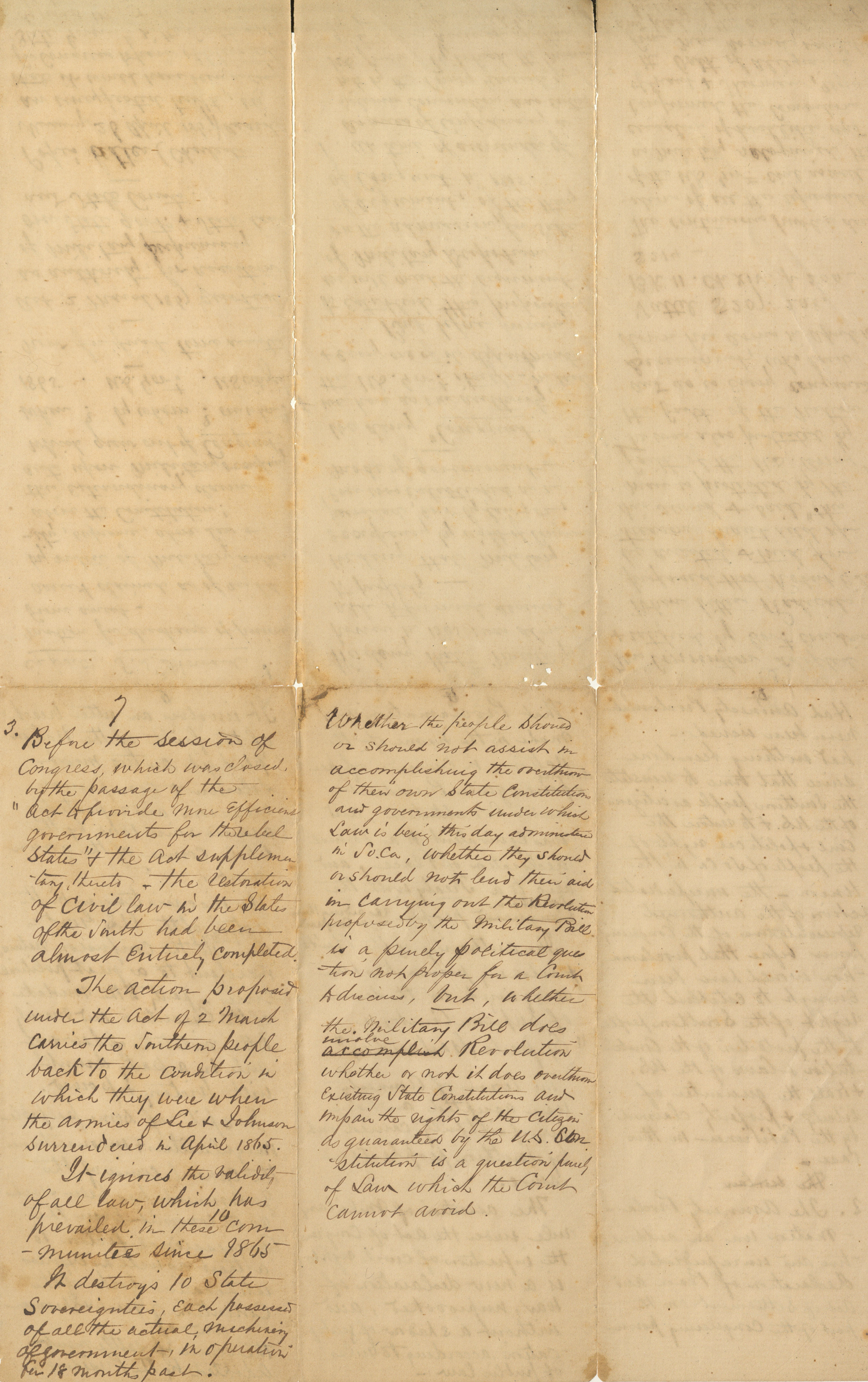
Transcription
[Manuscript page numbered 7 at the top of the right-side-up column. The leaf is folded; the upper half shows ghost-image bleed-through from the verso and is illegible. The two right-side-up columns below are transcribed; numbering of points continues from page 651.]
Lower-left column (right-side-up — numbered point continuing from page 651)
- Before the session of Congress, which was closed by the passage of the “Act to provide more efficient governments for the Rebel States” & the Act supplementary thereto — the restoration of Civil Law in the States of the South had been almost Entirely completed.
The action proposed under the Act of 2 March carries the Southern people back to the condition in which they were when the armies of Lee & Johnson [Johnston] Surrendered in April 1865.
It ignores the validity of all law, which has prevailed in these 10 Communities since 1865.
It destroys 10 State Sovereignties, each possessed of all the actual machinery of government, in operation for 18 months past.
Lower-middle column (right-side-up — continuation)
Whether the people should or should not assist in accomplishing the overthrow of their own State Constitution and governments under which Law is being this day administered in S. C., whether they should or should not lend their aid in carrying out the Revolution proposed by the Military Bill, is a purely political question not proper for a Court to discuss; but, whether the Military Bill does
accomplishinvolve Revolution, whether or not it does overthrow Existing State Constitutions and impair the rights of the Citizens as guaranteed by the U. S. Constitution, is a question purely of Law which the Court cannot avoid.
AI Notes
Continuation of the Reconstruction-era legal-political essay begun on page 651. The leaf is folded into panels; the upper portion shows bleed-through from the verso. The two right-side-up columns at the lower half are densely written in iron-gall ink in the same hand as p651 and continue the numbered argument that the Military Reconstruction Act of 2 March 1867 (‘the Act to provide more efficient governments for the Rebel States’) and its supplementary Act would overthrow the existing State Constitutions and impair the rights of citizens as guaranteed by the U.S. Constitution. Cites the surrender of Lee and Johnston in April 1865 as the moment when Civil Law was restored. A pencil page-number ‘7’ appears at the top of the right-side-up text.
Margin/interlinear edits visible in this column: “accomplish” was crossed out and replaced with “involve” (i.e., “whether the Military Bill does involve Revolution”). The number “10” is inserted above the line in “in these 10 Com-munities” — the writer revising upward from a smaller initial count. The writing continues the argument from page 651: the Amnesty Proclamation (1865, Ex parte Garland) was a Treaty of Peace; the Military Reconstruction Acts of 1867 break that Treaty; the constitutionality of the Acts is therefore a question of Law that a Court must decide. Frame: a Reconstruction-era legal opinion or argument, likely connected to the Ex parte S. L. Howard case named on page 651.