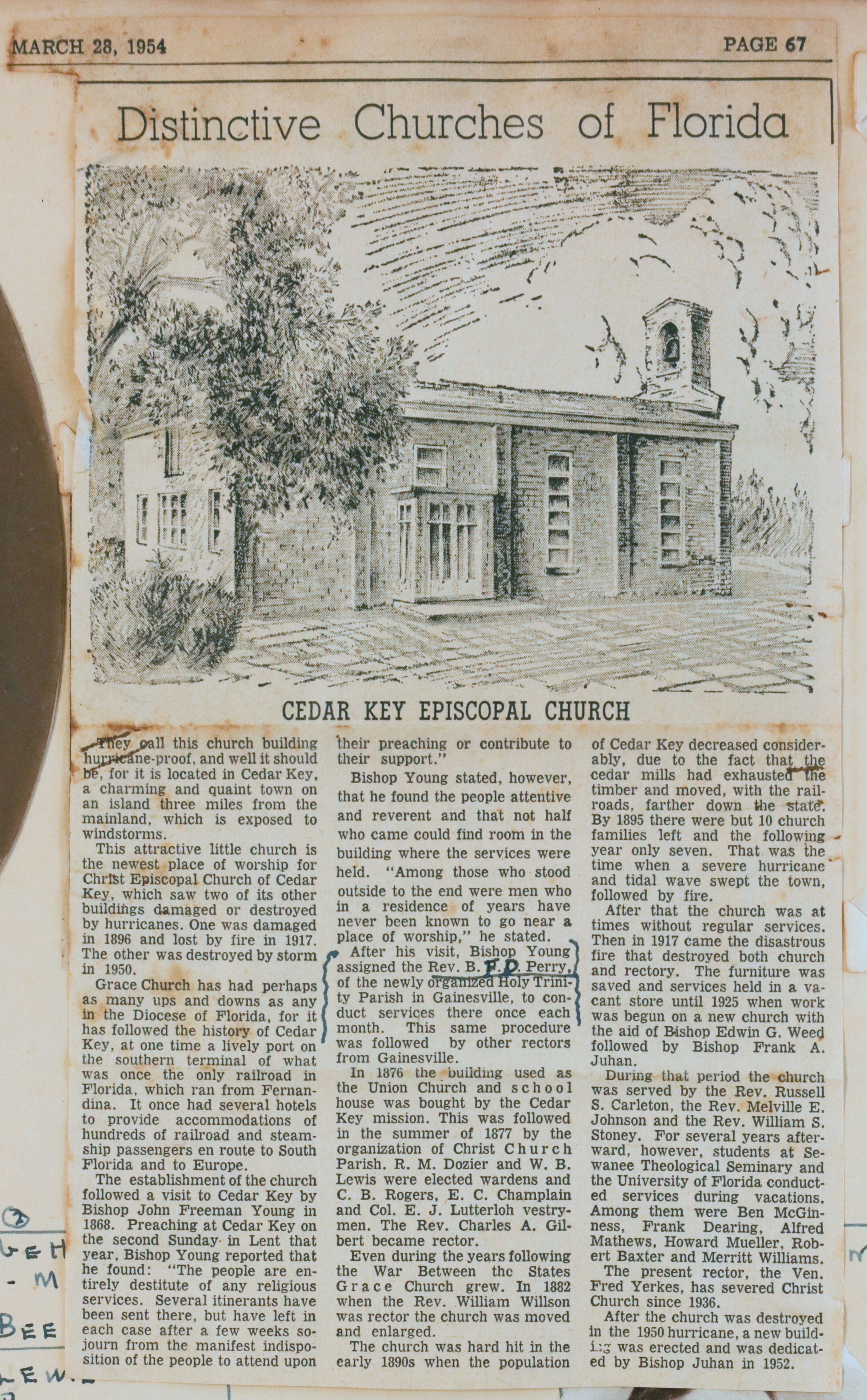
Newspaper clipping: 'Distinctive Churches of Florida — Cedar Key Episcopal Church'
Book 1, Page 621 ·1954
Transcription
A clipped newspaper article pasted to fill the album page.
Upper edge — header strip:
MARCH 28, 1954 PAGE 67
Headline:
Distinctive Churches of Florida
A pen-and-ink line drawing fills the upper center: a small, frame Gothic-revival church with steeply pitched roof, lancet windows, a central porch with twin doors, and a low picket fence — drawn from a low angle that emphasises the steep gable.
Beneath the drawing, the caption:
CEDAR KEY EPISCOPAL CHURCH
Article text (partially legible — newsprint is faded; transcription is best-effort):
Tiny but church building has been closed, and well it should be, for it is located in Cedar Key, a charming and quaint town on an island three miles from the mainland, which is exposed to windstorms.
This attractive little church is the central, place of worship for the Episcopal Church of Cedar Key, which now two of its older buildings damaged or destroyed by hurricanes. One was damaged in 1896 and lost by fire in 1917. The other was destroyed by storm in 1939.
Grace Church has had perhaps as many ups and downs as any in the Diocese of Florida, for it has followed the destiny of Cedar Key, at one time a lively port on the southern terminal of what was then known as the Florida Railroad. By 1896 only a small congregation remained from the manifold difficulties of that period.
The establishment of the church followed a visit to Cedar Key by Bishop John Freeman Young in 1868. Preaching at Cedar Key on the second Sunday in Advent that year, Bishop Young reported that he found: “The people are exceedingly desirous of religious services. Several Episcopalians have been sent there, but have left in each case after a few weeks sojourn from the manifold indisposition of the people to attend upon their preaching or contribute to their support.”
Bishop Young stated, however, that he found the people steadfast and earnest and that he saw no reason why they could not rally around the building where the services were held. “Among them are many descendants of Captain Henry Mott Plant, who in the early days made shipments to and from Cedar Key, and a number of his children, who in addition to his earlier-day kinships were the ancestors of many people there of today, and earnestly desire it.” With this thought in mind, Bishop Young followed up the matter with the missionary visit by the Rev. Henry Olcott Judd, who organized Christ Church on April 13, 1869, with vestrymen, however, students at the Western Theological Seminary and the University of Florida conducting services during vacations. Among them were Howard Mathews, Frank Young, Alfred Mathews, Howard Mosley, Robert Baxter and Merritt Williams.
The present rector, the Rev. Fred Yerkes, has served Christ Church since 1936.
After the church was destroyed in the 1939 hurricane, a new building was erected and was promptly and was dedicated by Bishop Juhan in 1953.
[The lower right portion of the article describes the rebuilding of the church and its dedication; portions are faded and not fully legible.]
Pencilled in the lower-left margin, in the compiler’s hand:
G E M B E E L E W
AI Notes
A single newspaper clipping pasted across the page, taken from the Florida Times-Union, March 28, 1954, page 67. Headline ‘Distinctive Churches of Florida — Cedar Key Episcopal Church’ over a pen-and-ink line drawing of the small frame Gothic church. The article recounts the history of Christ Church at Cedar Key from its founding in 1869, its destruction by storm in 1917, its rebuilding through the efforts of B. F. Perry and the Young family, and the vestrymen and rectors associated with it through 1954. Pencilled at the lower left in the compiler’s hand are a few key family names (‘GERT’, ‘M.’, ‘BEE’, ‘LEW’) — apparently shorthand notes tying members of the FitzSimons/Perry/Coffin/Crawford circle to the church.
Apparent shorthand initials — possibly “Gertrude,” “Marion,” “Bee” (Coffin), “Lewis” — connecting the church’s history to family members named in the tree on page 620.
The visiting “Bishop Young” who preached at Cedar Key in 1868 is John Freeman Young (1820–1885), second Bishop of Florida — best remembered today as the translator of the German Stille Nacht into the English “Silent Night” sung worldwide every Christmas Eve. Christ Church at Cedar Key remains an active parish of the Episcopal Diocese of Florida.