Letter from John E. Gibbs honoring Ellen M. FitzSimons on her retirement, 1963 (page 3)
Book 1, Page 528 ·1963
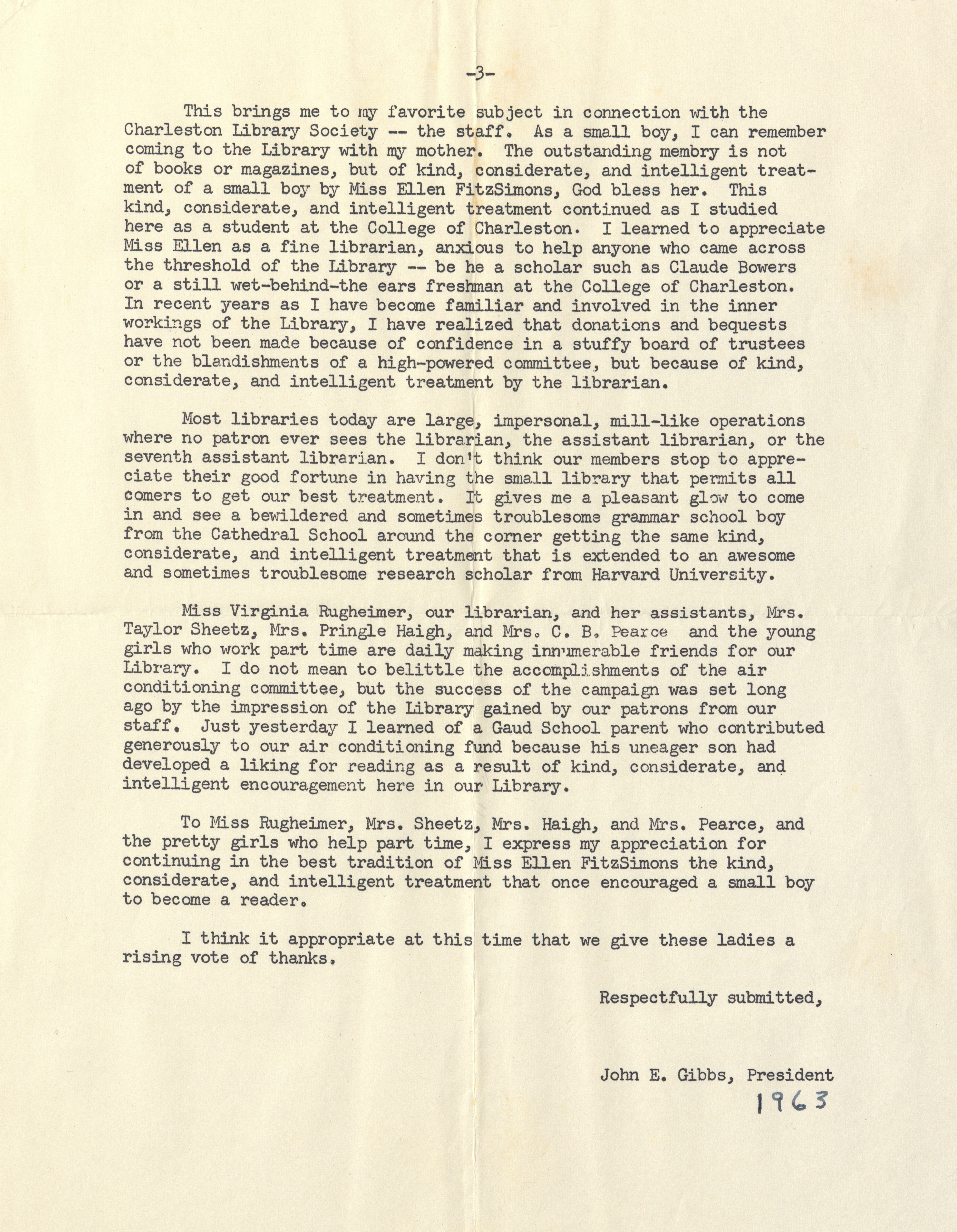
Transcription
[Page numbered “-3-” at top.]
This brings me to my favorite subject in connection with the Charleston Library Society — the staff. As a small boy, I can remember coming to the Library with my mother. The outstanding memory is not of books or magazines, but of kind, considerate, and intelligent treatment of a small boy by Miss Ellen FitzSimons, God bless her. This kind, considerate, and intelligent treatment continued as I studied here as a student at the College of Charleston. I learned to appreciate Miss Ellen as a fine librarian, anxious to help anyone who came across the threshold of the Library — be he a scholar such as Claude Bowers or a still wet-behind-the-ears freshman at the College of Charleston. In recent years as I have become familiar and involved in the inner workings of the Library, I have realized that donations and bequests have not been made because of confidence in a stuffy board of trustees or the blandishments of a high-powered committee, but because of kind, considerate, and intelligent treatment by the librarian.
Most libraries today are large, impersonal, mill-like operations where no patron ever sees the librarian, the assistant librarian, or the seventh assistant librarian. I don’t think our members stop to appreciate their good fortune in having the small Library that permits all comers to get our best treatment. It gives me a pleasant glow to come in and see a bewildered and sometimes troublesome grammar school boy from the Cathedral School around the corner getting the same kind, considerate, and intelligent treatment that is extended to an awesome and sometimes troublesome research scholar from Harvard University.
Miss Virginia Rugheimer, our librarian, and her assistants, Mrs. Taylor Sheetz, Mrs. Pringle Haigh, and Mrs. C. B. Pearce — and the young girls who work part time are daily making innumerable friends for our Library. I do not mean to belittle the accomplishments of the air conditioning committee, but the success of the campaign was set long ago by the impression of the Library gained by our patrons from our staff. Just yesterday I learned of a Gaud School parent who contributed generously to our air conditioning fund because his uneager son had developed a liking for reading as a result of kind, considerate, and intelligent encouragement here in our Library.
To Miss Rugheimer, Mrs. Sheetz, Mrs. Haigh, and Mrs. Pearce, and the pretty girls who help part time, I express my appreciation for continuing in the best tradition of Miss Ellen FitzSimons the kind, considerate, and intelligent treatment that once encouraged a small boy to become a reader.
I think it appropriate at this time that we give these ladies a rising vote of thanks.
Respectfully submitted,
John E. Gibbs, President
1963
AI Notes
Typed letter, third (final) page numbered ‘-3-’ at top. The closing portion of a tribute speech/letter by John E. Gibbs, President of the Charleston Library Society, addressed in 1963 on the occasion of Ellen M. FitzSimons’s retirement. Recalls his boyhood library visits when Miss Ellen welcomed him; her long courtesy to scholars (the diplomat-historian Claude Bowers is named) and students at the College of Charleston, the Cathedral School, the Gaud School, and Harvard. Acknowledges current librarian Virginia Rugheimer and assistants Mrs. Taylor Sheetz, Mrs. Pringle Haigh, and Mrs. C. B. Pearce, proposing a rising vote of thanks. Signed ‘John E. Gibbs, President’ with ‘1963’ written in hand below. The staff members named are Mrs. Haigh and Mrs. Pearce (library assistants) — there are no daughters of those surnames in the letter.
The “Miss Ellen FitzSimons” celebrated throughout the speech is the compiler’s paternal aunt Ellen Milliken FitzSimons (1862–1953), librarian of the Charleston Library Society 1898–1948 — see the memorial spread on page 534. Claude Bowers (1878–1958) was an American journalist, popular historian (Jefferson and Hamilton, 1925; The Tragic Era, 1929), and FDR’s ambassador to Spain and Chile; his sympathetic, Dunning-School treatment of Reconstruction made him a welcome figure in Charleston scholarly circles. Gibbs delivered this tribute fifteen years after her retirement and a decade after her death.