Letter fragment — reflections on American society and the 'uplift' movement, undated
Book 1, Page 503 ·1900-1930
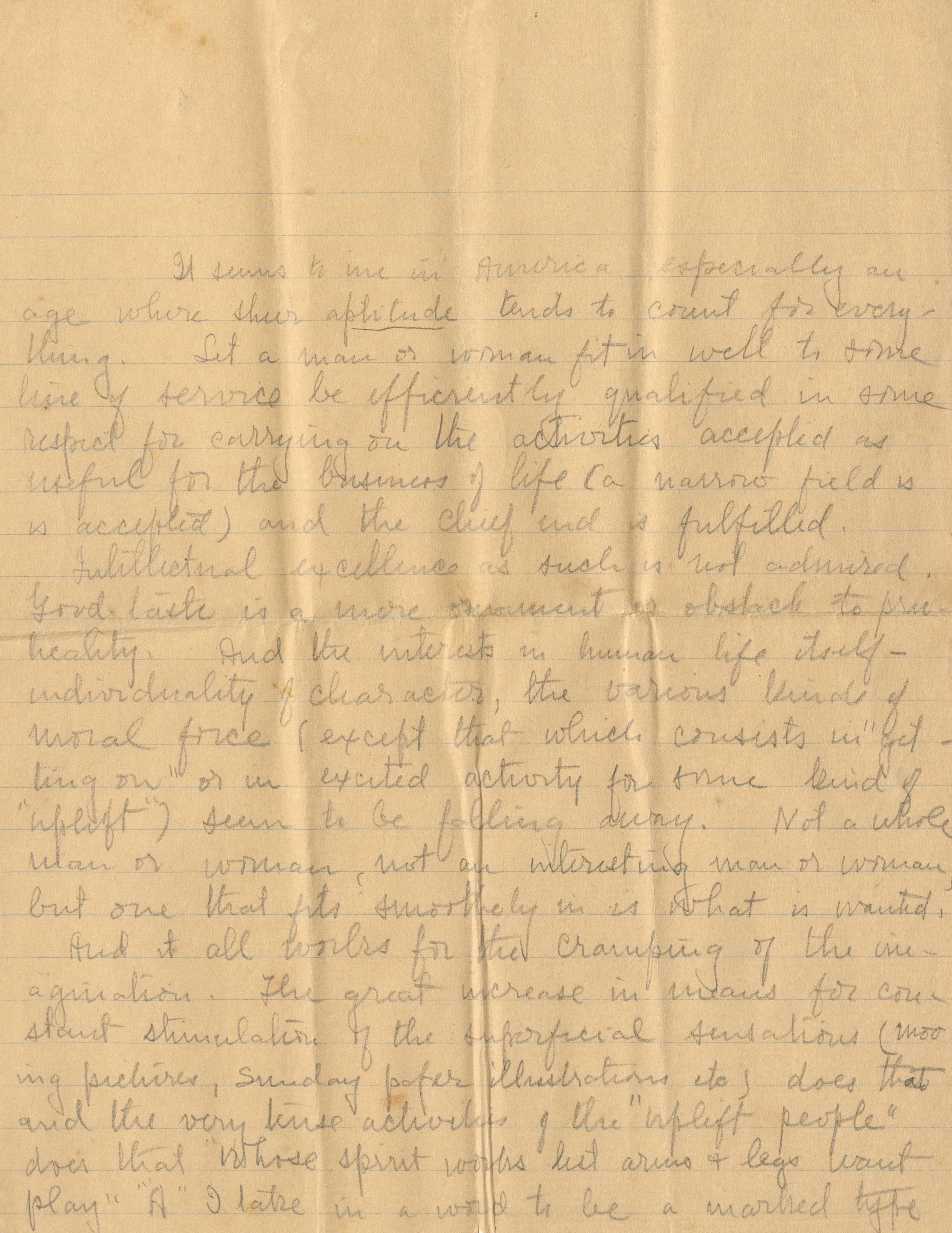
Transcription
It seems to me in America — especially an age where their aptitude tends to count for everything. Let a man or woman fit in well to some line of services be sufficiently qualified in some respect for carrying on the activities accepted as useful for the business of life (a narrow field is
isso accepted) and the chief end is fulfilled.Individual excellence as such is not admired. Good taste is a more ornament an obstacle to practicality. And the interest in human life itself — individuality of character, the various kinds of moral force (except that which consists in “yelling on” or in excited activity for some kind of “uplift”) seem to be falling away. Not a whole man or woman, not an interesting man or woman but one that fits smoothly in is what is wanted.
And it all works for the cramping of the imagination. The great increase in means for constant stimulation of the superficial sensations (movie pictures, Sunday papers illustrations, etc.) does that and the very tense activities of the “uplift people” does that. Whose spirit works but arms & legs want play? “A.” I take, in a word, to be a marked type
AI Notes
A single sheet of cream paper written in pencil cursive, deeply creased and partially faded. The page begins mid-thought and reads like a continuation of the philosophical-letter sequence on pp 499–500–502 (same hand and voice); the section divider on page 504 catalogs the next several family letters that follow, suggesting page 503 is the closing leaf of the philosophical fragment rather than a separate piece. The writer reflects on American society: that aptitude tends to count for everything; that individual excellence is not admired; that good taste is more an ornament an obstacle to practicality; that what is wanted is a man or woman who fits smoothly into the machinery rather than an interesting individual; and that the ‘uplift’ movement, magazine pictures, and Sunday-paper illustrations only stimulate the superficial sensations. The text continues onto the next leaf but the connection to subsequent pages is unclear. Page is folded in half vertically; pencil is faded and several words remain uncertain.