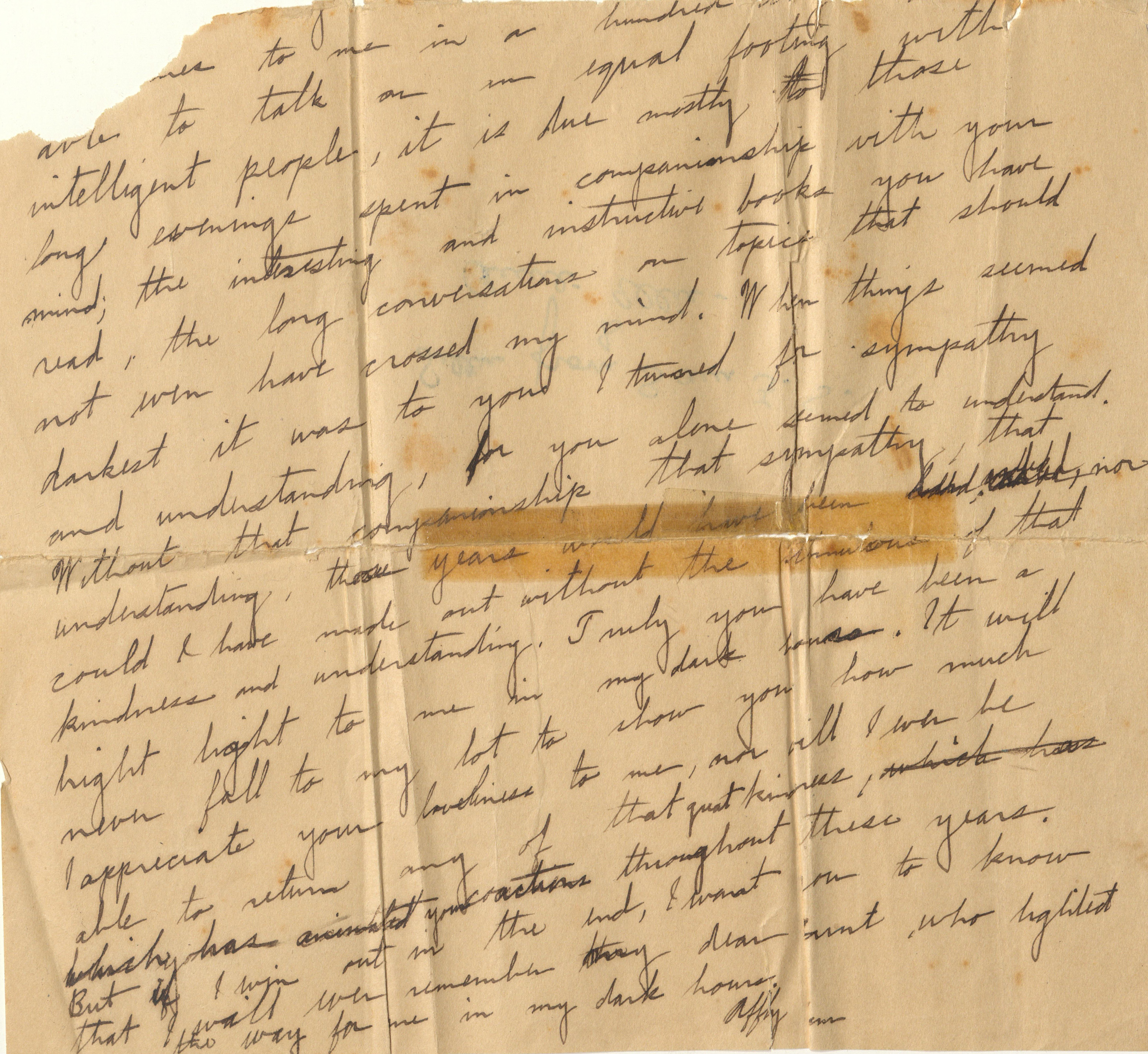
Letter continued: closing paragraph thanking the recipient for kindness and understanding through dark hours, signed 'Affy'
Book 1, Page 483 ·1929
Transcription
A single sheet, the closing portion of a letter. The text is in the same hand as pages 482 and 486 (the same 22 November 1929 letter from W. Huger FitzSimons in Hendersonville, N.C., to his sister Ellie).
…were to me in a hundred ways. Able to talk on an equal footing with intelligent people, it is true mostly through those long evenings spent in companionship with your mind, the interesting and instructive books you have read, the long conversations on topics that should not even have crossed my mind. When things seemed darkest it was to you I turned for sympathy and understanding, for you alone seemed to understand. Without that companionship — [long redaction-like horizontal mark struck across the page; writer’s interlinear corrections to “companionship” / “those years” / “understanding” partly visible] — that sympathy and understanding, those years would have been the darkest [that I?] could & have made out without the [shadow?] of that kindness and understanding. Truly you have been a bright light to me in my dark hours. It will never fall to my lot to show you how much I appreciate your kindness to me, nor will I ever be able to return any of that great kindness, [struck through: which has] which has accompanied your actions throughout these years. But if I live out to the end, I want one to know that fact, [struck through: that they] that I will ever remember the very dear one who brightened the way for me in my dark hours.
Affy
AI Notes
A single sheet of pale letter paper, water-stained, toned and creased — the closing portion of the letter dated ‘Hendersonville, N.C. / November 22nd 1929’ that begins on page 482 (and whose continuation page 2 is on page 486). The writer thanks the recipient for being his support and sole source of sympathy through ‘the darkest’ hours, and praises the kindness, understanding, and long evening conversations they have shared. A long horizontal stripe of staining (resembling a redaction stripe) runs across the middle of the page, partially obscuring a sentence; there are multiple inline strike-throughs and caret insertions in the writer’s own hand. The closing signature ‘Affy’ (a shortened ‘Affectionately’) matches the hand of pages 482 and 486 — almost certainly W. Huger FitzSimons writing to his sister, Ellen Milliken FitzSimons (‘Ellie’).
Signature is the writer’s affectionate sign-off ‘Affy’ (a clipped form of ‘Affectionately’ commonly used in the FitzSimons family correspondence — cf. other letters in the album closing the same way). The letter is the conclusion of the November 22, 1929 letter that begins on page 482 (datelined Hendersonville, N.C.) and whose second-page continuation is on page 486. The writer’s hand and the surrounding context identify him as W. Huger FitzSimons, writing in the last weeks of his life (he died at Hendersonville on 19 December 1929) to his sister Ellen Milliken FitzSimons.