Letter from France, A.P.O. 717, August 10, 1918: an American officer writes Mr. FitzSimons after meeting his aviator son on a French street
Book 1, Page 480 ·1918
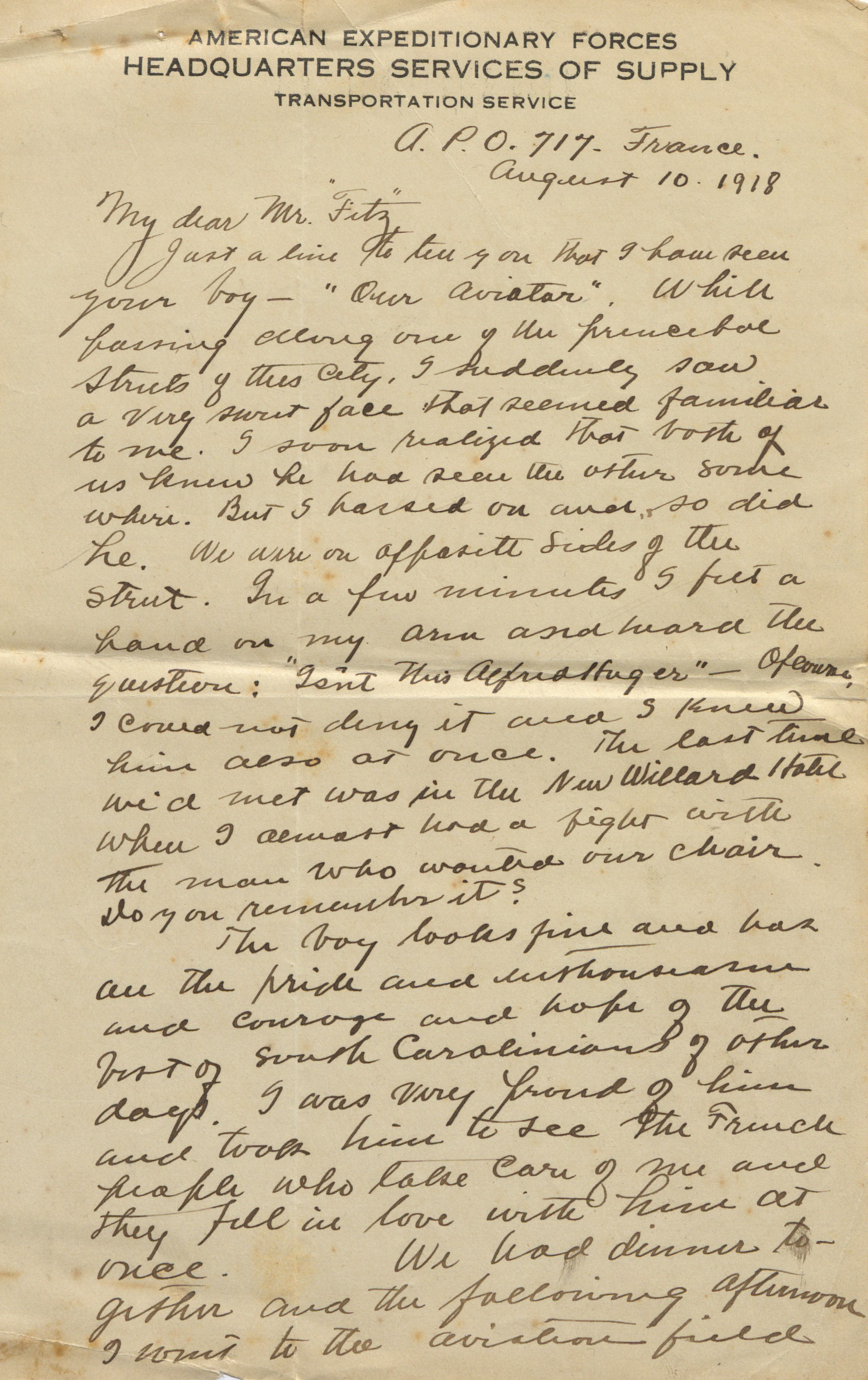
Transcription
A single sheet of US Army stationery. Printed letterhead at the top:
AMERICAN EXPEDITIONARY FORCES HEADQUARTERS SERVICES OF SUPPLY TRANSPORTATION SERVICE
Datelined at the upper right in cursive ink:
A.P.O. 717. France. August 10. 1918
"My dear Mr. Fitz —
Just a line to tell you that I have seen your boy — “Our Aviator.” While passing along one of the principle Streets of this City, I suddenly saw a very sweet face that seemed familiar to me. I soon realized that both of us knew he had seen the other somewhere. But I passed on and so did he. We are on opposite sides of the Street. In a few minutes I felt a hand on my arm and heard the question: “Isn’t this Alfred Huger?” — Of course I could not deny it and I knew him also at once. The last time we’d met was in the New Willard Hotel when I almost had a fight with the man who wanted our chair. Do you remember it?
The boy looks fine and has all the pride and enthusiasm and courage and hope of the best of South Carolinians of other days. I was very proud of him and took him to see the French people who take care of me and they fell in love with him at once. We had dinner together and the following afternoon I went to the aviation field [continued on next sheet, not preserved]…"
AI Notes
A single sheet of US Army stationery, printed at the top with “AMERICAN EXPEDITIONARY FORCES / HEADQUARTERS SERVICES OF SUPPLY / TRANSPORTATION SERVICE.” Datelined “A.P.O. 717. France. / August 10. 1918” and addressed “My dear Mr. Fitz —”. The body recounts the writer’s chance meeting in a French street with the recipient’s aviator son, who hails him with the question “Isn’t this Alfred Huger?” — establishing the writer’s own identity as Alfred Huger of Charleston, a family connection. The young man recalls their last meeting at the New Willard Hotel (in Washington, D.C.) when Alfred Huger had nearly come to blows with a stranger over a chair. The writer dines with the boy and visits his aviation field the next afternoon. The letter breaks off mid-sentence at the foot of this sheet; the continuation is not present in the album.
The cursive hailing question reads “Isn’t this Alfred Huger?” — meaning the writer’s own name is Alfred Huger, a Charleston relation of the Huger / FitzSimons families. Per the album’s surrounding WWI aviator material (the obituary on p452 and the Maj. Peter Gething eulogy on pp472–473), “our aviator” — the recipient’s son — is almost certainly Samuel Gaillard FitzSimons (b. 21 Apr 1894, the WWI combat aviator attached to the Royal Flying Corps in France and Flanders, d. by his own hand near Flat Rock NC c.1932 from progressive war-related blindness). The recipient “Mr. Fitz” is then his father William Huger FitzSimons (b. 8 Jan 1861, d. 16 Sep 1939; the eldest of Dr. Christopher 3rd’s surviving sons; Charleston attorney; retired to Flat Rock). While Gavin is listed as the eldest son of W. Huger + Annie Cain on the family chart p271, the surviving documentary record identifies Samuel Gaillard as the family aviator.
The letter breaks off at the foot of the sheet; the continuation is not mounted in the album, and the writer’s signature is therefore not visible on this page. The writer’s own name is recovered from the boy’s question: Alfred Huger, a member of the Charleston Huger family (the addressee W. Huger FitzSimons was a nephew of his uncle William Huger, and was named for him — see p487 biographical memorandum). The “boy” is most likely Samuel Gaillard FitzSimons, W. Huger FitzSimons’s son and the WWI combat aviator whose obituary is mounted on p452. The “New Willard Hotel” of the writer’s anecdote is the Washington, D.C. hotel at 14th and Pennsylvania Ave. NW — a noted gathering place for Southern men of affairs in the early 20th century.