Typescript: 'The Charm of Charleston Houses and Gardens' by Theodore Lynch FitzSimons — page 1
Book 1, Page 454 ·1920–1940
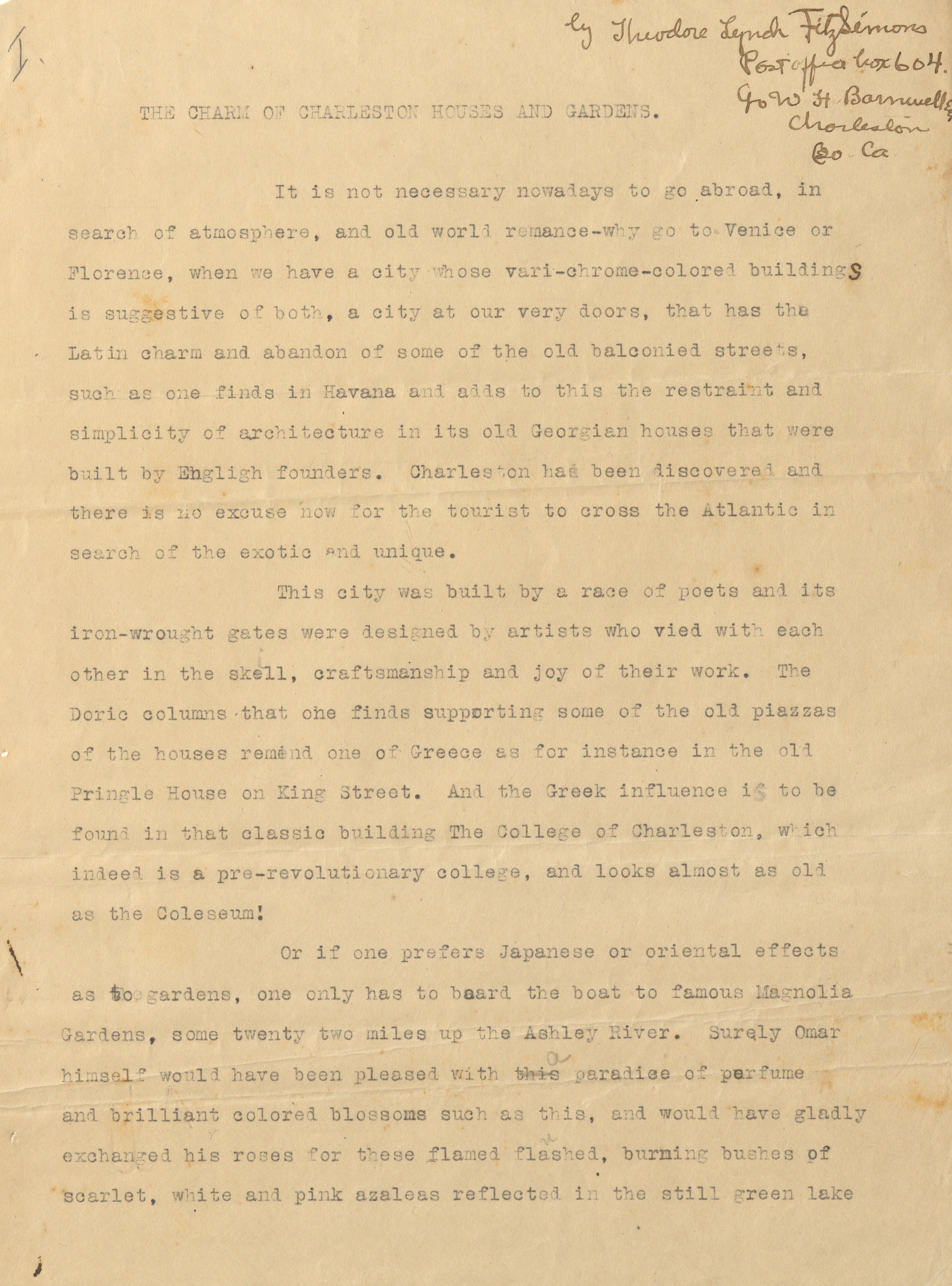
Transcription
[Inscribed in cursive at upper right:]
By Theodore Lynch FitzSimons Postoffice box 604 for W. H. Barnwell Charleston So. Ca.
THE CHARM OF CHARLESTON HOUSES AND GARDENS.
It is not necessary nowadays to go abroad, in search of atmosphere, and old world romance — why go to Venice or Florence, when we have a city whose vari-chrome-colored buildings is suggestive of both, a city at our very doors, that has the Latin charm and abandon of some of the old baleonied streets, such as one finds in Havana and adds to this the restraint and simplicity of architecture in its old Georgian houses that were built by Bnglish founders. Charleston has been discovered and there is no excuse now for the tourist to cross the Atlantic in search of the exotic and unique.
This city was built by a race of poets and its iron-wrought gates were designed by artists who vied with each other in the skell, craftsmanship and joy of their work. The Doric columns that one finds supporting some of the old piazzas of the houses remind one of Greece as for instance in the old Pringle House on King Street. And the Greek influence is to be found in that classic building The College of Charleston, which indeed is a pre-revolutionary college, and looks almost as old as the Coloseum.
Or if one prefers Japanese or oriental effects as to gardens, one only has to board the boat to famous Magnolia Gardens, some twenty two miles up the Ashley River. Surely Omar himself would have been pleased with
thisparadice of perfume and brilliant colored blossoms such as this, and would have gladly exchanged his roses for these flamed flushed, burning bushes of scarlet, white and pink azaleas reflected in the still green lake
AI Notes
First page of a typewritten essay by Theodore Lynch FitzSimons on the architecture and gardens of Charleston. The upper-right inscription reads ‘for W. H. Barnwell’ — most likely a male Charleston Barnwell (the Barnwell family was prominent in Charleston; possibly Rev. William Hazzard Barnwell or a later W. H. Barnwell descendant). The typescript shows several typist’s misspellings retained as written: ‘baleonied’ for balconied, ‘Bnglish’ for English, ‘skell’ for skill, ‘paradice’ for paradise (a struck-through and re-inserted ‘this paradice of perfume’), and ‘Coloseum’ for Colosseum.
Theodore Lynch FitzSimons (1893–1956) is the compiler’s first cousin once removed — son of Theodore Stoney FitzSimons and Sabina Lynch McCrady — whose obituary and the poem “Last Voyage” appear on page 469. He attended the College of Charleston, was a Navy veteran of the First World War, and worked for several New York publishers; he is the “young artist … in college” of the small clipping on page 469. The essay continues on pages 456–461.