Newspaper column 'Apostolic Succession' by Jack Leland
Book 1, Page 336 ·1980–1982
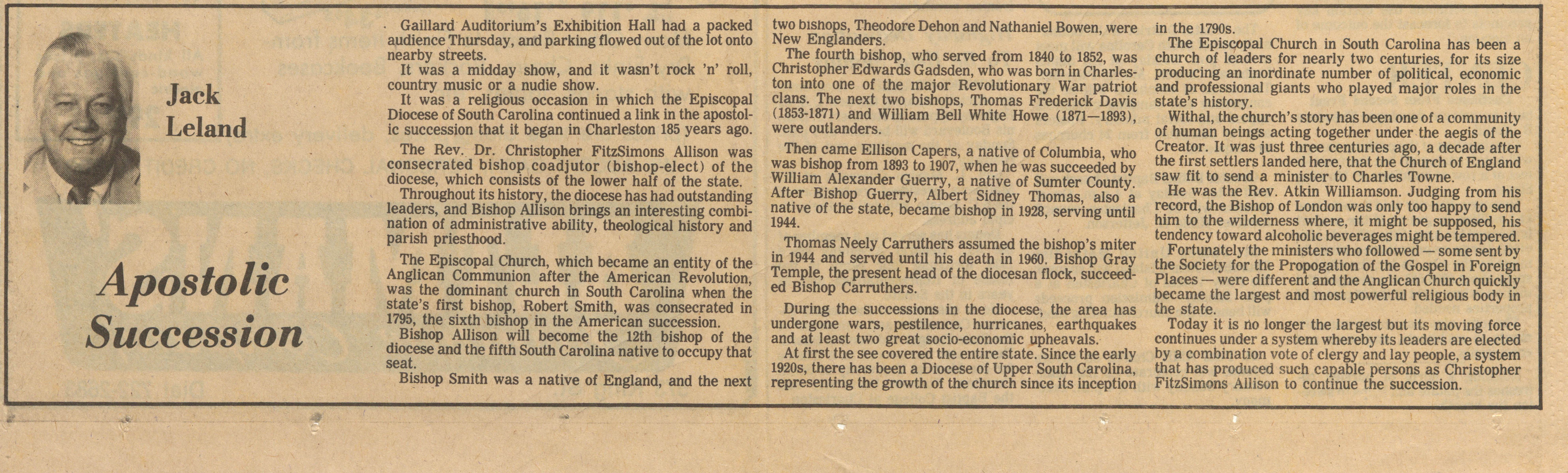
Transcription
A multi-column newspaper feature pasted to the page, with a small portrait of columnist Jack Leland at the top and the standing column head Apostolic Succession set vertically along the left.
Byline portrait caption:
Jack Leland
Column head:
Apostolic Succession
Article:
Gaillard Auditorium’s Exhibition Hall had a packed audience Thursday, and packing flowed out of the lot onto nearby streets.
It was a unique, an august, and it wasn’t rock ‘n’ roll, country music or a radio show.
It was a religious occasion in which the Episcopal Diocese of South Carolina continued a link in the apostolic succession that it began in Charleston 196 years ago.
The Rev. Dr. Christopher FitzSimons Allison was consecrated bishop coadjutor / bishop-elect of the Diocese of South Carolina. The next two bishops, [the Rt. Rev. Gray Temple as senior bishop and Dr. Allison], will serve as co-extensive bishops, theological history and parish priesthood.
The Episcopal Church, which became an entity of the Anglican Communion after the American Revolution, was the daughter church which gave the state its first bishop, Robert Smith, was consecrated …
Bishop Allison will become the 12th bishop of the diocese and the fifth South Carolina native to occupy that seat.
Bishop Smith was a native of England, and the next two bishops, Theodore Dehon and the Rt. Rev. Nathaniel Bowen, were both born in Massachusetts.
The fourth bishop, who served the longest but its starring here was Christopher E. Gadsden, born in Charleston in 1785 and consecrated in 1840.
Thomas Frederick Davis succeeded him in 1853 and was born in North Carolina. He was the first of three bishops in succession who were natives of that state, the last being Albert Sidney Thomas, native of Wilmington in 1928, serving until 1944.
Thomas Neely Carruthers assumed the bishop’s miter in 1944 and served until his death in 1960. Bishop Gray Temple, born in the diocesan field, succeeded him.
During the ceremonies in the diocese, the area has undergone wars, pestilences, hurricanes, earthquakes and at least two great socio-economic upheavals.
At first the see covered the entire state. Since the early 1920s, there has been a Diocese of Upper South Carolina, representing the growth of the church since its inception in the 1700s.
The Episcopal Church in South Carolina has been a church of leaders for nearly two centuries, for its size producing an inordinate number of political, economic and professional giants who played major roles in the state’s history.
Withal, the church’s story has been one of a community of human beings acting in part under the aegis of the Creator. It was just three centuries ago, in a decade after the first settlers landed here, that the Church of England — by 1706 was made it a tax-supported entity of the Carolinas as a colony of the British crown.
He was the Rev. Atkin Williamson. Judging from his record, the Bishop of London was only too happy to send him to the wilderness where, it might be supposed, his tendency toward alcoholic beverages might be tempered.
Fitzpatrick has the closest contact in his journey to the city for the Propagation of the Gospel in Foreign Parts — were silvered and the Anglican Church quickly became the largest and most powerful religious body in the state.
It was no longer the largest but its starring here continues to make the church the largest force in the south’s denomination of religious bodies, especially in its character of “Mother Church” to the Episcopal Church in S.C.
AI Notes
A newspaper column titled ‘Apostolic Succession’ by Jack Leland, with a small head-and-shoulders photograph of the author at the top, pasted to the album page. The article traces the line of consecration of the Episcopal bishops of South Carolina from colonial days to the recent election of C. FitzSimons Allison. The clipping is from the News and Courier or Evening Post (Charleston). Some text along the trimmed edges is partly cut off.
Some words along the trimmed inner and outer margins are cut off; readings flagged as uncertain where possible.