Magazine article 'Boyhood in a Ricefield' by Archibald Rutledge with mailing envelope from Mrs. Albert Simons
Book 1, Page 318 ·1959
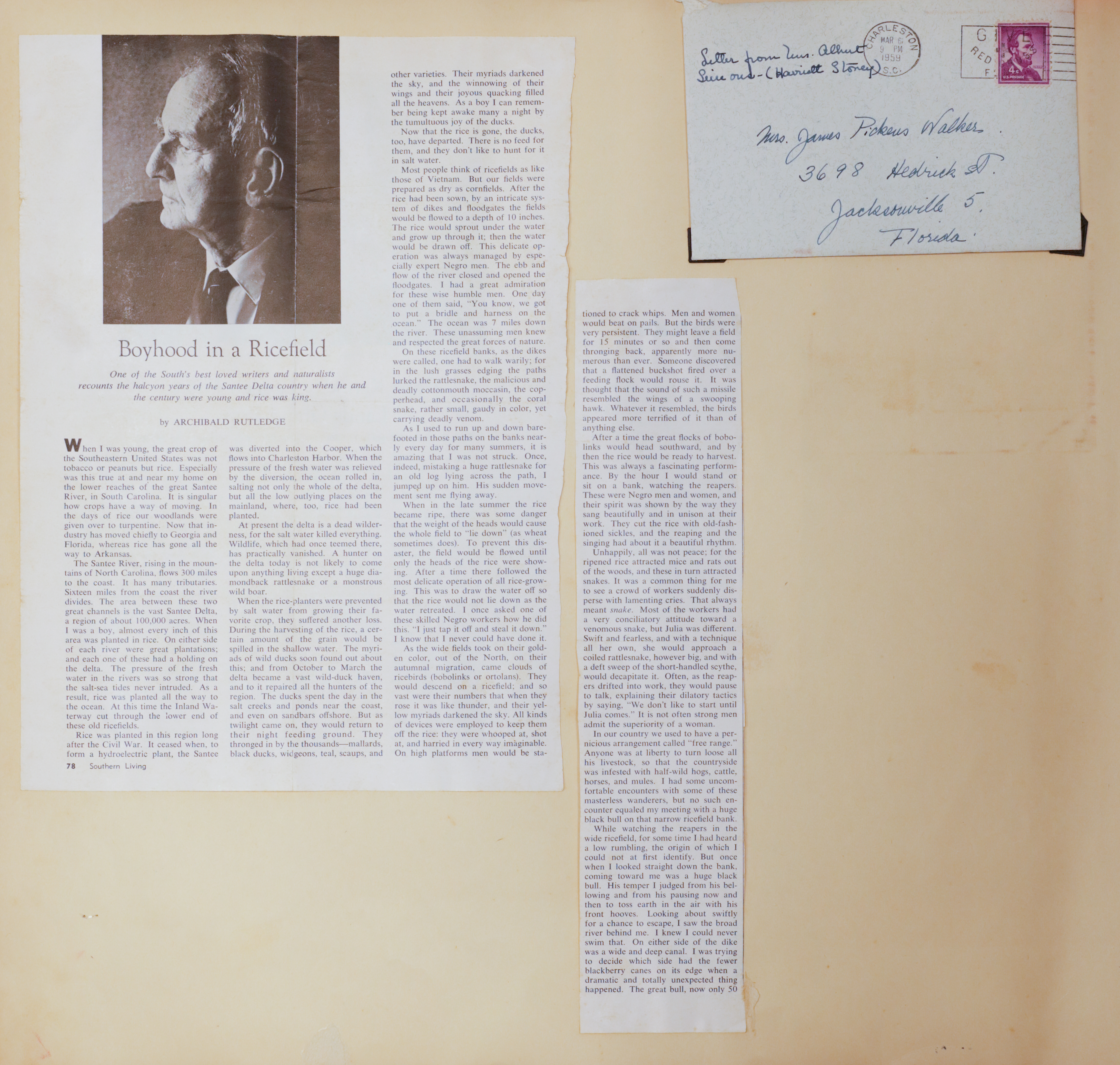
Transcription
A magazine page mounted at the upper left of the album sheet, an addressed envelope at the upper right, and a narrow column clipping along the right edge.
Magazine article (upper left):
A black-and-white profile portrait of an older man with white hair, captioned beneath:
Boyhood in a Ricefield
One of the South’s best loved writers and naturalists recounts the halcyon years of the Santee Delta country when he and the century were young and rice was king.
by ARCHIBALD RUTLEDGE
When I was young, the great crop of the Southeastern United States was not tobacco or peanuts but rice. Especially was this true at and near my home on the lower reaches of the great Santee River, in South Carolina. It is singular how crops have a way of moving. In the days of rice our woodlands were given over to turpentine. Now that industry has moved chiefly to Georgia and Florida, whereas rice has gone all the way to Arkansas.
The Santee River, rising in the mountains of North Carolina, flows 300 miles to the coast. It has many tributaries. Sixteen miles from the coast the river divides. The area between these two great channels is the vast Santee Delta, a region of about 100,000 acres. When I was a boy, almost every inch of this area was planted in rice. On either side of each river were great plantations; and each one of these had a holding on the delta. The pressure of the fresh water in the rivers was so strong that the salt-sea tides never intruded. As a result, rice was planted all the way to the ocean. At this time the Inland Waterway cut through the lower end of these old ricefields.
Rice was planted in this region long after the Civil War. It ceased when, to form a hydroelectric plant, the Santee was diverted into the Cooper, which flows into Charleston Harbor. When the pressure of the fresh water was relieved by the diversion, the ocean rolled in, salting not only the whole of the delta, but all the low outlying places on the mainland, where, too, rice had been planted.
At present the delta is a dead wilderness, for the salt water killed everything. Wildlife, which had once tenanted there, has practically vanished. A hunter on the delta today is not likely to come upon anything living except a huge diamond-back rattlesnake or a monstrous wild boar.
When the rice-planters were prevented by salt water from growing their favorite crop, they suffered another loss. During the harvesting of the rice, a certain amount of the grain would be spilled in the shallow water. The myriads of wild ducks soon found out about this, and from October to March the delta became a vast wild-duck haven, and to it repaired all the hunters of the region. The ducks spent the day in the salt creeks and ponds near the coast, and even on sandbars offshore. But as twilight came on, they would return to their night feeding ground. They thronged in by the thousands — mallards, black ducks, widgeons, teal, scaups, and …
[Page number “78” visible at the lower left with “Southern Living.”]
Envelope (upper right):
A small pale envelope franked with a 3¢ purple Statue of Liberty stamp and a circular Charleston, S.C., postmark dated MAR 5 9 PM 1959. Across the upper edge in pencil in the compiler’s hand:
Letter from Mrs. Albert Simons — (Harriott Stoney)
Addressed in blue fountain-pen ink:
Mrs. James Pickens Walker 3648 Hedrick St. Jacksonville 5, Florida.
Right-margin clipping (column of newsprint):
A narrow vertical strip of newsprint, the continuation of the Rutledge “Boyhood in a Ricefield” article (hand-trimmed at left, clipping one or two characters per line):
…tioned to crack whips. Men and women would beat on pails. But the birds were very persistent. They might leave a field for 15 minutes or so and then come thronging back, apparently more numerous than ever. Someone discovered that a flattened buckshot fired over a feeding flock would rouse it. It was thought that the sound of such a missile resembled the wings of a swooping hawk. Whatever it resembled, the birds appeared more terrified of it than of anything else.
After a time the great flocks of bobolinks would head southward, and by then the rice would be ready to harvest. This was always a fascinating performance. By the hour I would stand or sit on a bank, watching the reapers. These were Negro men and women, and their spirit was shown by the way they sang beautifully and in unison at their work. They cut the rice with old-fashioned sickles, and the reaping and the singing had about it a beautiful rhythm.
Unhappily, all was not peace; for the ripened rice attracted mice and rats out of the woods, and these in turn attracted snakes. It was a common thing for me to see a crowd of workers suddenly disperse with lamenting cries. That always meant snake. Most of the workers had a very conciliatory attitude toward a venomous snake, but Julia was different. Swift and fearless, and with a technique all her own, she would approach a coiled rattlesnake, however big, and with a deft sweep of the short-handled scythe, would decapitate it. Often, as the reapers rested into work, they would pause to talk, explaining their dilatory tactics by saying, “We don’t like to start until Julia comes.” It is not often strong men admit the superiority of a woman.
In our country we used to have a pernicious arrangement called “free range.” Anyone was at liberty to turn loose all his livestock, so that the countryside was infested with half-wild hogs, cattle, horses, and mules. I had some uncomfortable encounters with some of these masterless wanderers, but no such encounter equaled my meeting with a huge black bull on that narrow ricefield bank.
While watching the reapers in the wide ricefield, for some time I had heard a low rumbling, the origin of which I could not at first identify. But once when I looked straight down the bank, coming toward me was a huge black bull. His temper I judged from his bellowing and from his pausing now and then to toss earth in the air with his front hooves. Looking about swiftly for a chance to escape, I saw the broad river behind me. I knew I could never swim that. On either side of the dike was a wide and deep canal. I was trying to decide which side had the fewer blackberry canes on its edge when a dramatic and totally unexpected thing happened. The great bull, now only 50 …
AI Notes
An album page with a clipped magazine article at the upper left from Southern Living (page 78), a stamped mailing envelope at the upper right, and a narrow vertical strip of newsprint along the right margin (continuation of the same article). The magazine article is ‘Boyhood in a Ricefield’ by Archibald Rutledge — South Carolina’s first poet laureate (1934) — and is illustrated with a head-and-shoulders profile portrait of the white-haired author. Subtitle: ‘One of the South’s best loved writers and naturalists recounts the halcyon years of the Santee Delta country when he and the century were young and rice was king.’ The envelope is addressed in blue fountain-pen ink to Mrs. James Pickens Walker at 3648 Hedrick St., Jacksonville 5, Florida, and bears a 3¢ purple Statue of Liberty stamp and a Charleston, S.C., MAR 5 9 PM 1959 postmark. A pencilled note above the address reads ‘Letter from Mrs. Albert Simons (Harriott Stoney)’ identifying the sender — Mrs. Albert Simons (née Harriott Stoney), almost certainly a cousin or family connection in the Charleston Stoney network (cf. Louisa Cheves Stoney on p226). The article describes the Santee River, the Santee Delta rice culture, harvest with old-fashioned sickles, the workers’ songs, the snake-decapitating Julia, and an encounter with a black bull on a ricefield bank.
The diversion of the Santee into the Cooper that Rutledge mourns is the Santee-Cooper Hydroelectric Project of 1939–1942, which created Lakes Marion and Moultrie and effectively ended Lowcountry rice culture. The sender Harriott Stoney Simons was the wife of Albert Simons (1890–1980), the Charleston architect whose preservation work — most notably the 1931 Charleston zoning ordinance, America’s first historic-district law — shaped the modern peninsula; she was a daughter of the genealogist Samuel Gaillard Stoney (and Louisa Cheves Smythe).