Handwritten family-history notes on Christopher FitzSimons; Pinopolis antiques exhibit clipping
Book 1, Page 279 ·1797–1962
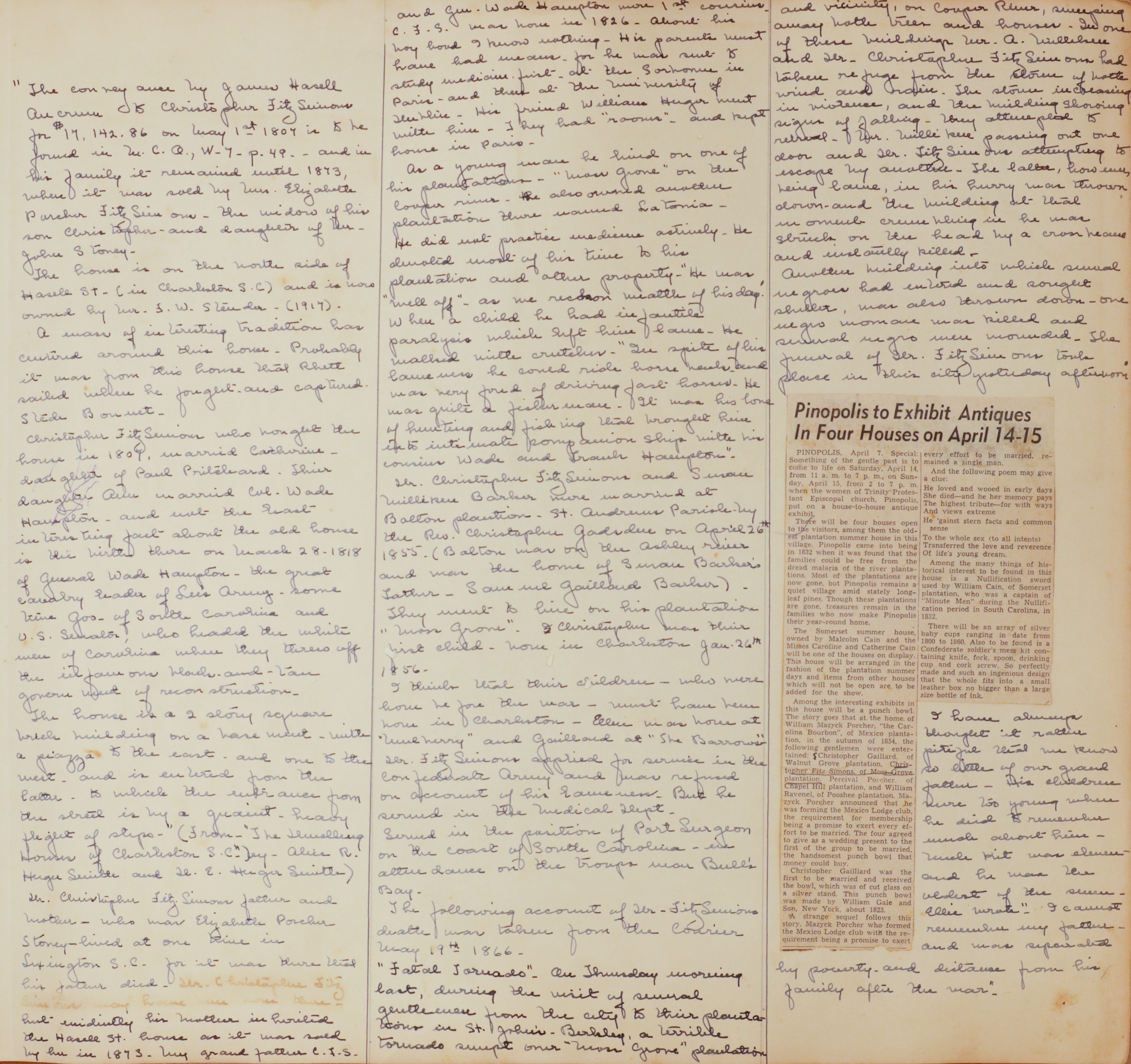
Transcription
Handwritten notes — left column
"The conveyance by James Hasell Ancrum to Christopher Fitz Simons for $17,142.86 on May 1st 1804 is to be found in M.C.O., W-7, p.49 — and in his family it remained until 1873, when it was sold by Mrs. Elizabeth Porcher FitzSimons — the widow of his son Christopher — and daughter of Mr. John Stoney.
The house is on the north side of Hasell St. — (in Charleston S.C.) and is now owned by Mr. S. W. Stender — (1917).
A mass of interesting tradition has centered around this house — Probably it was from this house that Rhett sailed when he fought and captured Stede Bonnet —
Christopher FitzSimons who bought the house in 1804, married Catherine — daughter of Paul Pritchard — Their daughter Ann married Col. Wade Hampton — and not the least interesting fact about the old house is the birth there on March 28, 1818 of General Wade Hampton — the great Cavalry leader of Lee’s Army — sometime Gov. of South Carolina and U.S. Senator, who headed the white men of Carolina when they threw off the infamous Black-and-Tan government of reconstruction —
The house is a 2 story square brick building on a basement — with a piazza to the east — and one to the west — and is entered from the latter — to which the entrance from the street is by a quaint — heavy flight of steps — (From ‘The Dwelling Houses of Charleston S.C.’ by — Alice R. Huger Smith and D. E. Huger Smith.)
Mr. Christopher FitzSimons['s] father and mother — who was Elizabeth Porcher Stoney — lived at one time in Lexington S.C. for it was there that his father died — Mr. Christopher Fitz Simons may have been born there — but evidently his mother inherited the Hasell St. house as it was sold by her in 1873. My grandfather C.F.S."
Handwritten notes — middle column
"C.F.S. was born in 1828 — and of his boyhood I know nothing. His parents must have had means, for he was sent to study medicine — first at the Sorbonne in Paris — and then at the University of Dublin — His friend Williams Huger was with him — they had ‘rooms’ — and a house in Paris.
As a young man he lived on one of his plantations — ‘Moss Grove’ on the Cooper river — He also owned another plantation there named Latonia — He did not practice medicine actively — He devoted most of his time to his plantation and other property — He was ‘well off’ — as we reckon wealth of his [day]. When a child he had infantile paralysis which left him lame — He walked with crutches — ‘In spite of lameness he could ride horseback, was very fond of driving fast horses, was quite a fisherman — It was his [love] of hunting and fishing that brought him into intimate companionship with his cousins Wade and Frank Hampton’ —
Mr. Christopher FitzSimons and Susan Milliken Barker were married at Bolton plantation — St. Andrew’s Parish — [by] the Rev. Christopher Gadsden on April [illegible day], 1855. (Bolton was on the Ashley river and was the home of Susan Barker’s father — Samuel Gaillard Barker.) They went to live on his plantation ‘Moss Grove’. I, Christopher, was their first child — born in Charleston Jan. [26?] 1856 —
[The writer places Bolton plantation on the Ashley river. Other family records describe a Bolton on the Cooper river near Pinopolis; the two may be distinct properties, or the writer’s geography may be in error.]
I think that their children — who were born before the war — must have been born in Charleston — Ellen was born [at] ‘Mulberry’ and Gaillard at ‘The Barrows’ —
Mr. FitzSimons applied for service in the Confederate Army and was refused on account of his lameness — But he served in the Medical Dept. — Served in the position of Port Surgeon on the coast of South Carolina — in attendance on the troops near Bull’s Bay.
The following account of Mr. FitzSimons['s] death was taken from the Courier May 19th 1866 —
‘Fatal Tornado’. On Thursday morning last, during the visit of several gentlemen from the city to their plantations in St. John’s-Berkeley, a terrible tornado swept over ‘Moss Grove’ planta[tion]"
Handwritten notes — right column (above clipping)
"[carrying] away both trees and houses — In one of these buildings Mr. A. Milliken and Mr. Christopher FitzSimons had taken refuge from the storm of both wind and rain. The storm increasing in violence, and the building showing signs of falling — they attempted to retreat — Mr. Milliken passing out one door and Mr. FitzSimons attempting to escape by another. The latter, however, being lame, in his hurry was thrown down — and the building at that moment crashing in he was struck on the head by a cross beam and instantly killed —
Another building into which several negroes had entered and sought shelter, was also thrown down — one negro woman was killed and several negroes were wounded — The funeral of Mr. FitzSimons took place in this city yesterday afternoon"
Newspaper clipping — right side
Pinopolis to Exhibit Antiques
In Four Houses on April 14-15
PINOPOLIS, April 7. Special: Something of the gentle past is to come to life on Saturday, April 14, from 11 a.m. to 7 p.m., on Sunday, April 15, from 2 to 7 p.m. when the women of Trinity Protestant Episcopal church, Pinopolis, put on a house-to-house antique exhibit.
There will be four houses open to the visitors, among them the oldest plantation summer house in this village. Pinopolis came into being in 1832 when it was found that the families could be free from the dread malaria of the river plantations. Most of the plantations are now gone, but Pinopolis remains a quiet village amid stately long-leaf pines. Though these plantations are gone, treasures remain in the families who now make Pinopolis their year-round home.
The Somerset summer house, owned by Malcolm Cain and the Misses Caroline and Catherine Cain will be one of the houses on display. This house will be arranged in the fashion of the plantation summer days and items from other houses which will not be open are to be added for the show.
Among the interesting exhibits in this house will be a punch bowl. The story goes that at the home of William Mazyck Porcher, ‘the Carolina Bourbon’, of Mexico plantation, in the autumn of 1854, the following gentlemen were entertained: Christopher Gaillard, of Walnut Grove plantation, Christopher Fitz-Simons, of Moss-Grove plantation, Percival Porcher, of Chapel Hill plantation, and William Ravenel, of Pooshee plantation. Mazyck Porcher announced that he was forming the Mexico Lodge club, the requirement for membership being a promise to exert every effort to be married. The four agreed to give as a wedding present to the first of the group to be married, the handsomest punch bowl that money could buy.
Christopher Gaillard was the first to be married and received the bowl, which was of cut glass on a silver stand. This punch bowl was made by William Gale and Son, New York, about 1823.
A strange sequel follows this story. Mazyck Porcher who formed the Mexico Lodge club with the requirement being a promise to exert every effort to be married, remained a single man.
And the following poem may give a clue:
He loved and wooed in early days She died — and he her memory pays The highest tribute — for with ways And views extreme He 'gainst stern facts and common sense To the whole sex (to all intents) Transferred the love and reverence Of life’s young dream.
Among the many things of historical interest to be found in this house is a Nullification sword used by William Cain, of Somerset plantation, who was a captain of ‘Minute Men’ during the Nullification period in South Carolina, in 1832.
There will be an array of silver baby cups ranging in date from 1800 to 1860. Also to be found is a Confederate soldier’s mess kit containing knife, fork, spoon, drinking cup and cork screw. So perfectly made and such an ingenious design that the whole fits into a small leather box no bigger than a large size bottle of ink.
Handwritten notes — beside / below clipping (family voice)
“I have always thought it rather pitiful that we know so little of our grandfather — His children were too young when he died to remember much about him — Uncle Kit was eleven and he was the oldest of the seven — Ellie wrote, ‘I cannot remember my father — and was separated by poverty — and distance from his family after the war.’”
AI Notes
Three columns of dense handwritten family-history notes (in the compiler’s hand) on Christopher FitzSimons 2nd (1828–1866), centred on the Hasell Street house in Charleston, his education in Paris and Dublin, his marriage to Susan Milliken Barker, and the tornado that killed him at his Moss Grove plantation on May 17, 1866 (Courier obituary May 19, 1866). A printed clipping pasted at right announces a Pinopolis antiques exhibit organised by the women of Trinity Episcopal church on April 14–15 (undated year, almost certainly 1962). The opening quoted passage is from Alice R. Huger Smith and D. E. Huger Smith, ‘The Dwelling Houses of Charleston, S.C.’