Letter from Sullivan's Island, July 5, 1853 — page 1 (to 'My dear Mollie')
Book 1, Page 254 ·1853–1853
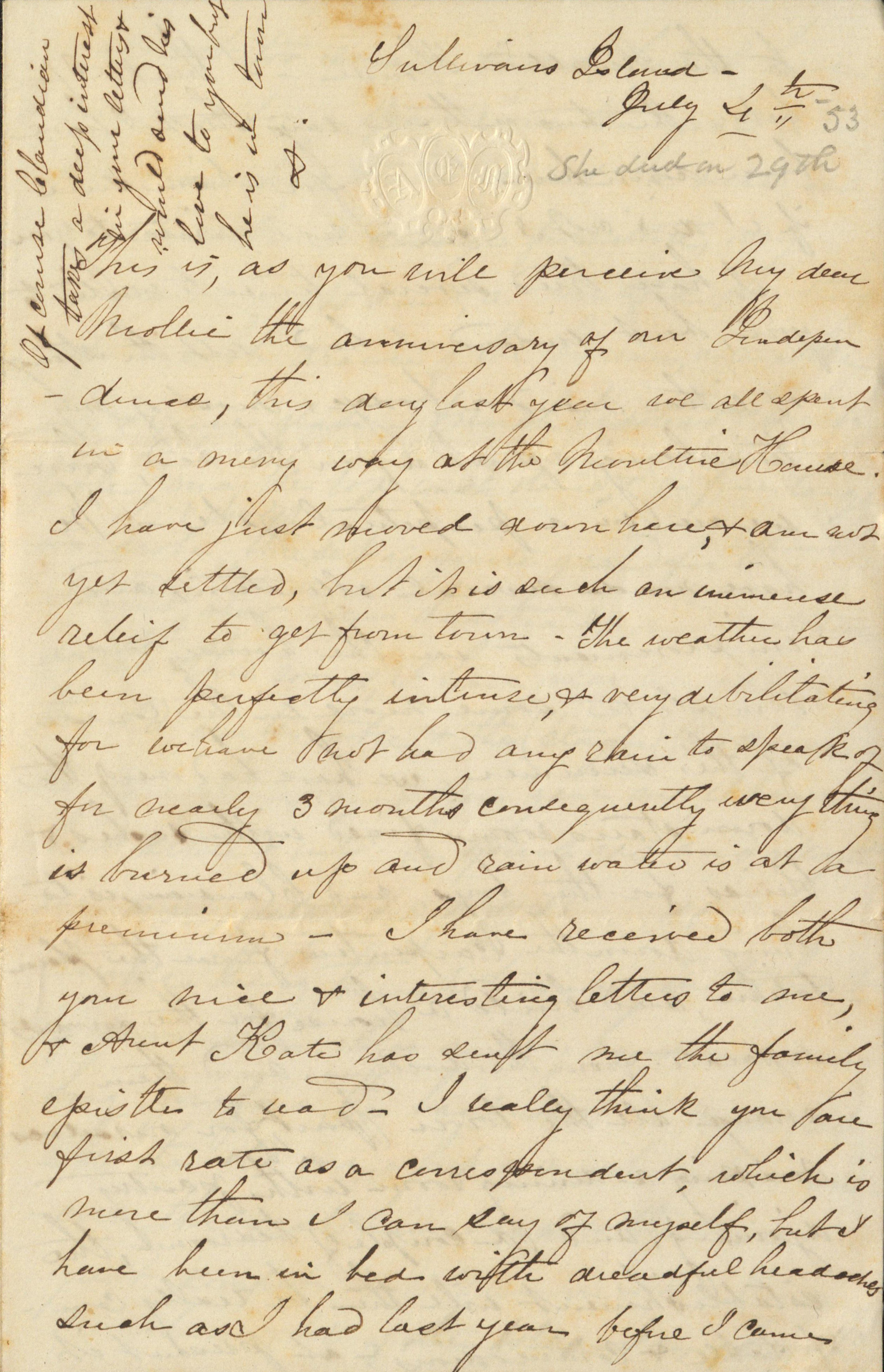
Transcription
[Pencilled annotation in upper right, in the compiler’s hand:] She died on 29th
[Cross-hatched writing in the upper-left margin, running vertically (read by rotating the page 90° clockwise):]
Of course Claudian takes a deep interest in your letters & would send [illegible]
[Main letter text, beginning at top right:]
Sullivans Island — July 5th / 53
This is, as you will perceive My dear Mollie the anniversary of our Indepen- -dence, this day last year we all spent in a merry way at the Moultrie House. I have just moved down here & am not yet settled, but it is such an immense relief to get from town — The weather has been perfectly intense, & very debilitating for we have not had any rain to speak of for nearly 3 months consequently every thing is burned up and rain water is at a premium — I have received both your nice & interesting letters to me, & Aunt Kate has sent me the family epistles to read — I really think you first rate as a correspondent, which is more than I can say of myself, but I have been in bed with dreadful headaches such as I had last year before I came
AI Notes
First page of a multi-page handwritten letter on cream paper with an embossed crest at the top center. Headed ‘Sullivans Island — July 5th / 53’. To the right of the date is a pencilled annotation in the compiler’s hand reading ‘She died on 29th’. A short cross-hatched postscript runs up the top of the left margin (4 lines), referencing ‘Claudian’. The letter addresses ‘My dear Mollie’ and discusses Independence Day, the heat, drought, and family correspondence including a reference to Aunt Kate.
Letter continues on the next scan.
The pencilled “She died on 29th” is the compiler’s later annotation linking this 5 July 1853 letter to its writer’s death later the same month — see the deathbed-account letter on pp. 261-263, which reports a sister’s death “this morning July 29 at the Island.” Sullivan’s Island, just outside Charleston Harbor, was the city’s principal summer resort; the Moultrie House (1850) was its leading hotel, named for the Revolutionary fort just inland.