Mulberry Plantation: brochure, family anecdote, and inventory of related letters
Book 1, Page 233 ·1714–1923
Transcription
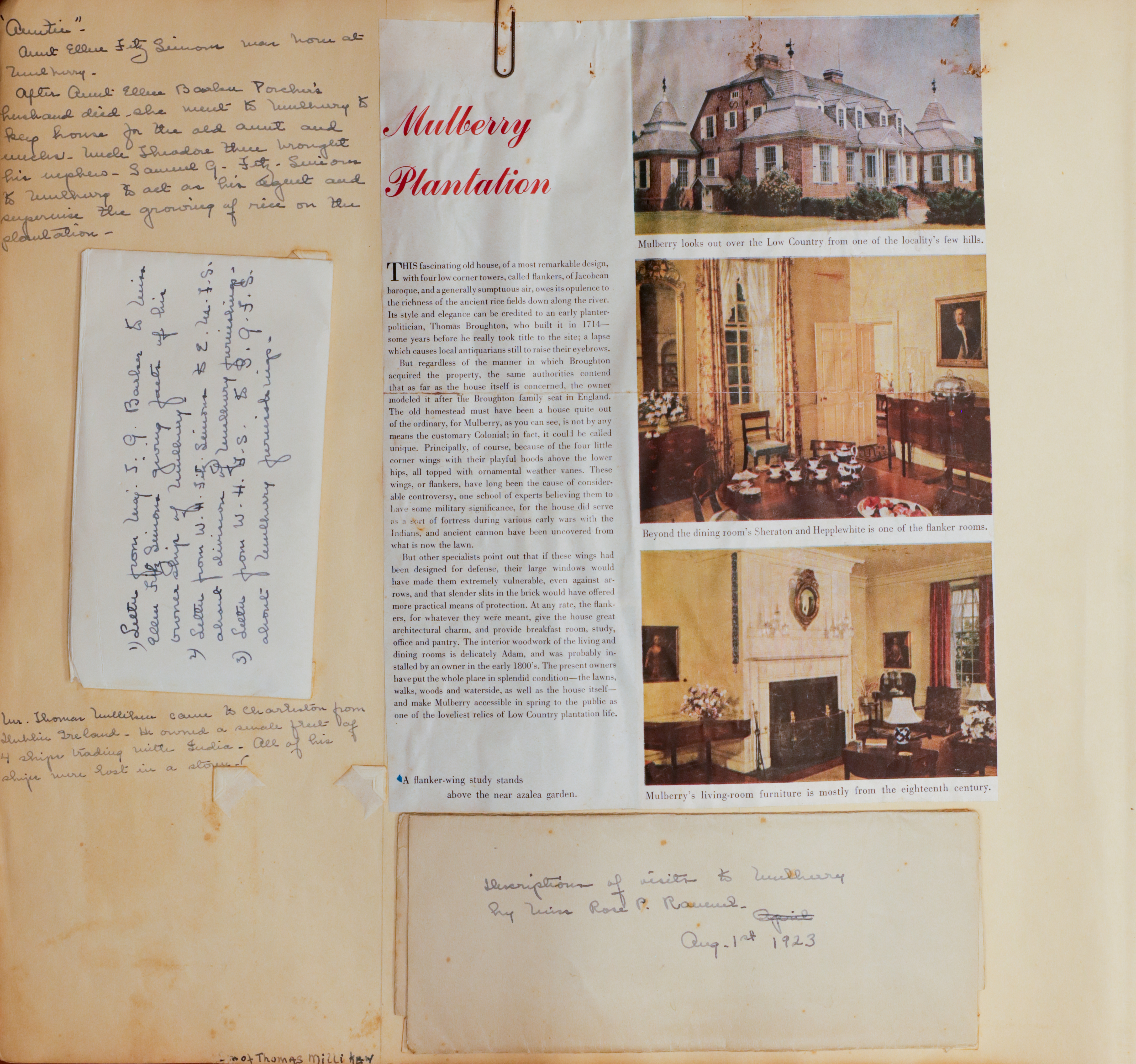
A page with several mounted items: a handwritten note at the upper left, a folded color brochure paper-clipped at center-right, a small white slip beneath the clip (rotated 90 degrees), pencil annotations along the lower-left margin, and a small inscription strip beneath the brochure.
Handwritten anecdote (upper left, blue ink)
“Auntie.”
Aunt Ellen Fitz Simons was born at Mulbery.
After Aunt Ellen Barker Porcher’s husband died, she went to Mulbery to keep house for the old aunt and uncles. Uncle Theodore then brought his nephew — Samuel G. Fitz - Simons to Mulbery to act as his agent and supervise the growing of rice on the plantation —
Brochure (paper-clipped, center-right)
A folded color brochure with red script title and three captioned photographs.
Mulberry Plantation
THIS fascinating old house, of a most remarkable de[sign,] with four low corner towers, called flankers, of Jaco[bean] baroque, and a generally sumptuous air, owes its opulen[ce to] the richness of the ancient rice fields down along the r[iver]. Its style and elegance can be credited to an early pla[nter], politician, Thomas Broughton, who built it in 17[14 —] some years before he really took title to the site; a [lapse] which causes local antiquarians still to raise their eyeb[rows.]
But regardless of the manner in which Brough[ton] acquired the property, the same authorities co[ntend] that as far as the house itself is concerned, the o[wner] modeled it after the Broughton family seat in Eng[land]. The old homestead must have been a house quit[e out] of the ordinary, for Mulberry, as you can see, is not b[y any] means the customary Colonial; in fact, it could be [called] unique. Principally, of course, because of the four [little] corner wings with their playful hoods above the [lower] hips, all topped with ornamental weather vanes. [These] wings, or flankers, have long been the cause of cons[ider]able controversy, one school of experts believing th[ey] have some military significance, for the house did [serve] as a sort of fortress during various early wars wit[h] Indians, and ancient cannon have been uncovered [from] what is now the lawn.
But other specialists point out that if these wing[s had] been designed for defense, their large windows [would] have made them extremely vulnerable, even agai[nst ar]rows, and that slender slits in the brick would have [offered] more practical means of protection. At any rate, the[ flank]ers, for whatever they were meant, give the house [great] architectural charm, and provide breakfast room, [study,] office and pantry. The interior woodwork of the livi[ng and] dining rooms is delicately Adam, and was proba[bly in]stalled by an owner in the early 1800’s. The present [owners] have put the whole place in splendid condition — the [lawns,] walks, woods and waterside, as well as the house i[tself —] and make Mulberry accessible in spring to the pu[blic as] one of the loveliest relics of Low Country plantati[on life.]
Photo captions:
Mulberry looks out over the Low Country from one of the locality’s few hills.
Beyond the dining room’s Sheraton and Hepplewhite is one of the flanker rooms.
Mulberry’s living-room furniture is mostly from the eighteenth century.
◀ A flanker-wing study stands above the near azalea garden.
Small white slip (rotated 90 degrees, beneath the brochure clip)
A numbered list in blue pen on a folded white sheet, the right edges slightly clipped where the brochure overlaps.
- Letter from Maj. S. G. Barker to Ellen Fitz Simons giving facts of ownership of Mulbery
- Letter from W. H. F. S. (Fitz Simons) to E. F. about division of Mulbery furnishings
- Letter from W. H. F. S. to S. G. F. S. about Mulbery furnishings —
Pencil annotation (lower-left margin)
Mr. Thomas Milliken came to Charleston from Dublin Ireland — He owned a small fleet of 4 ships trading with India — All of his ships were lost in a storm —
A separate, fainter pencil note at the very bottom of the page reads:
— not Thomas Milliken
Inscription strip (beneath the brochure)
A small strip of paper pasted beneath the brochure, in pencil:
Description of visits to Mulbery By Miss Rose P. Ravenel —
AprilAug. 1st 1923
AI Notes
A multi-element page. A handwritten anecdote in blue ink about ‘Auntie’ (Aunt Ellen FitzSimons) at Mulberry sits at the upper left. To its right, paper-clipped, is a folded full-color travel brochure titled ‘Mulberry Plantation’ with three photographs (exterior, dining room, living room). Beneath the brochure clip, a small white slip rotated 90 degrees lists three related family letters about Mulberry ownership and furnishings: Maj. S. G. Barker to Ellen FitzSimons; W. H. FitzSimons to E. [Ellen] FitzSimons; W. H. F. S. to S. G. F. S. At the page’s lower-left, a pencil annotation describes Mr. Thomas Milliken of Dublin and his ship-trading career with India; a fainter corrective pencil note at the very bottom reads ‘— not Thomas Milliken’ (a self-correction by the compiler). Below the brochure, a small inscription strip identifies the source: ‘Description of visits to Mulberry / By Miss Rose P. Ravenel — April Aug. 1st 1923’ (April struck through, Aug. 1st 1923 retained).