Handwritten Milliken family narrative with silhouette, concert ticket, and Thomas Milliken portrait
Book 1, Page 226 ·1702–1849
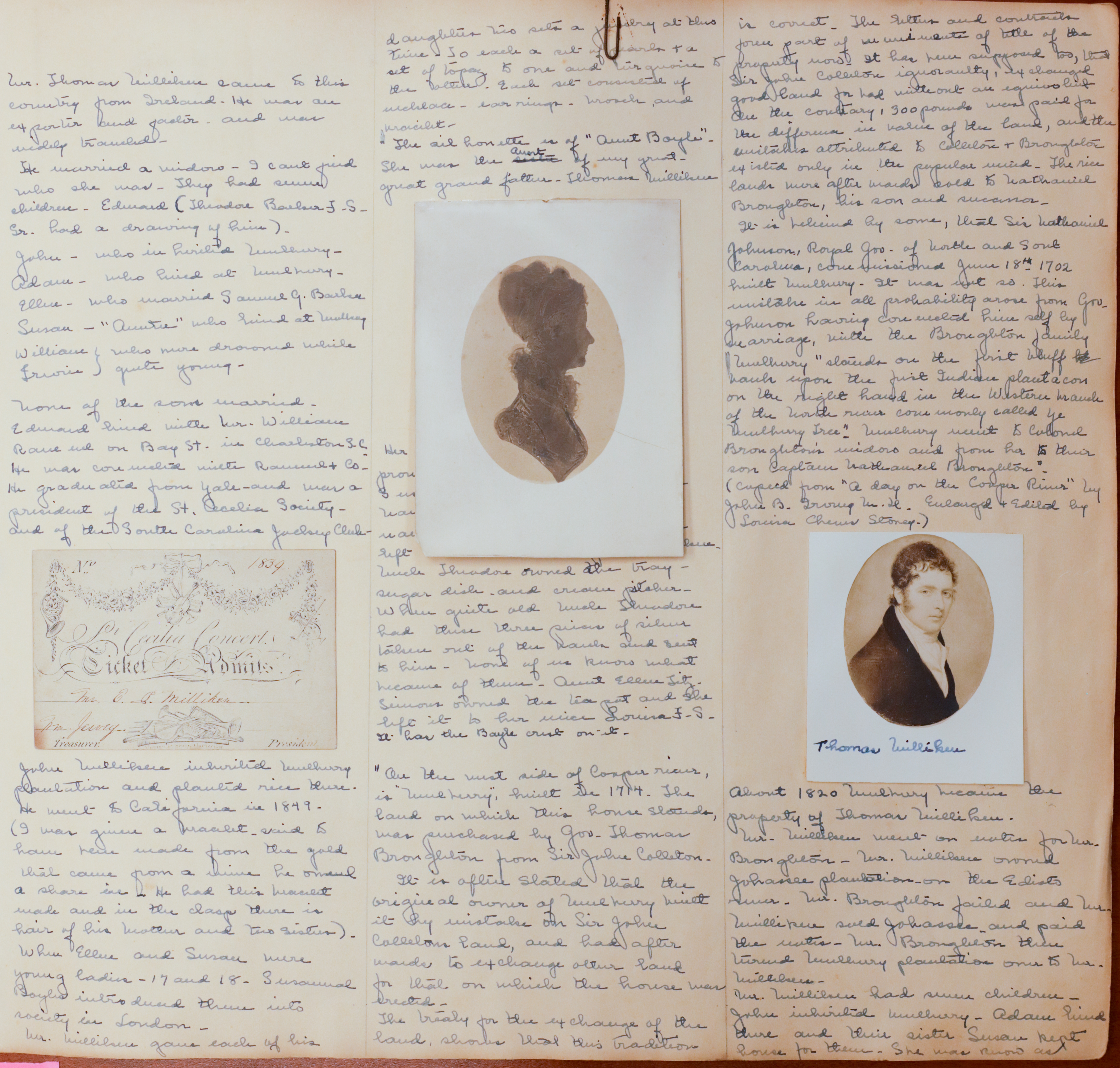
Transcription
The page is densely covered with cursive handwriting in blue ink, arranged in two main columns interrupted by three mounted items: an oval silhouette of a woman (mid-page, slightly left of center), a printed concert ticket (lower left), and a small oval painted portrait of a young man labelled “Thomas Milliken” (upper right, beneath which the narrative continues).
Left column (narrative on Thomas Milliken and his children)
Mr. Thomas Milliken came to this country from Ireland — He was an exporter and packer — and was widely travelled —
He married a widow — I can’t find who she was — They had seven children — Edward (Theodore Barker J. S. Sr. had a drawing of him.) — John — who inherited Mulberry — Adam — who lived at Mulberry — Ellen — who married Samuel G. Barker Susan — “Auntie” who lived at Mulberry William { who were drowned while Irvine { quite young —
None of the sons married — Edward lived with Mr. William Ravenel on Bay St. in Charleston S.C. He was connected with Ravenel + Co. He graduated from Yale — and was a president of the St. Cecilia Society — and of the South Carolina Jockey Club —
[A printed concert ticket is mounted here, in engraved 19th-century script with ornamental garlands, musical instruments, and a small mid-vignette of horns and a sword:]
No. 1839
La Cecilia Concert.
Ticket to Admit
Mr. E. P. Milliken
Mr. Jeavey Treasurer. … President.
John Milliken inherited Mulberry plantation and planted rice there — He went to California in 1849 — (I was given a bracelet — said to have been made from the gold that came from a mine he owned a share in — He had this bracelet made and in the clasp there is hair of his Mother and two sisters) — When Ellen and Susan were young ladies — 17 and 18 — Susannah Boyle introduced them into society in London — Mr. Milliken gave each of his
Middle column (continuation, around the silhouette)
daughters two sets of jewelry at this time — To each a set of pearls + a set of topaz to one and turquoise to the other — Each set consisted of necklace — earrings — brooch, and bracelet —
"The silhouette is of “Aunt Boyle” — She was the
sisteraunt of my great- great grand father — Thomas Milliken
[Mounted: oval silhouette portrait of a woman in profile facing right, with elaborate hair piled high.]
Uncle Theodore owned the tray — sugar dish — and cream pitcher — When quite old Uncle Theodore had these three pieces of silver taken out of the bank and sent to him — None of us know what became of them — Aunt Ellen Fitz- Simons owned the tea pot and she left it to her niece Louisa F. S. — It has the Boyle crest on it —
Right column (history of Mulberry, copied passage)
"On the west side of Cooper river, is “Mulberry”, built De 1714. The land on which this house stands, was purchased by Gov. Thomas Broughton from Sir John Colleton —
It is often stated that the original owner of Mulberry built it by mistake on Sir John Colletons land, and had after wards to exchange other land for that on which the house was erected — The treaty for the exchange of the land, shows that this tradition is correct — The letters and contents form part of [muniments] of title of the property now. It has been supposed too, that Sir John Colleton ignorantly, exchanged good land for bad without an equivalent — On the contrary, 1300 pounds were paid for the difference in value of the land, and the mistakes attributed to Colleton + Broughton existed only in the popular mind — The rice lands were afterwards sold to Nathaniel Broughton, his son and successor —
It is believed by some, that Sir Nathaniel Johnson, Royal Gov. of North and South Carolina, commissioned June 18th 1702 built Mulberry — It was not so. This mistake in all probability arose from Gov. Johnson having connected him self by marriage, with the Broughton family “Mulberry” stands on the first bluff to bank upon the first Indian planta’con on the right hand in the Western branch of the North river commonly called Ye “Mulberry Tree”. Mulberry went to Colonel Broughton’s widow and from her to their son Captain Nathaniel Broughton." (Copied from “A day on the Cooper River” by John B. Irving Jr. R. — Enlarged & Edited by Louisa Cheves Stoney —)
[Mounted at upper right: small oval painted portrait of a young man with curly dark hair in early-19th-century dress, captioned in blue ink beneath:]
Thomas Milliken
About 1820 Mulberry became the property of Thomas Milliken. Mr. Milliken went on notes for Mr. Broughton — Mr. Milliken owned Johassee plantation — on the Edisto river — Mr. Broughton failed and Mr. Milliken sued Johassee — and paid the notes — Mr. Broughton then turned Mulberry plantation over to Mr. Milliken — Mr. Milliken had seven children — John inherited Mulberry — Adam lived there and their sister Susan kept house for them — She was known as
AI Notes
Densely written page in blue cursive with three mounted items: an oval silhouette of a woman (identified in the text as ‘Aunt Boyle’), a printed La Cecilia Concert ticket made out to Mr. E. P. Milliken (No. 1839, signed by Mr. Jeavey Treasurer), and a small oval portrait labelled ‘Thomas Milliken’. Text gives a Milliken family narrative (Thomas Milliken’s emigration from Ireland, his children including Ellen Milliken who married Samuel G. Barker, John Milliken’s inheritance of Mulberry plantation, John Milliken’s trip to California in 1849), a description of jewelry given to daughters (each receiving a set of pearls plus either topaz or turquoise), and a long passage on the history of Mulberry plantation copied from ‘A day on the Cooper River’ by John B. Irving Jr., enlarged and edited by Louisa Cheves Stoney. The tea pot bears the Boyle crest (matching the Aunt Boyle silhouette); Edward Milliken’s ticket is for the St. Cecilia Society, of which he was president.
The page narrative cuts off at the lower-right edge mid-sentence. The completion (“Auntie”) appears earlier on the page itself in the left column and is also picked up on p233’s “Auntie” anecdote.
Mulberry Plantation, the four-flanker brick manor that Lt. Gov. Thomas Broughton built on the West Branch of the Cooper c. 1714, is the oldest surviving exposed-brick manor house in the Carolinas and Georgia. Thomas Milliken’s c. 1820 acquisition opens the album’s Milliken–Barker–FitzSimons line of descent in the house: from Milliken to his son John, to John’s sister Susan and her son Theodore Gaillard Barker (compiler’s great-uncle), who sold it out of the family in 1915. Edward P. Milliken’s St. Cecilia Society presidency places him at the head of the oldest musical society in continuous operation in the U.S. (founded Charleston 1766).