Mulberry Castle: typescript memorandum (Apr 5 1959) on the Broughton-Milliken-Barker descent of the plantation
Book 1, Page 219 ·1714–1959
Transcription
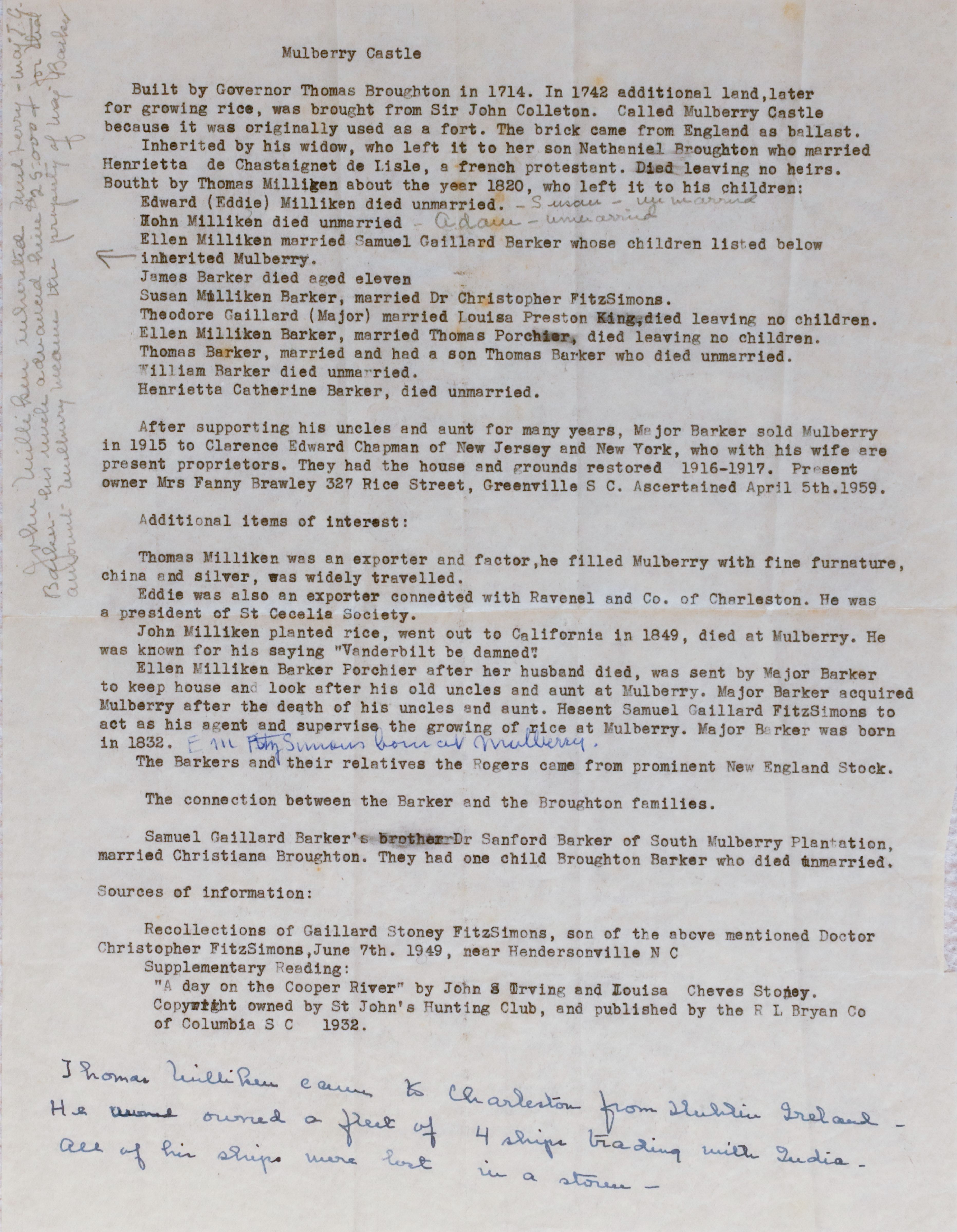
A typewritten memorandum sheet headed Mulberry Castle, compiled from a 1949 interview with Dr. Gaillard Stoney FitzSimons and supplemented from John B. Irving’s A Day on the Cooper River. A pencilled annotation runs vertically up the left margin (rotated 90° from the typescript). A second handwritten cursive note appears at the foot of the sheet.
[Pencilled annotation in cursive along the left margin, rotated 90° anticlockwise — pointing into the body of the typescript with an arrow at “Ellen Milliken married Samuel Gaillard Barker”]: Milliken inherited Mulberry — Maj. T. G. — his uncle advanced him $25,000 + for that — Mulberry became the property of Maj. Barker
Mulberry Castle
Built by Governor Thomas Broughton in 1714. In 1742 additional land, later for growing rice, was brought from Sir John Colleton. Called Mulberry Castle because it was originally used as a fort. The brick came from England as ballast.
Inherited by his widow, who left it to her son Nathaniel Broughton who married Henrietta de Chastaignet de Lisle, a french protestant. Died leaving no heirs.
Boutht [sic] by Thomas Milliken about the year 1820, who left it to his children:
Edward (Eddie) Milliken died unmarried.
John Milliken died unmarried [handwritten interlinear correction: A clear — unmarried]
Ellen Milliken married Samuel Gaillard Barker whose children listed below inherited Mulberry.
James Barker died aged eleven
Susan Milliken Barker, married Dr Christopher FitzSimons.
Theodore Gaillard (Major) married Louisa Preston King, died leaving no children.
Ellen Milliken Barker, married Thomas Porchier [sic], died leaving no children.
Thomas Barker, married and had a son Thomas Barker who died unmarried.
William Barker died unmarried.
Henrietta Catherine Barker, died unmarried.
After supporting his uncles and aunt for many years, Major Barker sold Mulberry in 1915 to Clarence Edward Chapman of New Jersey and New York, who with his wife are present proprietors. They had the house and grounds restored 1916–1917. Present owner Mrs Fanny Brawley 327 Pine Street, Greenville S C. Ascertained April 5th 1959.
Additional items of interest:
Thomas Milliken was an exporter and factor, he filled Mulberry with fine furniture, china and silver, was widely travelled.
Eddie was also an exporter connected with Ravenel and Co. of Charleston. He was a president of St Cecelia Society.
John Milliken planted rice, went out to California in 1849, died at Mulberry. He was known for his saying “Vanderbilt be damned!”
Ellen Milliken Barker Porchier after her husband died, was sent by Major Barker to keep house and look after his old uncles and aunt at Mulberry. Major Barker acquired Mulberry after the death of his uncles and aunt. Hasent [sic; probably ‘He sent’] Samuel Gaillard FitzSimons to act as his agent and supervise the growing of rice at Mulberry. Major Barker was born in 1832. [Handwritten cursive insertion in ink:] F. see Fitz Simons born at Mulberry.
The Barkers and their relatives the Porchers come from prominent New England Stock.
The connection between the Barker and the Broughton families.
Samuel Gaillard Barker’s [strike-through: Brother] Dr Sanford Barker of South Mulberry Plantation, married Christiana Broughton. They had one child Broughton Barker who died unmarried.
Sources of information:
Recollections of Gaillard Stoney FitzSimons, son of the above mentioned Doctor Christopher FitzSimons, June 7th 1949, near Hendersonville N C
Supplementary Reading:
“A day on the Cooper River” by John B Irving and Louisa Cheves Stoney. Copyright owned by St John’s Hunting Club, and published by the R L Bryan Co of Columbia S C 1932.
[Cursive pencil note at the foot of the sheet:]
Thomas Milliken came to Charleston from Dublin Ireland — He [strikeout] owned a fleet of 4 ships trading with India. all of his ships were lost in a storm —
AI Notes
Typewritten memorandum titled ‘Mulberry Castle’ on the descent and ownership of the plantation, dated ‘Ascertained April 5th 1959,’ compiled from a June 7, 1949 interview with Gaillard Stoney FitzSimons (Amy Walker’s father) near Hendersonville NC, and supplemented from John B. Irving’s A Day on the Cooper River (enlarged by Louisa Cheves Stoney, 1932, R.L. Bryan Co.). A handwritten cursive annotation in pencil runs vertically up the left margin (rotated 90° from the typescript); a second handwritten cursive note in pencil appears at the foot of the page. The left-margin pencil annotation reads (rotated): ‘Milliken inherited Mulberry — Maj. T. G. — his uncle advanced him $25,000 + for that — Mulberry became the property of Maj. Barker.’ The bottom cursive note reads: ‘Thomas Milliken came to Charleston from Dublin Ireland — He owned a fleet of 4 ships trading with India. all of his ships were lost in a storm —’ The margin annotation’s ‘Maj. T. G.’ is Theodore Gaillard Barker. Thomas Milliken’s Irish origin is given here as Dublin, where the related family tree on p. 220 says Belfast. The 1949 interviewee Gaillard Stoney FitzSimons is the same ‘Gaillie’ who wrote the Aug 8 1944 letter on p. 280 — his testimony is the direct source for this memorandum.
The marginal annotation’s “Maj. T. G.” is Theodore Gaillard Barker, who in 1915 sold Mulberry to Clarence Edward Chapman. The interview-source Gaillard Stoney FitzSimons (1864–1949) is “Gaillie” of pp. 283–286 and the writer of p. 280; he is the compiler Amy Walker’s father. The bottom cursive note differs from the family tree on p. 220, which places Thomas Milliken’s origin in Belfast; this Dublin attribution may be a later (and possibly less reliable) recollection.
Mulberry Plantation sits on a bluff above the west branch of the Cooper River, about three miles south of Moncks Corner in Berkeley County. Built c. 1711–1714 for Thomas Broughton — Indian trader, planter, and later Royal Governor of South Carolina (1735–1737) — it is the oldest surviving exposed-brick manor house in the Carolinas and Georgia, of mixed Jacobean / Anglo-Dutch baroque character; it is on the National Register of Historic Places and survives today as a private residence.