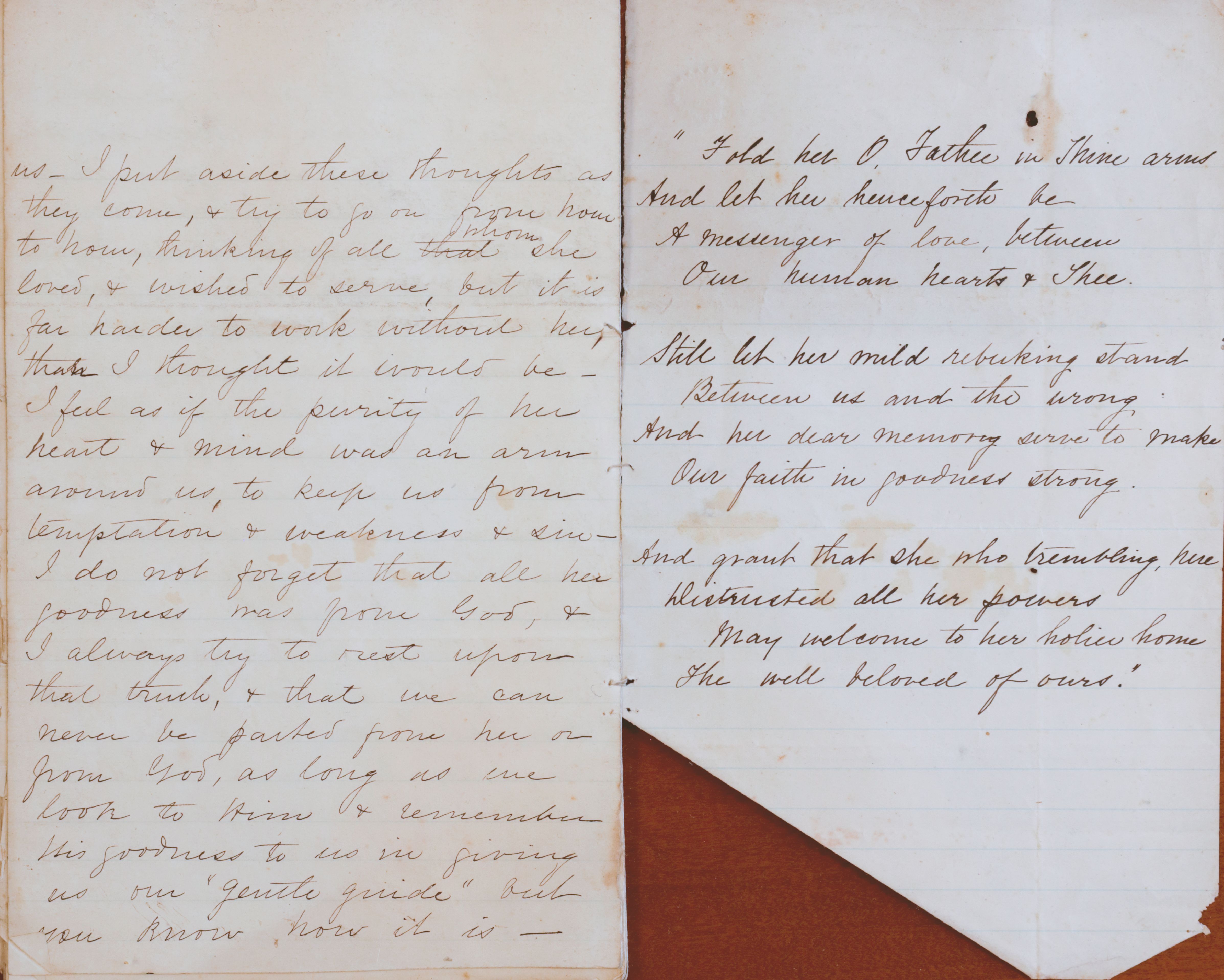
Handwritten letter, continuation: 'us — I put aside these thoughts as they come', closing with a verse
Book 1, Page 159 ·1874
Transcription
An open-book scan showing two leaves of a handwritten letter in brown ink on lined paper, a continuation from the previous page. The left leaf is fully written; the right leaf carries only a verse and ends partway down the page.
Left column
us — I put aside these thoughts as they come, & try to go on from hour to hour, thinking of all
that^whom she loved, & wished to serve, but it is far harder to work without her than I thought it would be — I feel as if the purity of her heart & mind was an arm around us, to keep us from temptation & weakness & sin — I do not forget that all her goodness was from God, & I always try to rest upon that truth, & that we can never be parted from her or from God, as long as we look to Him & remember His goodness to us in giving us our “gentle guide” but you know how it is —
Right column — copied verse (three stanzas)
The closing of John Greenleaf Whittier’s elegy “Gone” (1845), written for his sister Mary; here copied by the writer as a benediction for her own mother.
"Fold her O. Father in Thine arms And let her henceforth be A messenger of love, between Our human hearts & Thee.
Still let her mild rebuking stand Between us and the wrong, And her dear memory serve to make Our faith in goodness strong.
And grant that she who trembling here Distrusted all her powers May welcome to her holier home The well beloved of ours."
AI Notes
An open-book scan continuing the handwritten letter from p158. Part of the 1874 Barker family death cluster — dying Mother = Ellen Milliken Barker (1807–1874), writer = Susan Milliken Barker (her daughter), recipient = her sister Ellen Milliken Barker Porcher. The left leaf carries the writer’s reflection on resting in God after the loss of Mother, including an interlinear caret correction in which the writer struck through ‘that’ and wrote ‘^whom’ above it (‘thinking of all that ^whom she loved’). The right leaf ends partway down the page with a copied verse in three stanzas beginning ‘Fold her O. Father in Thine arms’. The verse is the closing of John Greenleaf Whittier’s elegy ‘Gone’ (1845) — an elegy for his sister Mary — which the writer has copied out as a closing benediction for her own mother.