End of one letter; new letter dated 'Charleston / Monday / June 22[nd]', 1874
Book 1, Page 157 ·1874
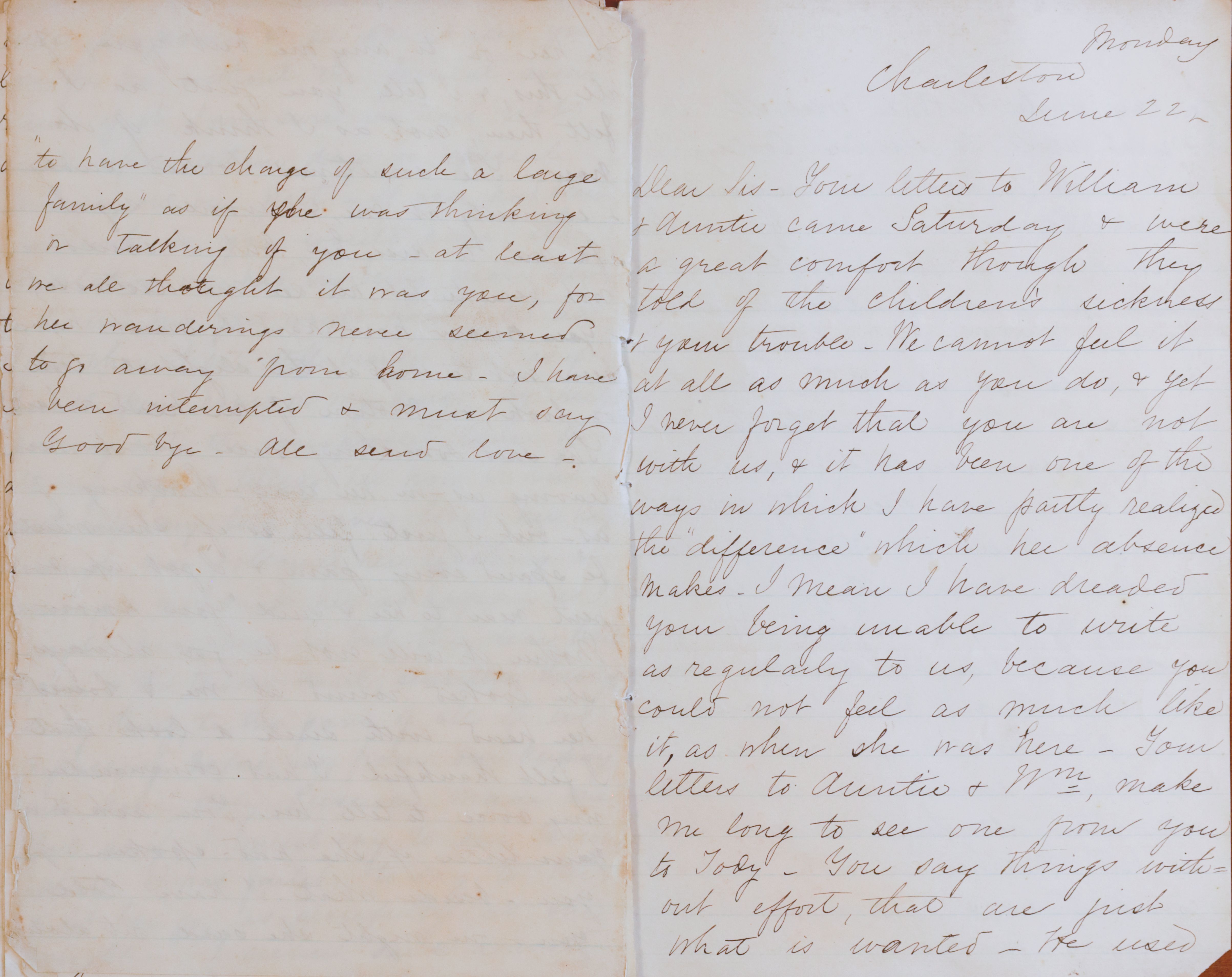
Transcription
An open-book scan showing two leaves of a handwritten letter in brown ink on lined paper. The left leaf carries only a few short lines at the upper portion, closing one letter; the right leaf opens a fresh letter with a Charleston dateline.
Left leaf
“to have the charge of such a large family” as if she was thinking or talking of you — at least we all thought it was you, for her wanderings never seemed to go away from home. — I have been interrupted & must say Good bye. All send love —
Right leaf
Charleston
Monday
June 22[nd]
Dear Sis, Your letters to William & Auntie came Saturday & were a great comfort, though they told of the children’s sickness & your trouble. We cannot feel it at all as much as you do, & yet I never forget that you are not with us, & it has been one of the ways in which I have partly realized “the difference” which her absence makes. I mean I have dreaded you being unable to write as regularly to us, because you could not feel as much like it, as when she was here — Your letters to Auntie & W*[m]* make me long to see one from you to Tody — You say things without effort, that are just what is wanted — He used
AI Notes
An open-book scan. The left leaf carries the final lines of one letter — closing ‘I have been interrupted & must say Good bye. All send love.’ — describing Mother’s wandering speech ‘as if she was thinking or talking of you,’ i.e. of the recipient Sis (Ellen Milliken Barker Porcher). The right leaf opens a NEW letter dated ‘Charleston / Monday / June 22[nd]’ (no year, but June 22 1874 was a Monday and the letter belongs squarely in the 1874 Barker death cluster — two days after the Saturday June 20 funeral). The new letter is addressed ‘Dear Sis,’ acknowledging letters from the recipient to William and ‘Auntie’ that arrived Saturday — Auntie is the writer’s sister-in-law Susan Milliken Barker FitzSimons. The writer says she longs to see a letter from Sis to Tody (Theodore Gaillard Barker), praising her gift of writing ‘just what is wanted.’
Letter continues on next page.