Letter from William (Buck Hill P.O., Va., Nov. 26/95) to 'Dear Kate' (page 2 — 'Miss Grundy' and the late Phil)
Book 1, Page 129 ·1895
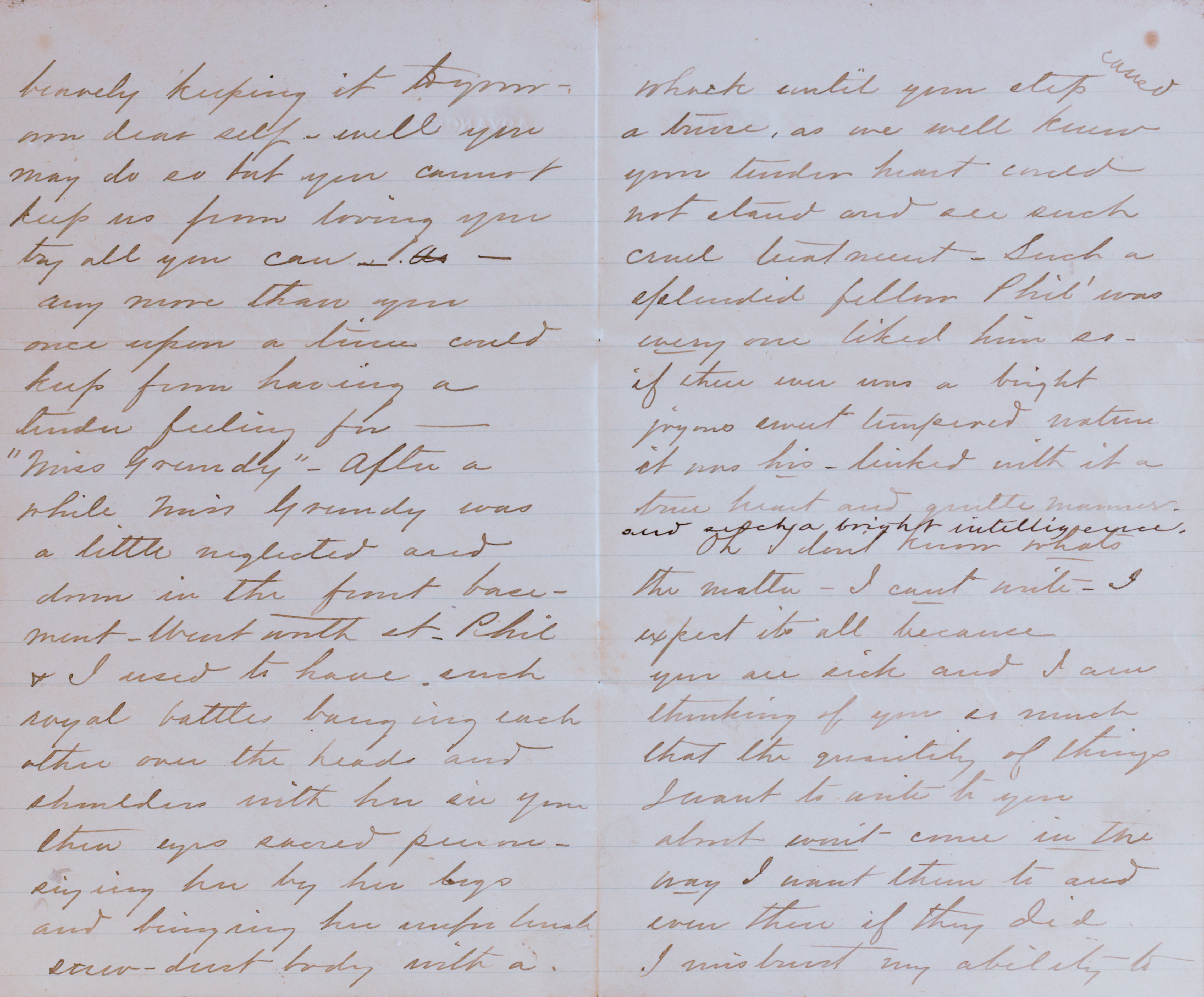
Transcription
A handwritten letter, page 2 of multiple, in brown ink. The leaf is photographed open as a two-column spread (left column then right column). A small caret-inserted word (‘caved’) appears at the top of the right column; a struck-through phrase appears mid right-column.
Left column
bravely keeping it to your- / own dear self — well you / may do so but you cannot / keep us from loving you / try all you can — I do — / any more than you / once upon a time could / keep from having a / tender feeling for / “Miss Grundy.” — After a / while Miss Grundy was / a little neglected and / down in the front base- / ment — [strike-through: Went with] at. Phil / & I used to have. such / royal battles banging each / other over the head and / shoulders with her in your / their eyes scared per-son- / -ifying her by her boys / and bringing her unprotected / saw-dust body with a
Right column
Whack until you step [caret-inserted: ^caved] / a knee. as we well knew / your tender heart could / not stand and see such / cruel treatment — Such a / splendid fellow Phil’ was / every one liked him so. / if there ever was a bright / joyous sweet tempered nature / it was his. — linked with it a / true heart and gentle manners. /
and a yet yaa bright intelligence. / Oh I dont know whats / the matter — I cant write — I / expect its all because / you are sick and I am / thinking of you as much / that the quantity of things / I want to write to you / about wont come in the / way I want them to and / even there if they did / I mistrust my ability to
AI Notes
Page 2 of a multi-page handwritten letter in brown ink — same hand and same Buck Hill P.O., Va., Nov. 26/95 letter to ‘Dear Kate’ that opens on p. 128 and is signed ‘William’ on p. 130 (squeezed sideways in the upper-left). The page is photographed open as a two-column spread (left column then right column). A small caret-inserted word (‘caved’) appears at the top of the right column; a phrase mid right-column (‘and a yet ya’ or similar) is struck through. The writer recalls childhood ‘royal battles’ over the doll ‘Miss Grundy’ — after a while she was neglected and down in the front basement, and William and Phil used to have such battles banging each other over the head and shoulders with her, persons making her their boys (i.e. using her as a weapon as boys would), bringing her unprotected sawdust body with a whack until they stepped a knee caved, as the recipient’s tender heart could not stand to see such cruel treatment. He then turns to praise of the late Phil (‘Such a splendid fellow Phil’ was, every one liked him so. If there ever was a bright joyous sweet tempered nature it was his — linked with it a true heart and gentle manners. — a bright intelligence.') and laments his inability to write what he wants (‘Oh I dont know whats the matter — I cant write — I expect its all because you are sick and I am thinking of you as much that the quantity of things I want to write to you about wont come in the way I want them to’). Letter continues onto p. 130. The recipient ‘Kate’ is Henrietta Catherine (‘Kate’) Barker (named at the head of p. 128 as ‘Miss H. C. Barker’); the writer ‘William’ (signed on p. 130) — likely William Barker, her brother (per the Mulberry Castle family list on p. 219 / family tree p. 220). ‘Phil’ (here ‘the late Phil’) is a third sibling or close family member; the writer recalls his death affectionately. ‘Buck Hill P.O.’ is in Hanover County, Va.
Letter continues on p. 130 with closing signed ‘William’ written sideways into the upper-left margin. ‘Miss Grundy’ is the name of a sawdust-bodied doll the writer and Phil used as a weapon in childhood mock-battles — the comic affection of the passage masks an undertone of mourning for Phil (‘Such a splendid fellow Phil’ was, every one liked him so’).