Handwritten letter fragments, close of one letter signed E.B. and opening of another
Book 1, Page 119
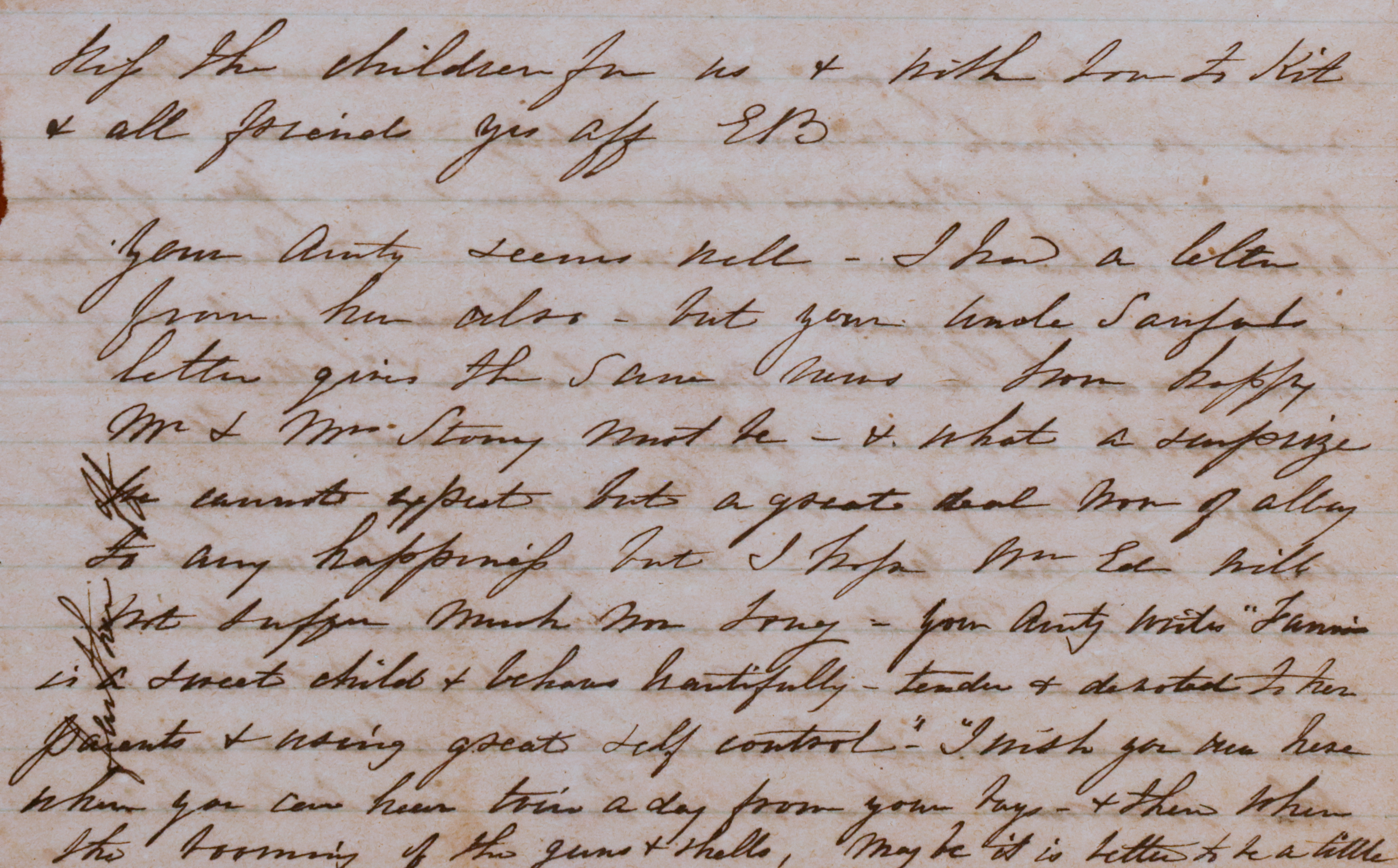
Transcription
Two handwritten letter fragments in brown ink on lined paper. The upper fragment is the closing two lines of a letter, ending in an initialed signature. Below a blank space, a longer fragment in the same hand opens a new section. A struck-through phrase appears mid-paragraph in the lower fragment.
[ki]ss the children for us & with love to Kit & all friends Yrs aff E.B.
Your Aunty seems well — I had a letter from her also — but your Uncle Sanford’s letter gives the same news. — How happy Mr & Mrs Stoney must be — & what a surprise
we cannot expectbut a great deal more of alloy to any happiness but I hope Mr Ed will not suffer much Mrs Stoney — Your Aunty writes “Fannie is a sweet child & behaves beautifully — tender & devoted to her parents & using great self control.” — I wish you were here when you can hear twice a day from your boys — & then when the booming of the guns & shells, Maybe it is better to be a little
AI Notes
Two handwritten letter fragments in brown ink on lined paper, photographed on the same page. The upper fragment (two lines) is the close of a letter, ending with the writer’s love and the initialed signature ‘E.B.’ — Ellen Milliken Barker, writing to her daughter Susan. The lower fragment (the body of the page) opens a new paragraph reporting news from ‘your Aunty’ and from ‘your Uncle Sanford,’ rejoicing for Mr. & Mrs. Stoney while hoping Mr. Ed will not suffer much. The Aunty’s quoted praise of ‘Fannie’ for being a sweet, self-controlled child is given. The closing lines mention hearing twice a day from ‘your boys’ and the booming of guns and shells — strongly suggesting wartime Charleston. A struck-through phrase ‘we cannot expect’ appears mid-page.
Letter continues on next page. The signature “E.B.” matches Ellen Milliken Barker (1807–1874), Susan’s mother, who signs in the same hand on p117. “Uncle Sanford” is most likely Sanford N. (or Sandford William) Barker — the Sanford named in the marriage notice on p120 — Susan’s uncle by blood. The booming of guns and shells points to Civil War Charleston, ca. 1863–1865.