Handwritten letter from Greenville (page 2)
Book 1, Page 110 ·1862–1864
Transcription
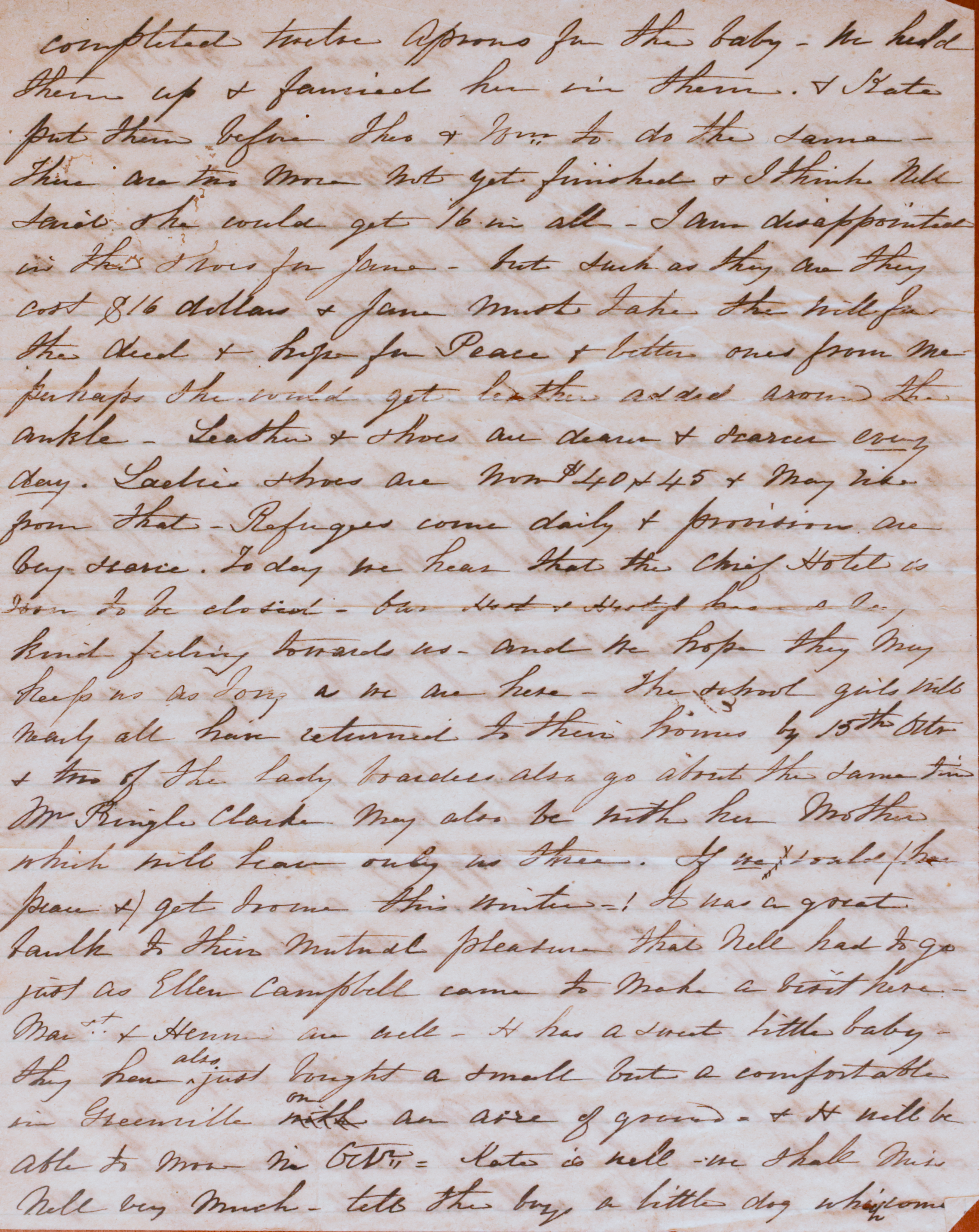
A handwritten letter, page 2 of multiple, in brown ink on aged paper. Same hand as the preceding page.
completed twelve aprons for the baby — we hold them up & fancied her in them. & Kate put them before Theo & Wm to do the Same — There are two More not yet finished & I think Nell Said she would get to in all — I am disappointed in that I sent for Jane — but Such as they are they cost $16 dollars & Jane Must take the [will?] for the [dust?] & hope for Peace & better ones from me perhaps She would get leather added round the ankle. — Leather & shoes are dear & scarce every day. Ladies shoes are now $40 & $45 & May rise from that — Refugees come daily & provisions are very scarce. To day we hear that the Chief Hotel is soon to be closed — bar [yard?] & Hostly [hone?] — a very kind feeling towards us — and we hope they May Keep us as long as we are here — The school girls will nearly all have returned to their homes by 15th Octr. & two of the lady boarders also go about the same time Mr Pringle Clarke May also be with her Mother which will leave only us three. — If we [should be?] [snow bound?] this winter! — It was a great fault to their Mutual pleasure that Nell had to go just as Ellen Campbell came to Make a visit here. Mart. & Henne are well. — H. has a sweet little baby they have also just bought a small but a comfortable in Greenville with an acre of ground — & H will be able to Move in Octr. = Kate is well — we shall Miss Nell very much — tell the boys a little dog whippoor-
AI Notes
Page 2 of the multi-page handwritten letter begun on page 109, in the same brown ink and sloping hand. The writer continues with news of completed baby aprons (made with Kate, to be passed to Theo & Wm), wartime shoe prices ($40–$45 for ladies’ shoes), refugees arriving daily, the impending closure of the Chief Hotel, school girls returning home by 15 October, lady boarders leaving, and Nell’s purchase of a small comfortable house with an acre of ground in Greenville. Confederate-era inflation pricing and the influx of refugees place this letter in Civil War Charleston/Greenville (1862–1864). Letter continues onto subsequent pages.
Letter continues on next page.
The $40–$45 ladies’ shoes and “leather & shoes are dear & scarce every day” lines reflect Confederate inflation, which by autumn 1863 had pushed prices roughly 15× their 1861 levels and was driving the Lowcountry refugee economy in towns like Greenville and Walhalla.