Letter from Walhalla, 1 June 1864 (page 1)
Book 1, Page 93 ·1864
Transcription
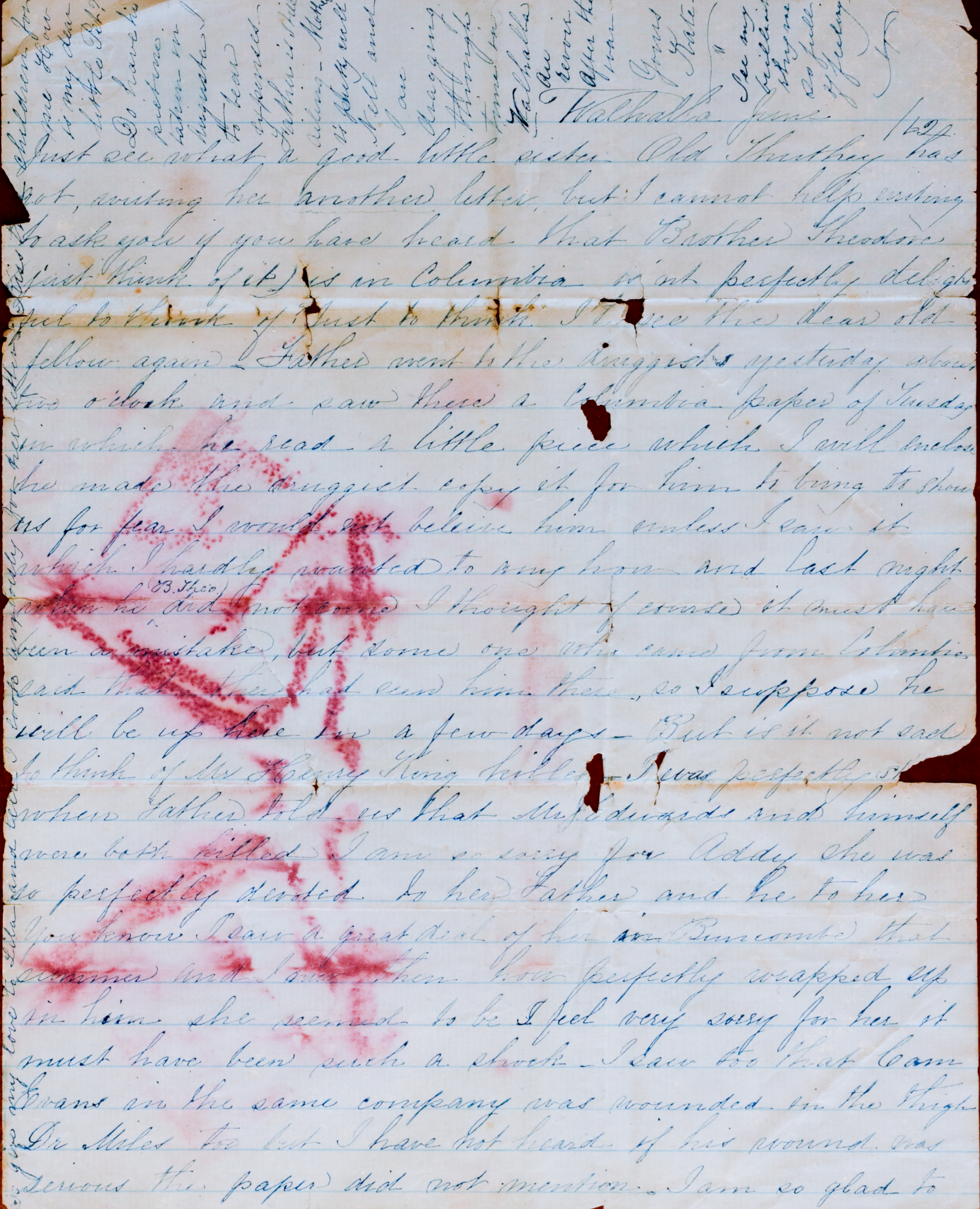
A handwritten letter, page 1, on light paper. Blue ink in a flowing cursive. The upper margin carries a perpendicular postscript that closes the letter (the body itself continues onto p094 and ends mid-sentence). Large irregular pinkish-red stains spread across the middle and lower-left portions of the page, obscuring portions of several lines.
Body (horizontal)
Walhalla June 1st
Just see what a good little sister Old Theophy has got, writing her brother [a] letter, but I cannot help [stopping] to ask you if you have heard what Brother Theodore [is doing]. Just think of it! [He] is in Columbia. Is’nt [it] perfectly delightful — just to think of [seeing] the dear old fellow again. Father went to the druggist’s yesterday afternoon at two o’clock and saw there a Columbia paper of Tuesday, in which he read a little piece which I will make the druggist copy off for him to bring to show us — for fear I would not believe him unless I saw it myself. [I] hardly wanted [him] to [come/go home] and last night [when] he did not come I thought of course it must have been a mistake — but someone who came from Columbia said that he had seen him there, so I suppose he will be up here in a few days. But is it not sad to think of Mr. Henry King killed! I was perfectly [stunned] when Father told us that Mr. Dewees and himself were both killed. I am so sorry for Addy — she was so perfectly devoted to her Father, and he to her. You know I saw a great deal of her in Buncombe that summer and I saw them — how perfectly wrapped up in him she seemed to be. I feel very sorry for her, it must have been such a shock. I saw too that Cam Evans, in the same company, was wounded in the thigh; Dr. Miles too, but I have not heard if his wound was serious — the paper did not mention. I am so glad to
Top-margin postscript (perpendicular cross-writing)
[Read with the page rotated 90° clockwise. A substantial closing postscript written by the same hand across the top margin, perpendicular to the body — likely added after the body filled both sheets.]
[send up the?] children for me. How is my dear little Pet? Do have his picture taken in Augusta — I to bear expenses. Father is still ailing — Mother is pretty well. Nell and I are dragging through time in Walhalla. Au revoir — after the war. Yours, Kate.
See my brilliant rhyme so full of feeling.
AI Notes
First page of a letter from Walhalla, S.C., datelined ‘Walhalla June 1st.’ Blue ink in flowing cursive. The upper margin carries a perpendicular postscript signed ‘Yours [Kate]’ — a substantial closing block, not a tiny note. The middle and lower-left of the sheet are disfigured by large irregular pinkish-red stains (possibly ink from a later page bleed). The body reports Brother Theodore newly seen in Columbia; Father’s daily errand to the druggist to read the Columbia paper; the death of Mr. Henry King (killed in battle) and of Mr. Dewees (also killed), with condolences for Dewees’s daughter Addy; and that Cam Evans was wounded in the thigh and Dr. Miles wounded too. The top-margin postscript closes the letter with a quip about ‘Au revoir after the war.’
The “Walhalla June 1st” dating and the references in the body — Mr. Henry King killed in action; Cam Evans wounded in the thigh in the same company; the Bermuda Hundred prisoner-exchange on the continuation page 094 — anchor the letter to early June 1864, just after the Bermuda Hundred Campaign (5 May–7 June 1864). The cross-written closing names Kate as the writer, addressing her brother (Theodore Stoney) and asking after a child nicknamed “Pet”; Walhalla, the German-colonization town in Oconee County, served as a standard refuge for Lowcountry families during the Union blockade and bombardment of Charleston. “Au revoir after the war” is a wartime valediction common in Confederate civilian letters.
Letter continues on next page.