Handwritten extract from Blackwood's Magazine, August 1858, p. 219 — on Hugh Miller and the literary man
Book 1, Page 76 ·1858
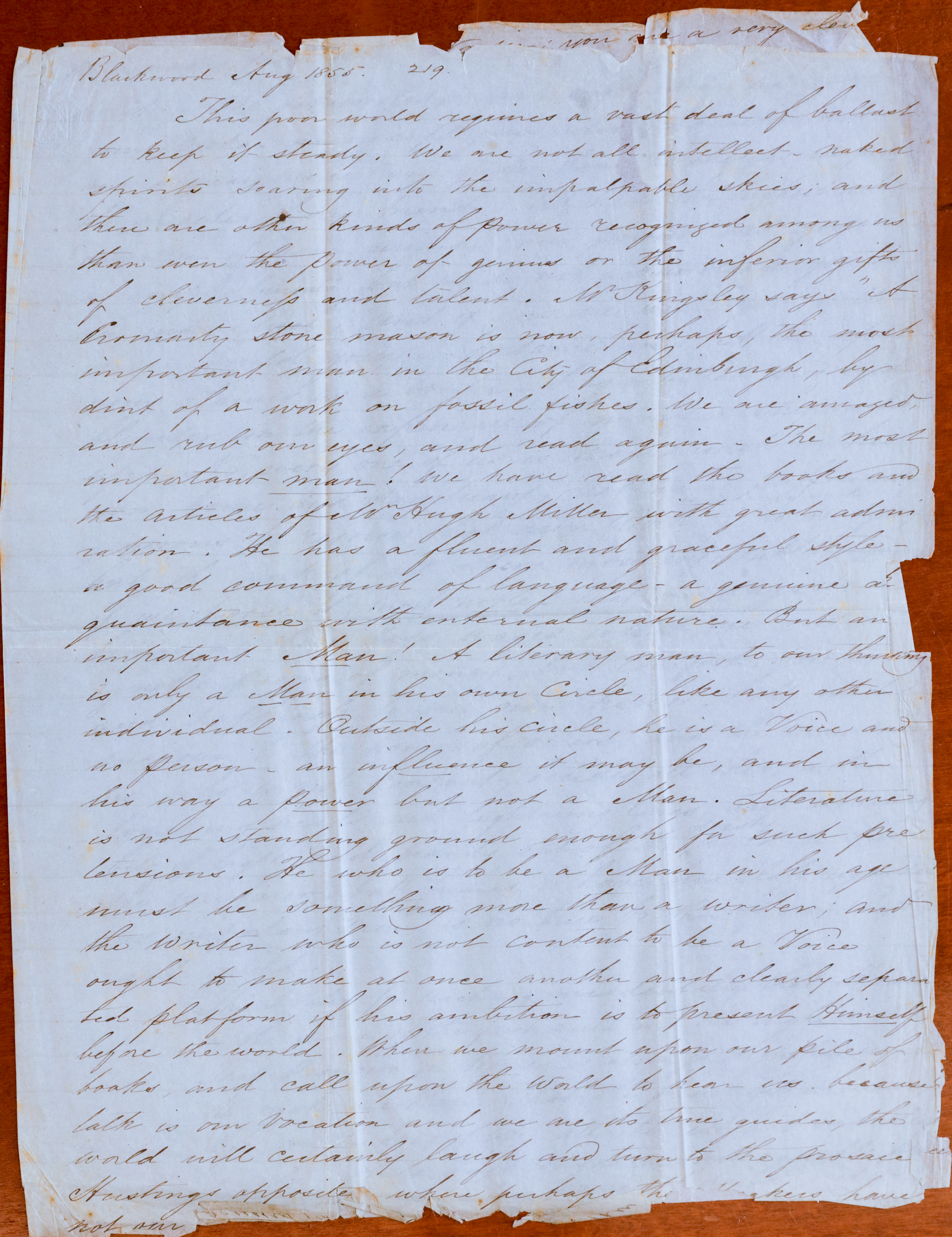
Transcription
A handwritten copy or extract on a single sheet, written in brown ink in a neat cursive. The page is torn along the right edge with several words lost. The header reads:
Blackwood Aug 1858 219
The body:
This poor world requires a vast deal of ballast to keep it steady. We are not all intellect — naked spirits soaring into the impalpable Skies; and there are other kinds of power recognized among us than even the power of genius or the inferior gifts of cleverness and talent. M[r] Kingsley says, "A Cromarty stone mason is now, perhaps, the most important man in the City of Edinburgh, by dint of a work on fossil fishes. We are amazed and rub our eyes, and read again. The most important man! We have read the books and the articles of old [H]ugh Miller with great admiration. He has a fluent and graceful style — a good command of language — a genuine ac-quaintance with external nature. But an important Man! A literary man, to our thinking is only a Man in his own Circle, like any other individual — Outside his circle, he is a Voice and no Person — an influence it may be, and in his way a power but not a Man. Literature is not standing ground enough for such pre-tensions. He who is to be a Man in his age must be something more than a writer; and the Writer who is not content to be a Voice ought to make at once another and clearly separa-ted platform if his ambition is to present Himself before the world. When we mount upon our pile of books and call upon the World to hear us because talk is our Vocation and we are its true guides, the world will certainly laugh and turn to the prosaic Austings opposite where perhaps the [Bakers?] have not over[…]
AI Notes
A handwritten extract or copy from Blackwood’s [Magazine], August 1858, page 219, on the nature of intellect, genius, and the literary man, with reference to Hugh Miller (1802–1856, the Cromarty stonemason and self-taught geologist) and a remark by Mr. Kingsley (almost certainly Charles Kingsley, 1819–1875, the English clergyman and author). The page is torn along the right edge with several words lost, and the bottom of the leaf is also torn so the closing sentence breaks mid-clause; transcription continues onto page 077. The header reads ‘Blackwood Aug 1858. 219’ (no internal comma); the final partial word resolves as ‘not over[looked]’; the source’s odd capitalization (‘Man’, ‘Voice’, ‘Person’, ‘Vocation’, ‘Circle’) is preserved.
Continues on next page.
The extract weighs in on a debate of literary celebrity that was very current in 1858. Hugh Miller (1802–1856), the Cromarty stonemason whose Old Red Sandstone (1841) and posthumous Testimony of the Rocks (1857) made him the Victorian public’s foremost popular geologist, had died by suicide in December 1856; the “Mr. Kingsley” quoted is almost certainly Charles Kingsley (1819–1875), the Church of England clergyman, novelist, and amateur naturalist whose social-Christian writings made him a household name in the same years.