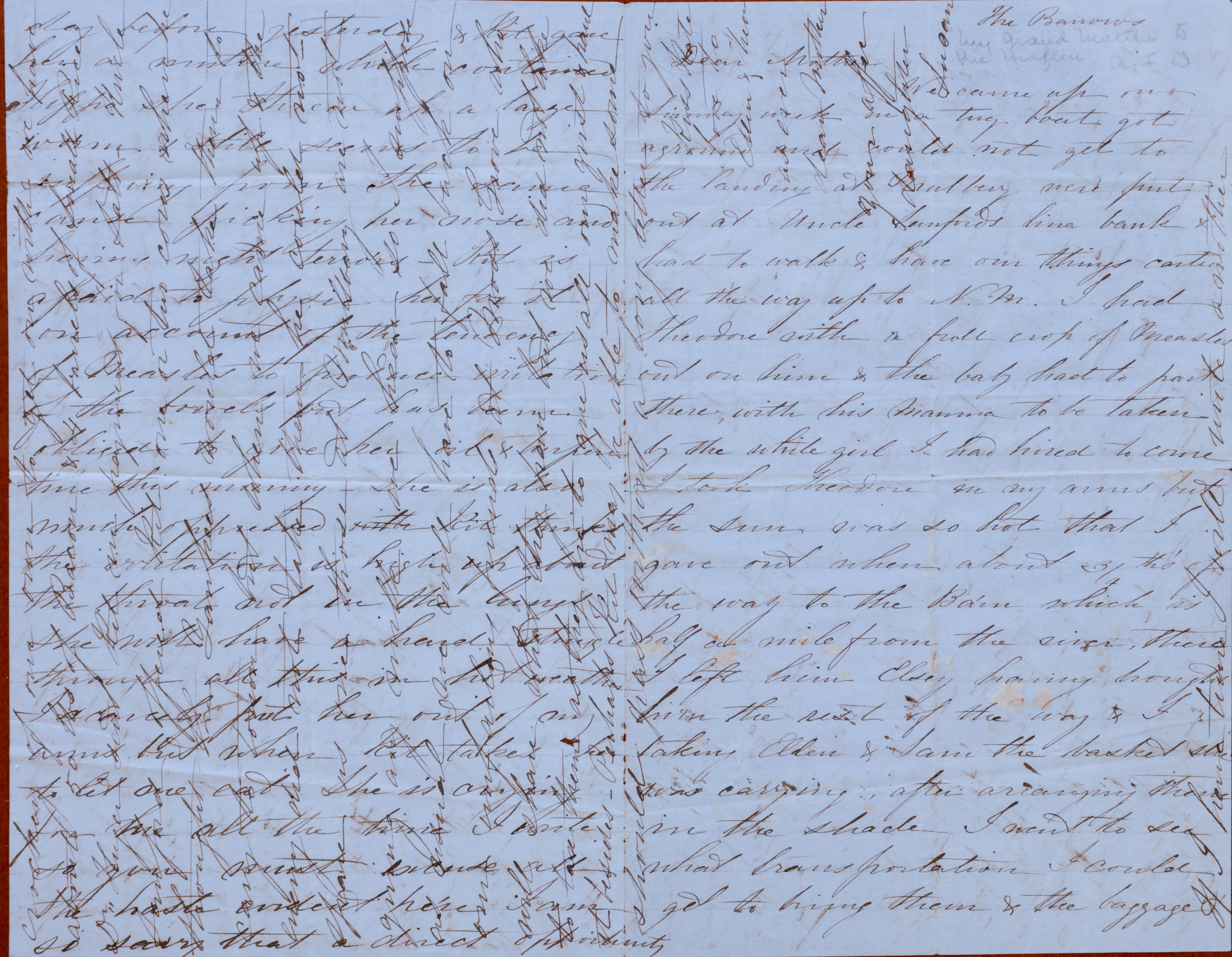
Cross-hatched handwritten letter, page 1 (datelined 'The Barrows')
Book 1, Page 71
Transcription
A handwritten letter sheet in brown ink, written first horizontally and then over-written at right angles in the same hand (cross-hatching), making the left half of the page very difficult to read. The right half is largely legible. The dateline at upper right reads The Barrows (a plantation name), with a faint later pencil annotation beneath it — likely by the compiler — that is only partially legible.
The Barrows
[Beneath the dateline, in faint pencil in a later hand — likely the compiler’s: “my grand mother / her [illegible] [illegible]”.]
Dear Mother
[Several lines on the left half of the sheet are obscured by cross-writing and are illegible.]
… We came up on [Sunday week?] [illegible — cross-written] my tug boat got aground and could not get to the landing at Mulberry, were put out at Uncle [Lanford’s?] line bank & had to walk & have our things carted all the way up to N.M. I had Theodore with a full crop of measles out on him & the baby had to part there, with his Mamma, to be taken by the white girl I had hired to come. I took Theodore in my arms, but the Sun was so hot that I gave out when about 2/3’d of the way to the Barn, which is half a mile from the river. There I left him — Eloy having brought him the rest of the way — & I, taking Ellen & Sam the basket she was carrying, after arranging the [things?] in the shade I went to see what transportation I could get to bring them & the baggage [illegible].
[The letter continues in cross-writing — perpendicular to the original direction, reading upright when the sheet is turned ninety degrees clockwise:]
… Crockery & one [pair?] to get on with — we have / barrels [of —] 5 [hogsheads?] of Bacon & 4 barrels of small Rice / Dr [for?] Sugar, Tea, but did not [request?] … Sat[urday] — Uncle / Hampton offered Pa one or two cows where he / thought he Sam[?] could ask them to [spare?] / … when we came up to the / [pen?] he could not / have us [try] those at Mulberry — [they] are not / giving any milk. Did not hear how our stock / and [animals] she [we?] will have to fall back on / and Sam [picking?] himself at [Bond’s?] Grove who / will I [hope?] have what they have, but he did not the / to take them as they are to give us all over just have / It besides — Perhaps he may be able to make some / [day or other?] [arrangement?] [so we?] / should pass without a long [time without?] letters to you /
Kiss Kate, love to Ellen & Theo, as ever / dear Mother / Y’r aff[ectionate] dau[ghter] [signature flourish, name illegible]
AI Notes
Cross-hatched (over-written at right angles) handwritten letter in brown ink, signed ‘Y’r aff[ectionate] dau[ghter]’ to ‘Mother’. Dateline at upper right reads ‘The Barrows’, with a faint later pencil annotation by the compiler beneath. Salutation ‘Dear Mother’. The horizontal pass describes a steamboat journey: the tug ran aground short of Mulberry landing, the party was put out at Uncle [Lanford’s?] line bank, and the writer carried young Theodore (down with measles) up toward the Barn until overcome by heat, after which Eloy carried him the rest of the way. The cross-written continuation discusses provisions stocked for the household — crockery, barrels of bacon and small rice, sugar, tea — and reports that Hampton offered Pa one or two cows because the Mulberry stock is not giving any milk; Sam is picking up at Bond’s Grove. The letter closes ‘Kiss Kate, love to Ellen & Theo, as ever — dear Mother’.
Letter continues on next page (072). Several phrases in the cross-writing are partial — where the horizontal and perpendicular ink lines intersect, individual letters drop out and some bridging words remain conjectural. The provisioning sense — bacon, rice, sugar, tea, cows, milk — is confident; specific personal names within the cross-writing (Sam, Hampton) appear in clear contexts.
Cross-writing — turning the sheet ninety degrees and writing a second pass over the first — was a common 19th-century economy when letter paper and postage were costly. The dateline “The Barrows” appears elsewhere in the album (see Charleston roster on page 151) as a Lowcountry place name; “Mulberry” is the Stoney family’s Cooper River plantation, where Susan Milliken Barker FitzSimons’s brother Major Theodore Gaillard Barker began rice-planting in 1874.