Letter from Sam'l G. Barker to 'Lyd' (Lydia C. Gaillard), Charleston, February 24, 1855 — marriage settlement trusts
Book 1, Page 69 ·1855-02-24
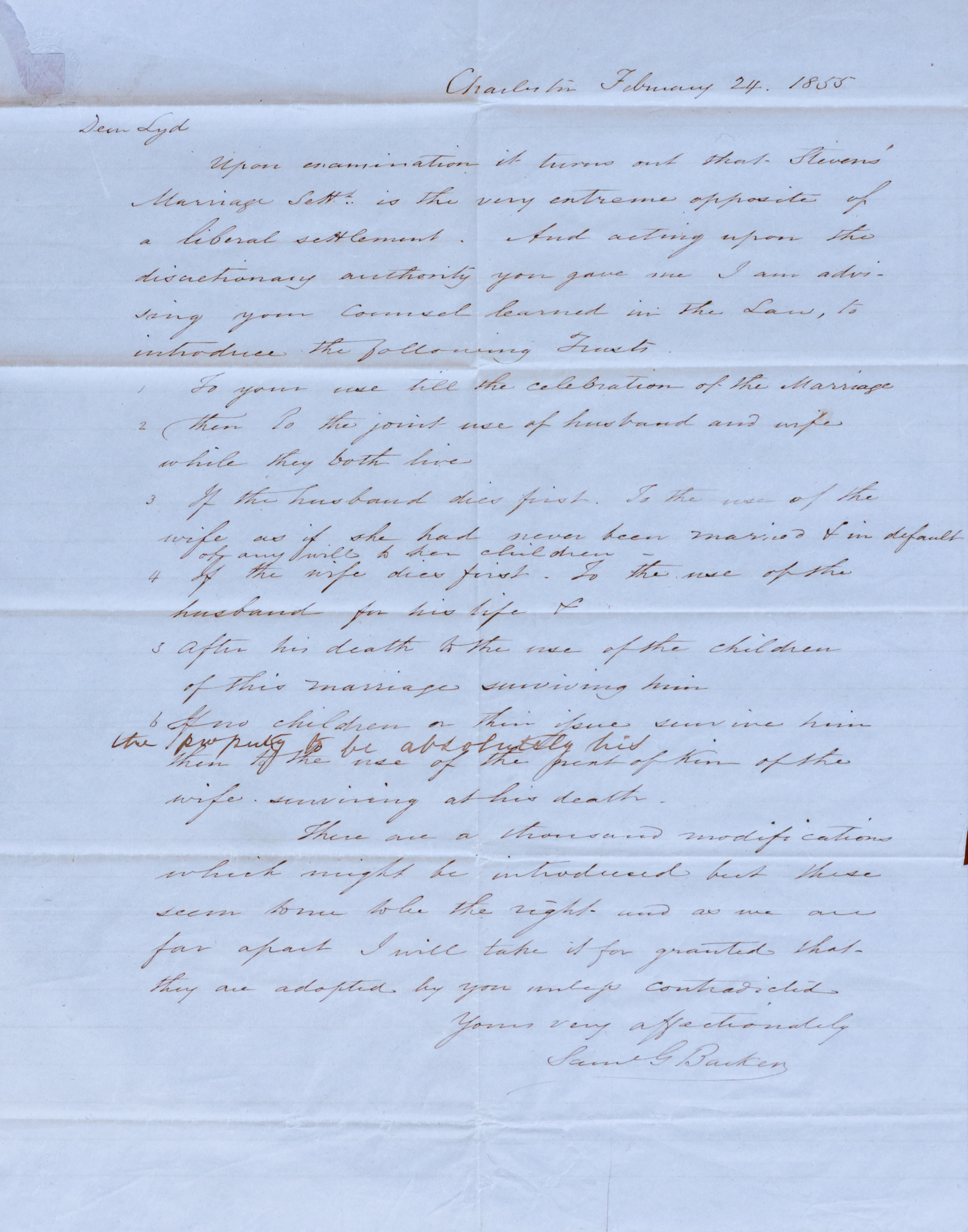
Transcription
A handwritten letter in brown ink on a single folded sheet, with a small wax-seal mark visible at upper left. Written in cursive.
Charleston February 24. 1855
Dear Lyd
Upon examination it turns out that Stevens’ Marriage Sett[lement] is the very extreme opposite of a liberal settlement. And acting upon the discretionary authority you gave me I am advising your Counsel learned in the Law, to introduce the following Trusts.
1 To your use till the celebration of the Marriage
2 Then to the joint use of husband and wife while they both live
3 If the husband dies first. To the use of the wife as if she had never been married & in default of any Will to her children
4 If the wife dies first. To the use of the husband for his life &
5 After his death to the use of the children of this marriage surviving him
6 If no children or their issue survive him then
the property to be absolutely histhen to the use of the next of kin of the wife. surviving at his death.There are a thousand modifications which might be introduced but these seem to me to be the right and as we are far apart I will take it for granted that they are adopted by you unless contradicted
Yours very affectionately
Sam’l G. Barker
AI Notes
A handwritten letter on a folded sheet, written from Charleston February 24, 1855, addressed ‘Dear Lyd’ and signed ‘Sam’l G. Barker’. The body, in the writer’s professional legal voice, advises the recipient on the six trust clauses to be introduced into a marriage settlement for one Stevens whose existing settlement Sam’l finds ‘the very extreme opposite of a liberal settlement’. The sixth clause carries an interlinear strikethrough/correction: the writer first wrote ‘the property to be absolutely his’, then struck through and substituted ‘then to the use of the next of kin of the wife’. The recipient is identified on the address fold (p070) as Lydia C. Gaillard at The Rocks, Cooper River, SC. Sam’l G. Barker (1799–1863), Henrietta Catherine Gaillard’s eldest son, is writing to a Gaillard cousin.
Samuel Gaillard Barker (1799–1863) was a Charleston-trained attorney as well as a planter; this letter shows him acting as informal counsel for a Gaillard cousin on a marriage-settlement question. The recipient — addressed informally as ‘Lyd’ — is identified on the address fold (p070) as Lydia C. Gaillard at “Rocks”, almost certainly The Rocks plantation on the Cooper River, a Gaillard family seat in St. John’s Berkeley Parish. “Stevens” is the prospective husband whose proposed marriage settlement Sam’l finds unfavourable to Lydia; the six trust clauses he recommends are the textbook 19th-century Lowcountry marriage-settlement framework (separate use to the wife, joint use, survivorship to wife if husband dies first, life estate to husband if wife dies first, remainder to children of the marriage, ultimate remainder to wife’s next of kin).