Account of Grandmother's last illness, July 17th (page 1)
Book 1, Page 47 ·1858-07-17/1858-08
Transcription
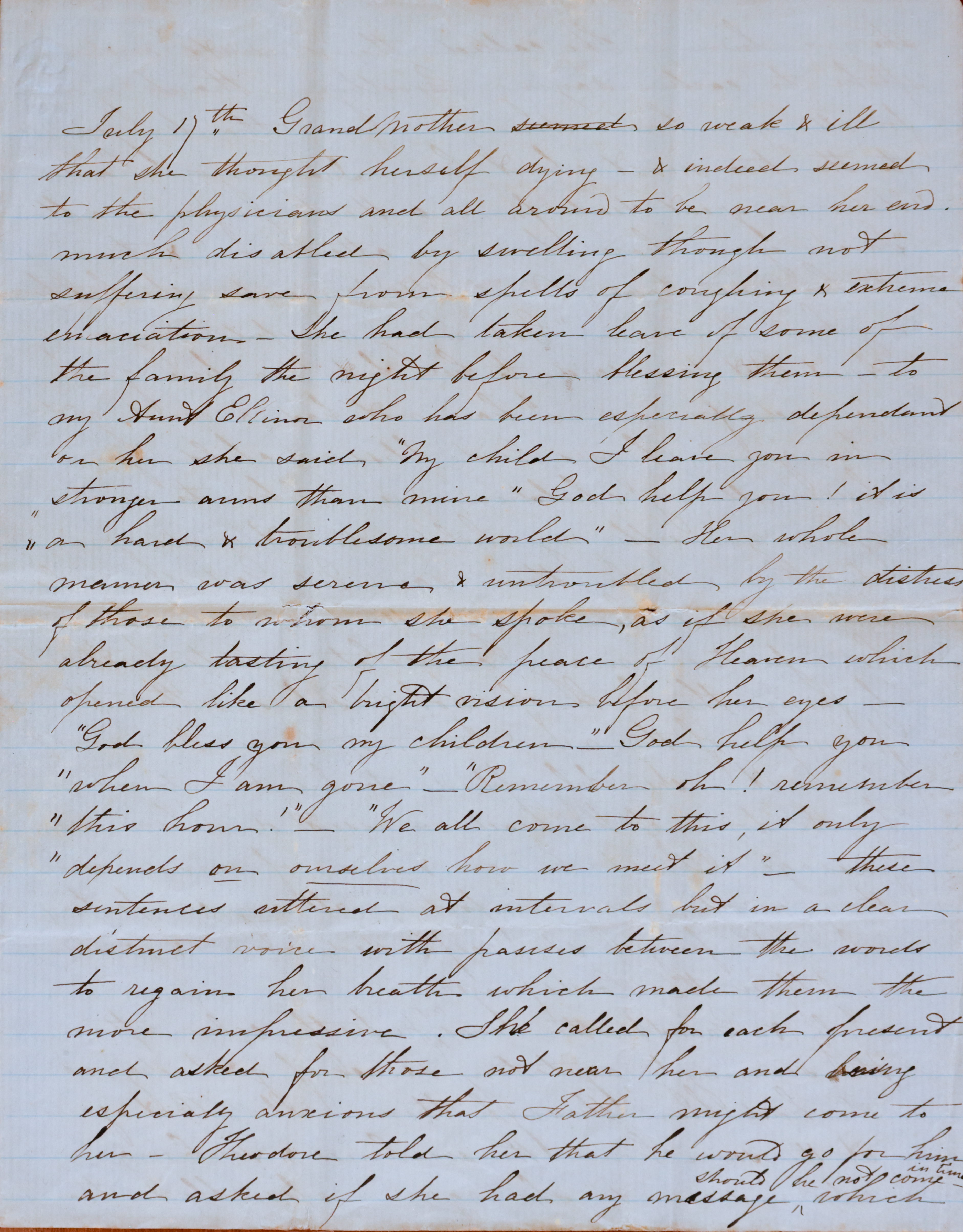
A single sheet of lined paper closely written in faded brown ink, in cursive.
July 17th. Grandmother seemed so weak & ill that she thought herself dying — & indeed seemed to the physicians and all around to be near her end. much disabled by swelling throat not suffering save from spells of coughing & extreme emaciation. She had taken leave of some of the family the night before — kissing them — to my Aunt Ellen who has been especially despondent over her she said, “My child, I leave you in stronger arms than mine.” "God help you! it is “an hard & troublesome world.” — Her whole manner was serene, & untroubled by the distress of those to whom she spoke, as if she were already tasting of the peace of Heaven which opened like
the“a bright vision” before her eyes — “God bless you, my children.” "God help you ^when “I am gone.” — "Remember oh! remember “this hour.” "We all come to this, it only “depends on ourselves how we meet it” — these sentences uttered at intervals but in a clear distinct voice with pauses between the words to regain her breath which made them the more impressive. She called for each present and asked for those not near her and being especially anxious that Father might come to her — Theodore told her that he would go for him and asked if she had any message ^should she not come ^in time which
AI Notes
First page of an eyewitness account of the last illness of Grandmother — Henrietta Catherine Gaillard Barker (b. Sept 6, 1774; d. Aug 13, 1858 per the genealogy on page 045) — written by her granddaughter Ellen Milliken Barker, who married Thomas Porcher (attribution from the inscribed slip on page 045 and the docket on page 054). The narrator’s ‘Father’ is Samuel Gaillard Barker (1799–1863), Henrietta’s eldest son; ‘Theodore’ is Theodore Gaillard Barker, the writer’s brother; ‘Aunt Ellen’ is Henrietta’s daughter Ellinor Cordes Barker (one of HC’s surviving daughters). The dated entry of July 17 opens the narrative, written in faded brown ink in flowing cursive on lined paper. Pages 047 through 053 form a continuous seven-page account; this page concludes mid-sentence (‘and asked if she had any message ^should she not come ^in time which’) and continues on 048. The text reads ‘each present’, with the caret insertion ‘should she not come in time’ and the interlinear addition ‘when’ before ‘I am gone’. The people list is standardized to canonical Barker-family forms (Aunt Ellen → Ellinor Cordes Barker is plausible but not stated; the canonical form here is omitted in favor of crediting the named writers/recipients only).
Account continues on next page.
The narrator is Ellen Milliken Barker (later Mrs. Thomas Porcher), recording her grandmother Henrietta Catherine Gaillard Barker (1774–1858)'s deathbed for the family record. Henrietta — widowed since her husband Joseph Sanford Barker’s 1844 death — was 83. The “Father” the dying woman calls for is her son Samuel Gaillard Barker; Theodore is the narrator’s brother, the future Major Theodore Gaillard Barker (the compiler’s great-uncle TGB, then 25). The seven-page account beginning here (pp 047–053) is the album’s most extended deathbed narrative — a genre that 19th-century evangelical Protestant culture treated as both spiritual record and family heirloom.