Letter from Henry C. Hammond to Ellen, March 9, 1932 (page 2)
Book 1, Page 10 ·1932
Transcription
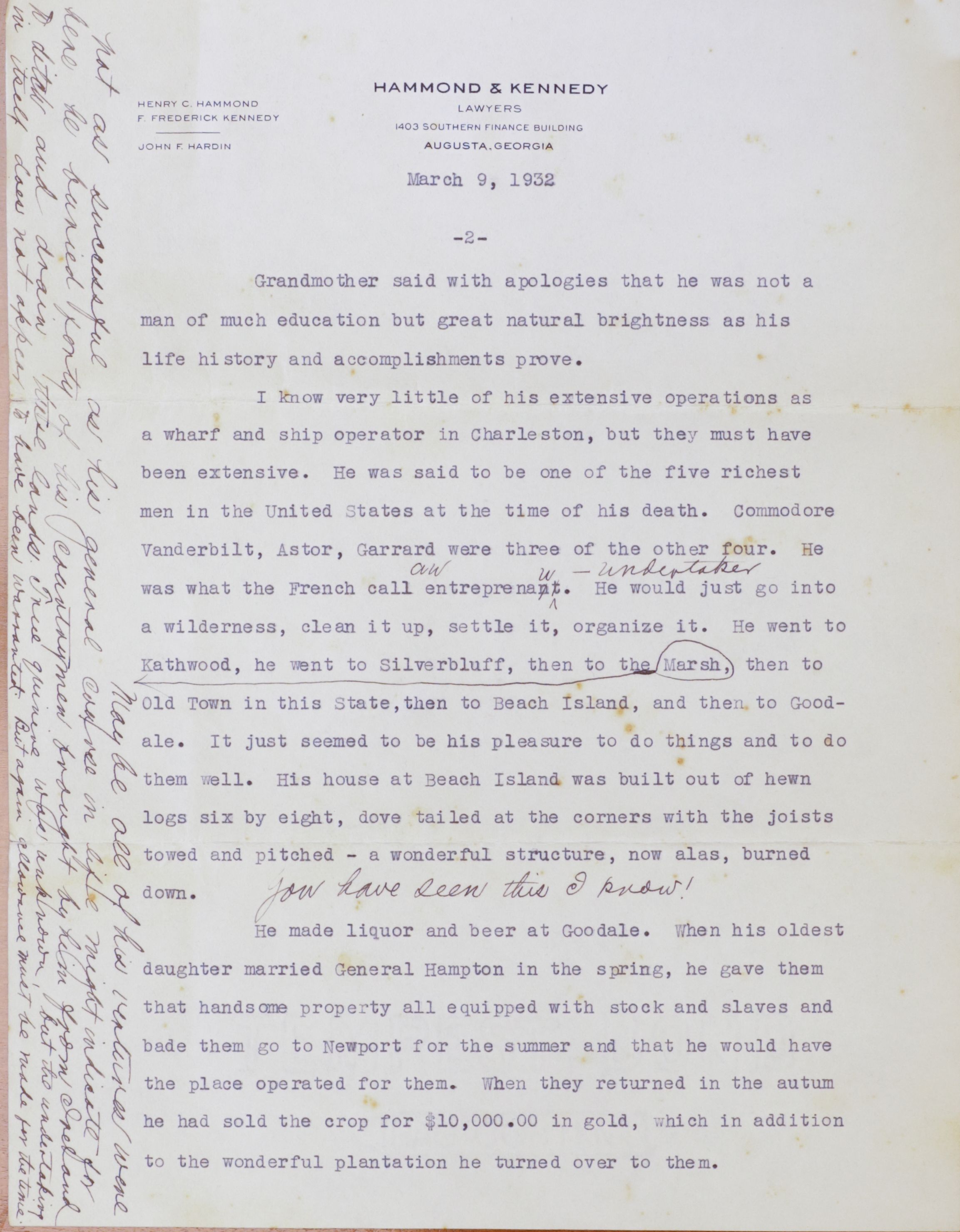
Page 2 of the typewritten letter on Hammond & Kennedy letterhead, dated March 9, 1932. A long handwritten note in pencil runs vertically up the left margin. There is also an interlinear correction above the word “entrepreneur” in the typed text, and a handwritten line in ink inserted between paragraphs.
March 9, 1932
-2-
Grandmother said with apologies that he was not a man of much education but great natural brightness as his life history and accomplishments prove.
I know very little of his extensive operations as a wharf and ship operator in Charleston, but they must have been extensive. He was said to be one of the five richest men in the United States at the time of his death. Commodore Vanderbilt, Astor, Garrard were three of the other four. He was what the French call entreprenaut. [interlinear corrections in ink: “an” inserted before, and “w. — undertaker” written above] He would just go into a wilderness, clean it up, settle it, organize it. He went to Kathwood, he went to Silverbluff, then to the Marsh, then to Old Town in this State, then to Beach Island, and then to Goodale. It just seemed to be his pleasure to do things and to do them well. His house at Beach Island was built out of hewn logs six by eight, dove tailed at the corners with the joists towed and pitched — a wonderful structure, now alas, burned down. [Handwritten in ink:] You have seen this I know!
He made liquor and beer at Goodale. When his oldest daughter married General Hampton in the spring, he gave them that handsome property all equipped with stock and slaves and bade them go to Newport for the summer and that he would have the place operated for them. When they returned in the autum he had sold the crop for $10,000.00 in gold, which in addition to the wonderful plantation he turned over to them.
[Pencilled marginal note running down the left edge of the page, oriented to read with the head tilted left:]
Maybe all of his ventures were not as successful as his general course in life might indicate for here he buried forty of his countrymen brought by him from Ireland to ditch and drain these lands. True quinine was unknown, but the undertaking in itself does not appear to have been warranted. But again allowance must be made for the time
AI Notes
Page 2 of the March 9, 1932 letter from Henry C. Hammond to Ellen on Hammond & Kennedy letterhead. Hammond reflects on Christopher FitzSimons’s enterprises across several South Carolina properties. The page carries a long pencilled marginal note running vertically down the left edge, plus a handwritten interlinear correction over ‘entrepreneur’ and a handwritten line at the foot of the upper paragraph. The typewritten body uses the spelling ‘Garrard’ (where the earlier 1940 letter has ‘Girard’ — i.e. Stephen Girard the Philadelphia banker, here mis-rendered) and the typo ‘autum’ for autumn. The interlinear ink correction over ‘entreprenaut’ clarifies the French word’s older meaning as ‘undertaker’. ‘The Marsh’ is hand-circled in the typescript. The long pencil note running down the left edge — almost certainly added by the recipient Aunt Ellen FitzSimons or the compiler Amy — is a substantive critical gloss that checks Hammond’s hagiographic account: one of Christopher’s ‘ventures’, it observes, killed forty Irish laborers he had brought over to ditch and drain Lowcountry rice swamps (malaria, ‘true quinine was unknown’), and the undertaking is judged unwarranted, though ‘allowance must be made for the time.’
Letter continues on the next scan.
The page sets two voices against one another. The typed body — Hammond family lore at its most expansive — ranks Christopher beside Astor, Vanderbilt, and Girard as one of the four richest men in the U.S. (Christopher’s actual estate at death was ~$700,000 — well below Girard’s $7.5 million in 1831). The pencilled left-margin note, almost certainly added by Aunt Ellen FitzSimons or the compiler Amy, talks back: “Maybe all of his ventures were not as successful… here he buried forty of his countrymen brought by him from Ireland to ditch and drain these lands. True quinine was unknown, but the undertaking in itself does not appear to have been warranted.” Quinine was not isolated as a pure alkaloid until 1820 (by Pelletier and Caventou); the malaria of the Lowcountry rice swamps killed enslaved and Irish-immigrant labor alike. The margin gloss is a rare moment of moral reservation in an album that otherwise reveres its founder.